

A high-volume keyword is not automatically a valuable SEO target. It may attract the wrong audience, require an unsuitable page type, face strong competition or demand more resources than its likely business impact justifies. SEO opportunity analysis solves this problem by comparing keywords through a consistent decision framework that combines value, search intent, current visibility, ranking feasibility and implementation effort.
The objective is not to produce a perfect score. It is to make assumptions visible, compare opportunities on the same basis and decide what should be optimized now, developed later or excluded from the roadmap. If you are still building your initial keyword list, begin with the complete SEO keyword research workflow before applying the prioritization model below.
What Is SEO Opportunity Analysis?
SEO opportunity analysis is the process of evaluating whether a keyword deserves investment and how urgently it should be targeted. Unlike a basic keyword export, it considers both the potential outcome and the conditions required to achieve it.
A practical analysis answers several connected questions. Is the keyword relevant to the offer? Does its search intent support a useful customer action? Is there meaningful demand? Does the website already have visibility for the topic? How strong are the competing pages? Can an existing page be improved, or is a new asset required?
The result should be a prioritized set of keyword groups rather than an isolated list of phrases. Each group should have a proposed page, an action, an owner and a reason for its position in the plan. This connects keyword selection with content production, technical implementation, internal linking and measurement.
Why Search Volume Is Not Enough to Prioritize Keywords
Search volume measures estimated demand, not business value. A query can be popular while producing few qualified visits, and a lower-volume phrase can be highly valuable if it reflects a specific problem, product need or purchase decision.
Volume data also needs interpretation. Ahrefs describes search volume as an estimate of how often a target keyword is searched per month, while its Traffic Potential metric estimates the organic traffic received by the top-ranking page from all the keywords for which that page ranks. Ahrefs also notes that tool-based search volumes are estimates and that searches do not necessarily produce organic clicks.
Before assigning priority, check whether the keyword:
- represents a relevant audience and problem;
- has an intent that your page can satisfy;
- supports a commercial or strategic objective;
- belongs to a broader topic with additional traffic potential;
- can generate a useful action after the visit;
- fits an existing page or justifies creating a new one.
The keyword review shown below illustrates how accepted, suggested and rejected phrases can be compared with search-volume ranges. The screenshot was captured on October 19, 2026. It supports demand and relevance review, but it should not be interpreted as calculating the custom keyword opportunity score described later in this guide.
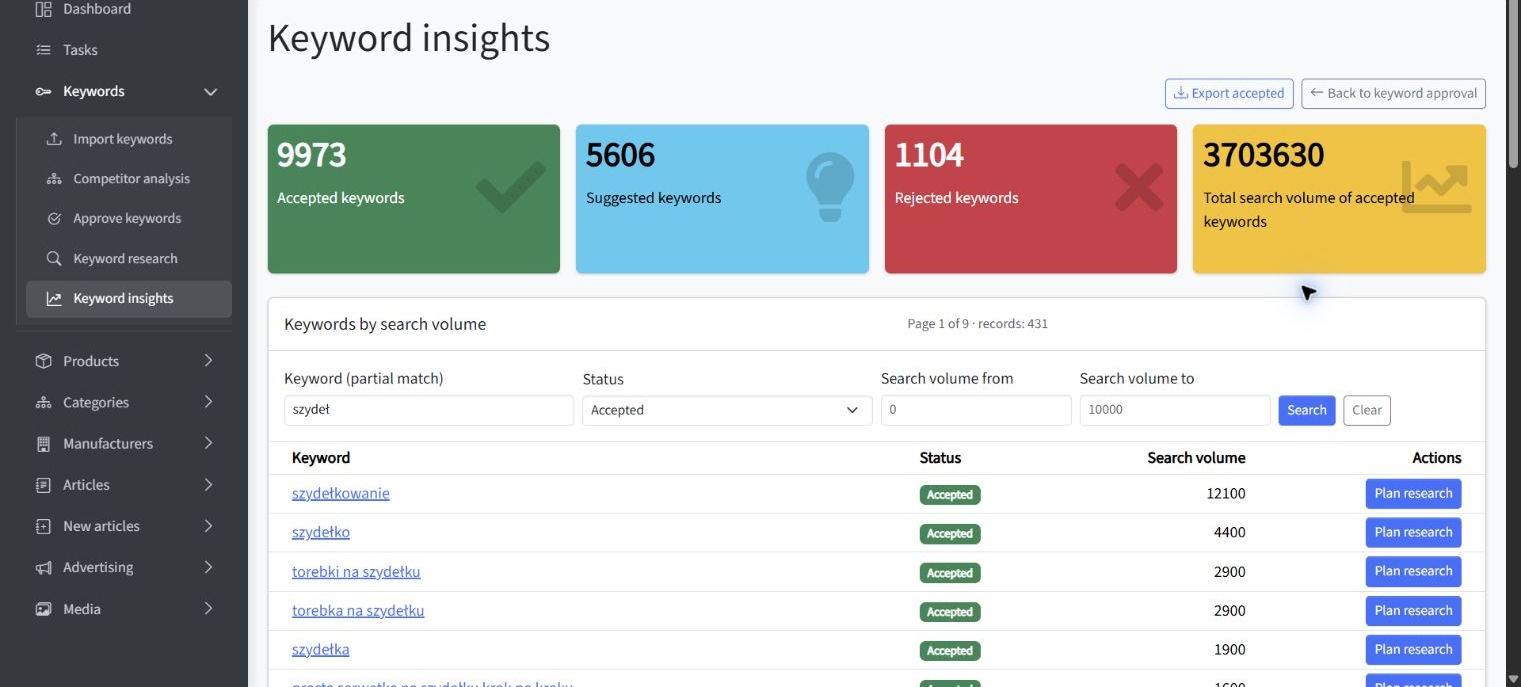
Volume is therefore one input, not the final decision. Its importance increases when relevance and conversion potential are already established. Without those conditions, a large number can simply magnify an irrelevant opportunity.
The Factors That Determine Keyword Value
Keyword value is the expected contribution a keyword can make to a business objective. That contribution may involve direct revenue, qualified leads, product discovery, customer education or authority in a strategically important topic.
Evaluate value through the following factors:
- Business relevance: Measure how closely the query relates to the products, services, expertise and audiences the organization wants to develop.
- Conversion potential: Consider whether a visitor can take a valuable next step, such as buying, requesting a quote, starting a trial or moving to a commercial page.
- Search intent alignment: Verify that the page you can provide matches the dominant result type, format and angle in the search results.
- Demand: Review volume, seasonality, impressions, related phrases and the total potential of the topic rather than one exact keyword alone.
- Strategic importance: Give additional weight to keywords that support priority products, profitable customer groups or topics the business needs to own over time.
- Customer journey contribution: Account for useful informational queries even when they do not produce an immediate transaction.
Commercial intent should not automatically override every other factor. An educational query may deserve a high priority when it introduces qualified users to a complex offer. Conversely, a transactional phrase may have limited value if the business cannot serve the location, price range or product category implied by the query.
Google recommends creating content for an existing or intended audience and ensuring that the main content directly fulfills the page’s purpose. This reinforces an important prioritization rule: do not target a keyword unless you can produce a page that genuinely serves the searcher’s expected task.
How to Assess Ranking Difficulty and Competitive Strength
Keyword difficulty analysis should estimate whether your website can compete in the actual search results. A third-party difficulty metric is useful for filtering and comparison, but it is not a complete measure of ranking feasibility.
For example, Ahrefs states that its Keyword Difficulty score is based on the referring domains pointing to the current top-ranking pages. The metric does not include on-page SEO factors. A low or moderate score can therefore conceal strong brands, highly specialized content, dominant product pages or result formats your planned page cannot match.
Review the search results and compare:
- the types of pages that rank, such as product pages, category pages, guides or tools;
- the authority and topical specialization of competing domains;
- the quality, depth and originality of ranking pages;
- the strength of their internal and external links;
- how precisely they satisfy the dominant intent;
- whether the results are stable or frequently changing;
- whether weaker pages or less relevant results already appear in prominent positions.
You should also distinguish business competitors from search competitors. The websites occupying the results may include publishers, marketplaces, directories and educational resources rather than companies selling the same offer. Use a dedicated process to identify competitor ranking opportunities and separate relevant gaps from keywords that do not fit your audience.
Convert the findings into a feasibility rating. A high rating means the result page contains realistic openings for your website, not merely that an SEO tool reports a low difficulty number.
How Current Rankings Change the Opportunity
A keyword for which the website already ranks requires different treatment from a keyword that needs a completely new page. Existing visibility can indicate that Google already connects a page with the topic, reducing the work needed to test and improve it.

Google Search Console reports clicks, impressions, click-through rate and average position by dimensions that include queries and pages. Average position represents the average position of the topmost result from the property for the selected grouping, so it should be interpreted as a trend and diagnostic metric rather than a fixed daily rank.
The view below, captured on October 19, 2026, illustrates how queries can be grouped with presets such as Opportunities and Worth pushing, then filtered by impressions, average position and search volume. This is a practical way to inspect current ranking potential before assigning work.
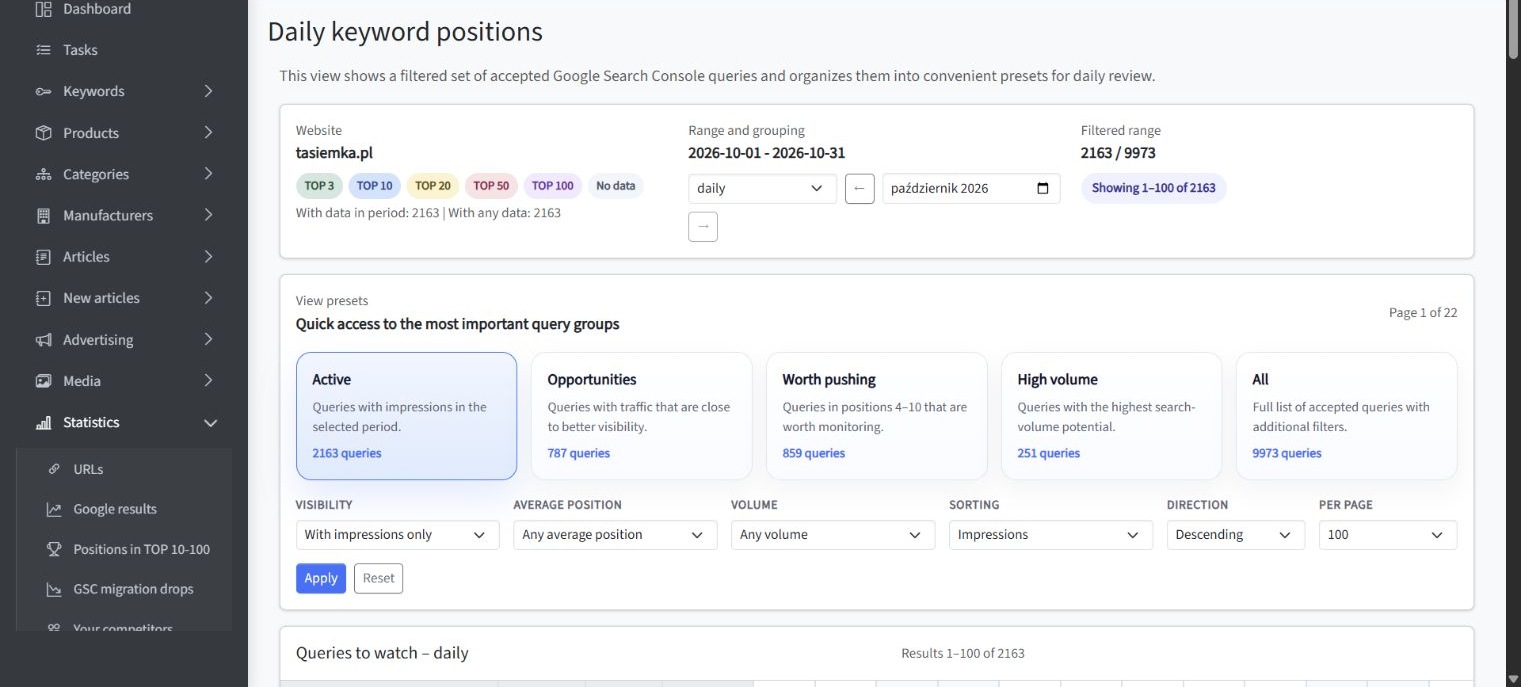
Segment existing visibility into actionable groups. Keywords already generating impressions just outside prominent positions may become quick wins if the ranking page matches intent and requires a focused update. Keywords ranking much lower may indicate partial relevance, weak authority or an unsuitable page assignment.
Check the query together with its ranking URL. A promising average position does not justify optimization if the wrong page appears, several pages compete for the same term or the ranking URL cannot support the intended user action. Search results can also vary by location, device, time and user context, so avoid making decisions from one manual search.
How to Estimate the Effort Required
Expected value needs to be compared with the resources required to capture it. Two keywords with similar demand and intent may have very different implementation costs.
Existing Page Optimization
An existing page may require better intent coverage, clearer headings, improved copy, updated examples, stronger internal links or more useful product information. This is often faster than creating a new asset, but only when the page has the right purpose and sufficient scope.
New Page Creation
A new page requires research, production, review, publishing, internal linking and ongoing measurement. Additional effort may be needed for original images, product data, expert input, templates, tools or digital PR. Record these requirements before giving the keyword a high priority.
Consolidation or Reassignment
Some opportunities should not create more content. The correct action may be to consolidate overlapping pages, redirect an obsolete URL or assign the keyword group to a stronger existing page. A maintained keyword map helps you map prioritized keywords to pages without creating avoidable cannibalization.
Estimate effort with a simple scale such as low, moderate or high, but document the reason. “High effort” could mean extensive expert research, development support or a need to build authority. This explanation is more useful than the label alone.
How to Build a Keyword Opportunity Scoring Model
A scoring model helps teams compare keywords consistently. It should be transparent enough that another person can understand why one opportunity outranks another and challenge any questionable assumptions.

One practical model rates each factor from 1 to 5, where 5 is the most favorable result. Difficulty and effort should be converted into positive measures such as ranking feasibility and resource efficiency, ensuring that a higher final score always means a stronger opportunity.
A balanced starting model can use these weights:
- Business relevance: 25%;
- Conversion potential: 20%;
- Demand and topic potential: 15%;
- Current visibility: 15%;
- Ranking feasibility: 15%;
- Resource efficiency: 10%.
The calculation can be expressed as: SEO opportunity score = ((relevance × 25) + (conversion × 20) + (demand × 15) + (visibility × 15) + (feasibility × 15) + (efficiency × 10)) ÷ 5. This produces a result on a 0–100 scale when each input is rated from 1 to 5.
For example, ratings of 5 for relevance, 4 for conversion, 3 for demand, 4 for visibility, 3 for feasibility and 4 for efficiency produce a score of 79. The number makes the assumptions comparable, but it does not prove that the keyword will rank or generate a particular return.
Add a short rationale beside every rating. A value such as “feasibility: 3” is difficult to audit. “Feasibility: 3 because the results contain strong specialist sites, but two ranking pages have weak intent alignment” creates a reviewable decision.
When Judgment Should Override the Score
Expert judgment should override the numerical order when a keyword presents a legal or reputational risk, supports a critical product launch, depends on an unavailable resource or has rapidly changing intent. A strategic topic may also remain important despite a low short-term score because it builds the authority needed for more commercial opportunities later.
Use the score to expose disagreements, not suppress them. If sales, content and SEO teams rate conversion potential differently, the discussion should focus on the evidence behind those ratings.
How to Weight Factors for Different Business Models
There is no universal weighting model. The correct balance depends on how the website creates value and how search contributes to the customer journey.
E-Commerce
An online store may give greater weight to product relevance, transactional intent, margin, availability and category-level demand. Informational keywords remain useful when they help customers choose a product, understand compatibility or solve a problem connected with the range.
Lead Generation
A service business should emphasize qualified lead potential, location, customer fit and sales value. A lower-volume query describing a specific service and location may deserve more attention than a broad educational term with substantially higher demand.
SaaS and Complex Offers
A software or complex B2B offer may need a broader portfolio. Commercial comparison queries can support acquisition, while educational topics explain the problem, introduce the method and create demand before a buyer is ready to evaluate solutions.
Publishers and Advertising Models
Publishers may assign more weight to total traffic potential, recurring demand and the ability to create a complete topic cluster. Even here, raw volume should be balanced with click potential, production cost and the site’s ability to provide something meaningfully better than existing results.
If the investment case remains unclear, evaluate when SEO is worth the investment before adjusting the model to make every keyword appear attractive.
How to Compare Quick Wins with Long-Term Opportunities
Effective keyword prioritization should not create a roadmap composed entirely of easy phrases or highly competitive strategic terms. The portfolio needs different types of opportunities because they serve different time horizons.

- Quick wins: Existing pages with relevant impressions, near-ranking positions and specific improvements that can be implemented quickly.
- Strategic growth topics: New or substantially expanded pages connected to priority offers, audiences and customer problems.
- Authority-building opportunities: Broader topics that may require multiple pages, stronger internal linking, original expertise and sustained promotion.
- Defensive priorities: Important rankings that need updates because competitors, intent or available information have changed.
Quick wins can create earlier feedback and measurable movement, but they should not consume the entire budget. Long-term topics may be necessary to build relevance in areas where the website currently has little visibility. When assessing the budget across these horizons, use a long-term SEO investment model rather than evaluating every page as an isolated monthly cost.
How to Prioritize Keywords with Incomplete Data
Keyword decisions are always made with some uncertainty. Search volume is estimated, conversion data may be unavailable and new topics may have no first-party performance history. Google also explains that Search Console may omit some data for privacy and that filtering can be affected by anonymized queries and data truncation.
Do not replace missing data with false precision. Instead, apply the following controls:
- add a confidence rating beside each opportunity score;
- use ranges instead of exact traffic or revenue forecasts;
- separate measured data from tool estimates and team assumptions;
- compare several evidence sources, including current results, Search Console, analytics, sales information and competitor pages;
- start with a limited test when the potential value is high but confidence is low;
- schedule a review after enough impressions, clicks or commercial outcomes have been collected.
A keyword with a score of 82 and low confidence is not automatically stronger than one scoring 76 with reliable first-party evidence. Confidence should influence sequencing, budget and the size of the initial commitment.
How to Turn Scores into an SEO Roadmap
A ranked spreadsheet is not yet a roadmap. Every selected keyword group needs a defined action and a connection to a suitable URL.

Translate the analysis into the following sequence:
- Validate intent: Confirm the expected page type, format, audience and next action.
- Assign a URL: Choose an existing page, a new page or a group of pages within a larger topic plan.
- Define the action: Optimize, create, consolidate, redirect, support with internal links or monitor without immediate intervention.
- Set the priority: Combine the score, confidence, dependencies and strategic importance.
- Estimate resources: Identify the content, design, development, review and promotion required.
- Assign ownership: Name the person responsible for approval and implementation.
- Set measurement criteria: Select relevant indicators such as qualified impressions, clicks, target-page visibility, leads or revenue.
- Schedule a review: Reassess performance, intent and competitive conditions after implementation.
An operational platform can help connect these page updates, new content assignments and monitored actions. The SEO analysis and publishing workflow shows how analysis, prioritization, controlled publishing and measurement can be brought into one reviewed process.
The roadmap should also preserve human approval. A keyword can be suggested or scored automatically, but someone still needs to verify intent, factual quality, brand fit and the suitability of the proposed page. This is the distinction between automated activity and turning keyword selection into a reviewed SEO workflow.
When examining performance evidence, keep individual case results within their proper context. Luksura.pl: 81% more TOP10 keywords in 86 days describes one result and should not be treated as a universal forecast for every site, market or keyword portfolio.
Common Keyword Prioritization Mistakes
Most weak roadmaps fail because one convenient metric replaces a complete decision. Watch for the following mistakes:
- Sorting only by search volume: This ignores relevance, intent, click potential and commercial contribution.
- Treating keyword difficulty as a complete answer: Third-party scores do not fully represent content quality, page type, brand strength or your site’s topical position.
- Ignoring the ranking URL: A current position is less valuable when the wrong page ranks or several URLs compete.
- Creating a new page for every phrase: Closely related keywords may belong to one page when their intent and search results overlap.
- Giving every factor equal weight: Business relevance should usually matter more than a small difference in estimated volume.
- Using unexplained scores: Ratings without written assumptions cannot be reviewed or improved.
- Prioritizing only quick wins: This can produce short-term movement without building authority in strategically important topics.
- Prioritizing only ambitious topics: A roadmap with no attainable near-term opportunities delays feedback and increases risk.
- Ignoring implementation capacity: A valuable keyword cannot produce an outcome if the required page is never approved, published or maintained.
- Failing to revisit the analysis: Rankings, competitors, demand, products and business objectives can change.
The remedy is not a more complicated spreadsheet. It is a repeatable review process in which every priority has a clear business reason, a suitable page and an achievable next action.
Key Conclusions from SEO Opportunity Analysis
A useful opportunity model should leave you with a small set of practical conclusions:
- Combine business relevance, conversion potential, demand, current visibility, ranking feasibility and required effort.
- Use search volume to measure estimated demand, not to define keyword value by itself.
- Review live competitors and result types instead of relying only on a keyword difficulty score.
- Treat near-ranking existing pages differently from keywords that require entirely new assets.
- Document the reason behind every rating and add a confidence level when evidence is incomplete.
- Use the SEO opportunity score to support judgment, not replace it.
- Maintain a balanced roadmap of quick wins, strategic pages and long-term authority-building topics.
- Translate every selected keyword group into a URL, action, owner and review date.
Summary
SEO opportunity analysis is a decision framework for choosing where limited SEO resources can create the most useful impact. The strongest keyword is not necessarily the one with the highest volume or the lowest reported difficulty. It is the one that combines meaningful business value, suitable search intent, realistic ranking conditions and an achievable implementation plan.
Start with a transparent scoring model, explain every assumption and allow strategic judgment to override the numerical order when the context requires it. Then convert the selected opportunities into page-level actions and review them as new performance data becomes available. This turns keyword prioritization from a one-time export into a controlled, evidence-based roadmap.