Learning how to measure SEO performance means looking beyond a single ranking or traffic number. Effective measurement connects search visibility with qualified visits, user engagement, conversions, revenue, and the technical health of your website. Because each metric answers a different question, the most reliable approach is to combine several SEO metrics and analyze their trends over time.
If you are new to optimization, start with this beginner’s introduction to SEO. It explains how search engines, website content, technical accessibility, and external trust signals work together before you begin evaluating results.
What Does SEO Performance Mean?
SEO performance describes how effectively your website attracts relevant audiences through unpaid search results and turns that visibility into useful business outcomes. It includes what happens before a visitor reaches your website, what the visitor does after arriving, and whether search engines can access your important pages.
A complete SEO measurement framework should answer several connected questions:
- Visibility: Are your pages appearing for relevant searches?
- Search engagement: Are people clicking your results?
- Website engagement: Do organic visitors interact with your content?
- Business impact: Do those visits generate inquiries, purchases, subscriptions, or other valuable actions?
- Technical health: Can search engines crawl, process, and index the pages that matter?
No individual number provides all these answers. A higher ranking may produce no meaningful traffic if the keyword has little demand. More organic sessions may have limited value if visitors are irrelevant or do not convert. Conversely, traffic can remain stable while lead quality, revenue, or visibility for strategically important searches improves.
Set Goals Before Choosing SEO Metrics
Before selecting SEO KPIs, define what the website should achieve. Otherwise, reports tend to collect easily available numbers without explaining whether SEO is helping the business.
Translate each business objective into a search goal and then assign suitable metrics. Common examples include:
- Increase brand discovery: track impressions, clicks, branded searches, and visibility across relevant topics.
- Generate sales: track organic transactions, revenue, conversion rate, and revenue per organic session.
- Generate leads: track qualified form submissions, calls, booked appointments, and lead quality.
- Build an audience: track newsletter registrations, account creation, returning visitors, and engagement with key content.
- Promote local services: track visits to location pages, calls, direction requests, and locally relevant queries.
Separate primary KPIs, which represent business outcomes, from diagnostic metrics, which help explain those outcomes. Revenue may be a primary KPI for an online store, while impressions, rankings, click-through rate, and indexed pages are diagnostic metrics. This distinction prevents teams from treating every increase as equally valuable.
If you are deciding whether the required investment is justified, consider when SEO is worth the investment in relation to customer value, competition, margins, and realistic growth opportunities.
Measure Organic Search Visibility
Organic visibility indicates how frequently and broadly your website appears in search results. It is an early signal of progress because visibility can increase before clicks, conversions, or revenue show a noticeable change.
Useful visibility measurements include total impressions, impressions for non-branded queries, the number of relevant queries producing impressions, and the number of landing pages appearing in search. Google Search Console defines an impression as an instance in which a link to your website is shown in an eligible Google surface, subject to the rules of the specific result type.
A rising impression count can indicate that search engines are beginning to associate your pages with more searches. However, it is not automatically a positive result. Confirm that the growth comes from relevant topics, target markets, appropriate devices, and pages that support your goals.
Analyze Visibility at Page and Query Level
Website-wide averages can conceal important changes. A site may report stable impressions even when commercial pages are losing visibility and informational pages are gaining it. Review performance by:
- individual query;
- landing page;
- topic or page group;
- country or region;
- device type;
- search appearance;
- branded and non-branded searches.
Page-level and query-level analysis makes the data actionable. If one category loses impressions, you can investigate its content, internal links, indexing status, competitors, or changing search demand instead of making unnecessary site-wide changes.
Track Impressions, Clicks, and Click-Through Rate
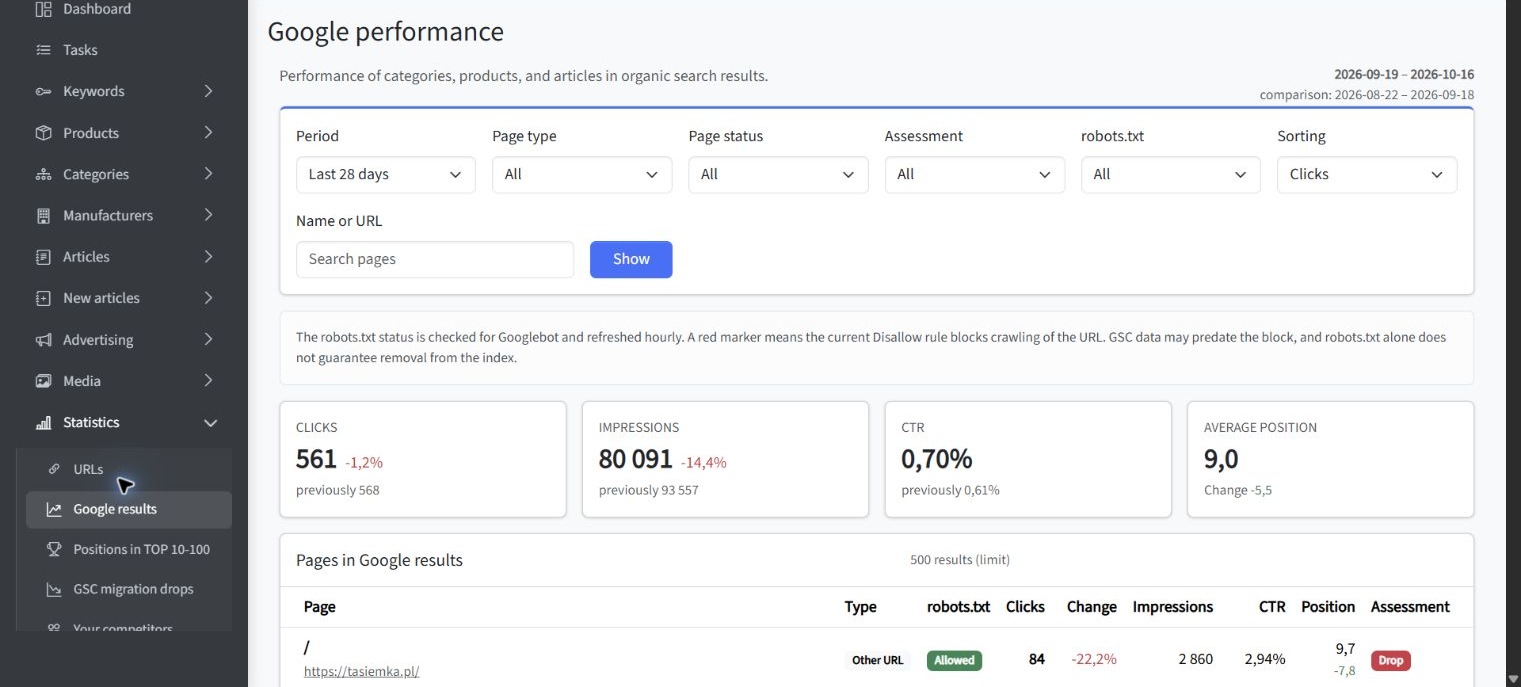
Impressions show how often your pages appear, while clicks show how often users choose your result and visit the website. Click-through rate, or CTR, is calculated by dividing clicks by impressions and multiplying the result by 100.
These metrics should be interpreted together:
- Impressions increase and clicks increase: visibility is expanding and generating additional visits.
- Impressions increase but clicks stay flat: the site may be appearing in lower positions, targeting broader queries, or presenting less persuasive search snippets.
- Impressions stay stable but clicks fall: rankings, result presentation, search features, or competing pages may have changed.
- Clicks increase while impressions remain stable: rankings, relevance, result presentation, or query mix may have improved.
CTR is not a universal quality score. It varies according to ranking position, search intent, device, brand familiarity, and the layout of the results page. Compare a page or query with its own historical performance rather than expecting every keyword to reach the same benchmark.
When an important query has strong impressions but a weak CTR, review whether the page title and visible result accurately communicate the page’s value. Do not optimize for clicks with exaggerated wording that the landing page cannot satisfy.
Interpret Keyword Rankings Carefully
Keyword rankings remain useful SEO metrics, but they should be treated as indicators rather than final outcomes. A ranking report shows where a page appears for selected searches, not whether those searches produce qualified customers.
Rank tracking is most valuable when keywords are selected through a structured keyword research process and grouped by shared intent. Tracking hundreds of unrelated phrases may create an impressive dashboard without providing meaningful business insight.
Why Average Position Can Be Misleading
Search Console reports an average position across eligible impressions. The value can combine different queries, pages, countries, devices, and result formats. Search results are also dynamic, so small movements do not always require action. Google recommends focusing primarily on impressions and clicks and investigating substantial, persistent ranking changes instead of reacting radically to normal fluctuations.
Use rankings to identify patterns such as:
- important queries moving from limited visibility into prominent positions;
- a page losing rankings across an entire topic group;
- different pages competing for similar search intent;
- mobile rankings behaving differently from desktop rankings;
- ranking improvements that do not lead to clicks or conversions.
A ranking improvement is most valuable when it increases relevant impressions, clicks, engagement, and business outcomes. Avoid presenting a single number-one position as proof that the overall SEO strategy is successful.
Measure Organic Traffic and Landing Page Performance
Organic traffic metrics show what happens after people arrive from unpaid search results. Common measurements include organic users, sessions, engaged sessions, engagement rate, landing page views, and returning visitors.
Google Search Console and Google Analytics measure different stages of the journey. Search Console focuses on performance within Google Search, including impressions, queries, and clicks. Google Analytics measures activity after visitors reach the website, including sessions, engagement, and actions. Click and session totals should not be expected to match exactly because the platforms use different definitions and processing methods.
Evaluate Individual Organic Landing Pages
Start with the pages where organic sessions begin. For each important landing page, compare:
- organic sessions and users;
- engagement rate;
- valuable actions and conversion rate;
- revenue or lead volume;
- queries generating impressions and clicks;
- changes against the previous comparable period;
- performance by device and market.
Interpret engagement in relation to page purpose. A concise contact page may satisfy a visitor quickly, while an educational guide may naturally produce longer interaction. Instead of judging every page by one engagement benchmark, ask whether visitors complete the next useful action.
For online store owners who want a practical way to understand results, the guide to judging SEO progress without being an expert provides additional context for connecting reports with customer acquisition.
Track Conversions, Leads, and Revenue
Conversions connect SEO activity with outcomes that matter to the organization. Depending on the website, they may include purchases, qualified inquiries, phone calls, bookings, account registrations, downloads, or newsletter subscriptions.
Divide them into two practical groups:
- Macro conversions: primary outcomes such as completed purchases, signed contracts, or qualified sales inquiries.
- Micro conversions: supporting actions such as adding a product to a cart, viewing pricing, downloading a guide, or starting a form.
Micro conversions help diagnose the customer journey, but they should not replace the primary business result. A page that generates many form starts but few completed inquiries may have a usability, trust, or qualification problem.
SEO KPIs for Commercial Results
Depending on your business model, useful commercial SEO KPIs may include:
- organic conversions;
- organic conversion rate;
- organic revenue;
- revenue per organic session;
- average order value from organic visitors;
- qualified leads from organic search;
- lead-to-customer rate;
- estimated customer value generated by SEO.
Validate analytics configuration before drawing conclusions. Confirm that important actions are recorded correctly, internal visits are handled consistently, and duplicate events are not inflating results. For lead generation, connect website submissions with customer relationship or sales data whenever possible. Ten qualified opportunities may be more valuable than one hundred low-quality inquiries.
Attribution also requires care. A person may first discover a business through an informational search, return later through another channel, and only then convert. Review both direct organic conversions and the wider role search plays in customer discovery rather than relying exclusively on one attribution view.
Monitor Crawling, Indexing, and Technical Health
SEO measurement is incomplete without technical monitoring. Content cannot consistently generate search results if important pages are blocked, unavailable, incorrectly canonicalized, or excluded from the index.
Prioritize checks that can affect essential pages:
- indexing status of important URLs;
- unexpected increases in excluded or error pages;
- server errors and unavailable pages;
- robots directives and noindex instructions;
- canonical signals;
- XML sitemap status;
- broken internal links and redirect chains;
- mobile usability and page experience;
- security or manual action notifications.
Use the technical SEO health checks to distinguish critical crawlability and indexability problems from lower-priority warnings. The objective is not to eliminate every message generated by an audit tool. It is to resolve issues that prevent users and search engines from accessing valuable content.
Measure Web Performance in Context
PageSpeed Insights combines real-user field data with controlled lab analysis, while Lighthouse provides automated audits and diagnostic recommendations. Field and lab results can differ because they represent different devices, networks, conditions, and measurement methods.
Monitor trends for key templates and landing pages rather than relying on a single test. Performance scores can help reveal regressions, but the final decision should consider real-user experience, implementation cost, and whether the improvement supports important customer journeys.
Essential SEO Measurement Tools
A beginner does not need every available platform. Start with tools that cover search visibility, website behavior, conversions, and technical diagnostics. Add specialized software only when it answers a question your current setup cannot resolve.
Google Search Console
Use Google Search Console to monitor Google Search impressions, clicks, CTR, average position, queries, pages, countries, devices, indexing, sitemaps, Core Web Vitals, and selected technical issues. It is the primary source for understanding how a verified website performs in Google Search.
Google Analytics
Use Google Analytics to evaluate organic sessions, landing pages, engagement, key actions, conversions, and revenue after visitors enter the website. Configure business-critical events before depending on conversion reports.
Bing Webmaster Tools
Bing Webmaster Tools can supplement Google data with information about Bing search performance, keywords, links, crawl activity, indexing, and submitted sitemaps. Its API also supports programmatic access to rank, traffic, keyword, link, and crawl statistics.
PageSpeed Insights and Lighthouse
Use these tools to investigate page performance and identify technical opportunities. Lighthouse can audit performance, accessibility, best practices, and selected SEO fundamentals, but its SEO score is not a prediction of rankings.
SEO Crawlers, Rank Trackers, and Reporting Platforms
Website crawlers can identify broken links, redirect chains, missing page elements, duplicate signals, and crawlability problems at scale. Rank trackers monitor selected keyword groups across locations and devices. Reporting platforms bring multiple sources into one dashboard, while operational SEO systems can connect analysis with prioritized, reviewed website improvements.
When analytics and search data need to lead to controlled changes rather than remain in separate reports, review available SEO performance monitoring features. You can also explore a comparison of SEO analysis, optimization, crawling, and implementation platforms to understand how different tool categories support the workflow.
How Often Should You Review SEO Results?
The right review frequency depends on the metric and the size of the website. Checking every number daily often encourages reactions to normal volatility, while reviewing too rarely can allow technical or tracking problems to continue unnoticed.
A practical schedule for SEO measurement for beginners is:
- Weekly: check major traffic changes, conversion tracking, security warnings, manual actions, website availability, and critical indexing problems.
- Monthly: review visibility, clicks, organic landing pages, conversions, revenue, technical health, and progress on completed work.
- Quarterly: reassess priorities, topic coverage, competitive changes, content quality, resource allocation, and business impact.
- After significant changes: monitor migrations, redesigns, URL changes, content updates, and technical releases more closely.
Google suggests that website owners do not need to check Search Console every day and can review it approximately monthly or after important site changes, while automated notifications can highlight newly detected issues.
Use comparable reporting periods. Month-over-month analysis is useful for recent direction, but year-over-year comparisons are often more informative for seasonal businesses. Google also recommends using longer date ranges and comparing equivalent periods when investigating search traffic changes.
How to Build a Simple SEO Report
A useful report should explain what changed, why it may have changed, and what action should follow. It should not be a collection of charts without interpretation.
Use this structure for a concise monthly report:
- State the goals. Remind readers which business outcomes the SEO program is expected to support.
- Present the primary KPIs. Show conversions, qualified leads, revenue, or other core outcomes before diagnostic numbers.
- Summarize visibility and traffic. Include impressions, clicks, CTR, organic sessions, and meaningful year-over-year or period-over-period changes.
- Analyze important pages and queries. Highlight gains, losses, and opportunities at landing-page and topic level.
- Report technical health. Focus on issues affecting important pages, not every automated warning.
- Explain likely causes. Separate confirmed explanations from hypotheses that still require investigation.
- Document completed work. Connect changes in performance with content, technical, internal linking, or off-page SEO activities.
- Define next actions. Assign priorities based on expected impact, confidence, effort, and business relevance.
Add annotations for major releases, migrations, campaigns, outages, tracking changes, and important content updates. Without this context, a report may attribute a performance shift to SEO even when the actual cause was seasonality, a promotion, a website error, or a measurement change.
Common SEO Measurement Mistakes
Relying on One Metric
Traffic without conversions, rankings without clicks, and conversions without reliable attribution all provide an incomplete view. Use a connected set of SEO KPIs covering visibility, visits, behavior, outcomes, and technical health.
Reporting Website-Wide Averages Only
Totals can hide losses on important commercial pages or gains in irrelevant areas. Break results down by page, query, topic, device, country, and search intent.
Treating Every Ranking Change as Significant
Small fluctuations are normal. Investigate persistent patterns that affect meaningful queries and pages rather than reacting to isolated daily movements.
Comparing Incompatible Periods
A holiday period, promotion, seasonal peak, or different number of days can distort conclusions. Compare equivalent periods and include year-over-year context when demand is seasonal.
Ignoring Brand Demand
Branded searches can rise because of advertising, public relations, social media, or offline activity. Separate branded and non-branded performance where possible so that existing brand demand is not mistaken for broader SEO growth.
Assuming Analytics Platforms Must Match
Search Console clicks and analytics sessions are calculated differently. Look for consistent trends and investigate large discrepancies, but do not expect identical totals.
Counting All Conversions as Equally Valuable
A newsletter signup, product purchase, and qualified sales consultation represent different levels of value. Define conversion categories and connect leads with actual sales outcomes whenever possible.
Reporting Changes Without Recommendations
A report that says traffic fell by 15 percent is not yet an analysis. Identify which pages and queries changed, assess plausible causes, and specify the next diagnostic or improvement step.
Key Conclusions About How to Measure SEO Performance
The following principles provide a practical foundation for reliable SEO reporting:
- No single SEO metric represents overall success.
- Measurement should begin with website and business goals.
- Impressions, clicks, rankings, traffic, conversions, and technical health answer different questions.
- Page-level and query-level trends are usually more actionable than website-wide averages.
- Rankings should be evaluated alongside demand, clicks, intent, and conversions.
- Search Console and analytics data complement each other but should not be expected to match exactly.
- Technical monitoring should prioritize problems affecting important pages.
- Reports should explain what changed, why it may have changed, and what action should follow.
- Comparable time periods and consistent tracking are essential for trustworthy conclusions.
Summary
To understand how to measure SEO performance, build a clear chain from search visibility to business impact. Begin with goals, select a small set of meaningful SEO KPIs, and use diagnostic metrics to explain changes in conversions, leads, or revenue.
Monitor impressions, clicks, CTR, rankings, organic landing pages, engagement, conversions, and technical health together. Review trends over appropriate periods, segment data by page and query, and avoid making decisions from isolated fluctuations. The best SEO report is not the one containing the most metrics. It is the one that helps you decide what to improve next and why that action matters.