

Keyword research is often reduced to exporting a list of popular queries. That approach creates activity, but not necessarily useful SEO decisions. Effective keyword research for SEO connects what people search for with what your business offers, which page can satisfy the query, and whether ranking for it is realistic.
The practical goal is not to collect as many SEO keywords as possible. It is to build a prioritized keyword map that shows which existing pages to optimize, which new pages to create, which overlapping pages to consolidate, and which opportunities to monitor. This guide explains that process step by step.
What Is Keyword Research?
Keyword research is the process of discovering the queries your audience uses, evaluating their value, and assigning suitable keyword groups to appropriate pages. It combines demand data, search intent, competitive evidence, business relevance, and the current state of your website.
A keyword is more than a phrase with a monthly search-volume estimate. It represents a need, question, comparison, task, or purchasing decision. Two terms with similar wording may require different pages because searchers expect different outcomes. Conversely, several variations may belong on one page if they express the same intent.
A complete keyword research process should answer five practical questions:
- What is the target audience searching for?
- What does the searcher expect to find?
- Can the business satisfy that expectation credibly?
- Which page should target the keyword group?
- Is the opportunity valuable enough to justify the required effort?
This makes keyword research a decision process rather than a search-volume export. Tools can generate ideas and estimates, but the final keyword selection still requires context and review.
Why Keyword Research Matters for SEO
SEO resources are limited. Every page requires planning, production, review, optimization, internal linking, and maintenance. Keyword research helps direct those resources toward topics that have identifiable demand and a credible connection to business goals.
Without structured research, a website may publish pages that target the wrong intent, duplicate existing content, compete with its own URLs, or attract visitors who are unlikely to take a useful next step. High traffic does not automatically mean high value.
Good research supports several connected decisions:
- Content planning: identifying topics that deserve new pages.
- On-page optimization: improving existing pages around relevant queries.
- Site architecture: organizing related topics and supporting pages.
- Opportunity management: balancing quick improvements with long-term topics.
- Measurement: tracking visibility for the queries that matter to the business.
The value of this work depends on the wider commercial case for organic search. If that question has not yet been resolved, review when SEO is worth the investment before committing significant resources to content production.
Step 1: Define Your Business Goals and Target Audience
Before asking how to find keywords, define what the website needs those keywords to achieve. A retailer may want product or category sales. A service business may need qualified inquiries. A publisher may prioritize subscriptions, while a software company may need trials, demonstrations, or product education.
Translate broad goals into observable actions. Instead of using “increase traffic” as the objective, identify the audiences, offers, markets, and conversions that matter. This prevents large but commercially weak keyword groups from dominating the plan.
Record the essential constraints before discovery begins:
- The products, services, or topics the business can support.
- The audience segments and problems relevant to the offer.
- The countries, regions, and languages being targeted.
- The actions visitors should take after reaching a page.
- The subjects for which the organization has credible expertise.
- The resources available for creating and maintaining pages.
For example, a business selling specialist equipment should not automatically prioritize every high-volume informational query in its industry. A lower-volume term describing a specific use case may attract fewer visitors but provide a much clearer path to a product, consultation, or quotation.
Step 2: Build a List of Seed Topics
Seed topics are broad concepts used to begin keyword discovery. They should reflect the language of the business and its customers, but they are not yet the final targets.
Start with products, services, customer problems, applications, industries, features, alternatives, and common questions. Input from sales, customer support, product teams, site search, and customer conversations can reveal language that does not appear in internal marketing documents.
A useful seed list may include several kinds of topics:
- Core product or service categories.
- Problems the offer helps resolve.
- Tasks the audience wants to complete.
- Features, materials, formats, or applications.
- Comparisons and alternatives considered before a decision.
- Questions asked before and after purchase.
Keep the list broad enough to expose adjacent opportunities, but remove topics that the business cannot satisfy. Seed topics are inputs for exploration, not a commitment to create a page for every idea.
Step 3: Discover Relevant Keyword Ideas
Use multiple discovery sources because each source exposes a different part of demand. A keyword database can provide scale, search results reveal current competitors and content formats, while first-party data shows how the website already appears in organic search.

Use search results as evidence
Search your seed topics and inspect suggestions, related searches, visible questions, result titles, page types, and recurring language. The objective is not to copy the results. It is to understand how the topic is expressed and what Google currently presents to searchers.
Review Google Search Console data
Google Search Console can show the queries for which your pages received impressions and clicks, together with metrics such as click-through rate and average position. This first-party data is particularly useful for finding relevant terms that an existing page already ranks for but does not yet address clearly.
Look for pages with growing impressions, relevant queries outside their main target, and terms where visibility exists but clicks remain limited. Review data by page, query, country, device, and time period where those distinctions affect the decision.
Use keyword research tools carefully
Platforms such as Ahrefs can expand seed terms, show related queries, compare ranking pages, and estimate metrics such as search volume or keyword difficulty. Use these figures for comparison, not as guaranteed forecasts. A practical Ahrefs keyword research workflow should still include manual SERP review and business validation.
Tool choice matters less than the quality of the process. If you are deciding how different platforms fit into research, implementation, and review, see this comparison of SEOAssistant with Semrush, Ahrefs, Surfer SEO, and Screaming Frog.
An operational platform can also combine generated suggestions with external volume data and an approval stage. The example below illustrates how ideas can be reviewed before they enter the keyword plan.
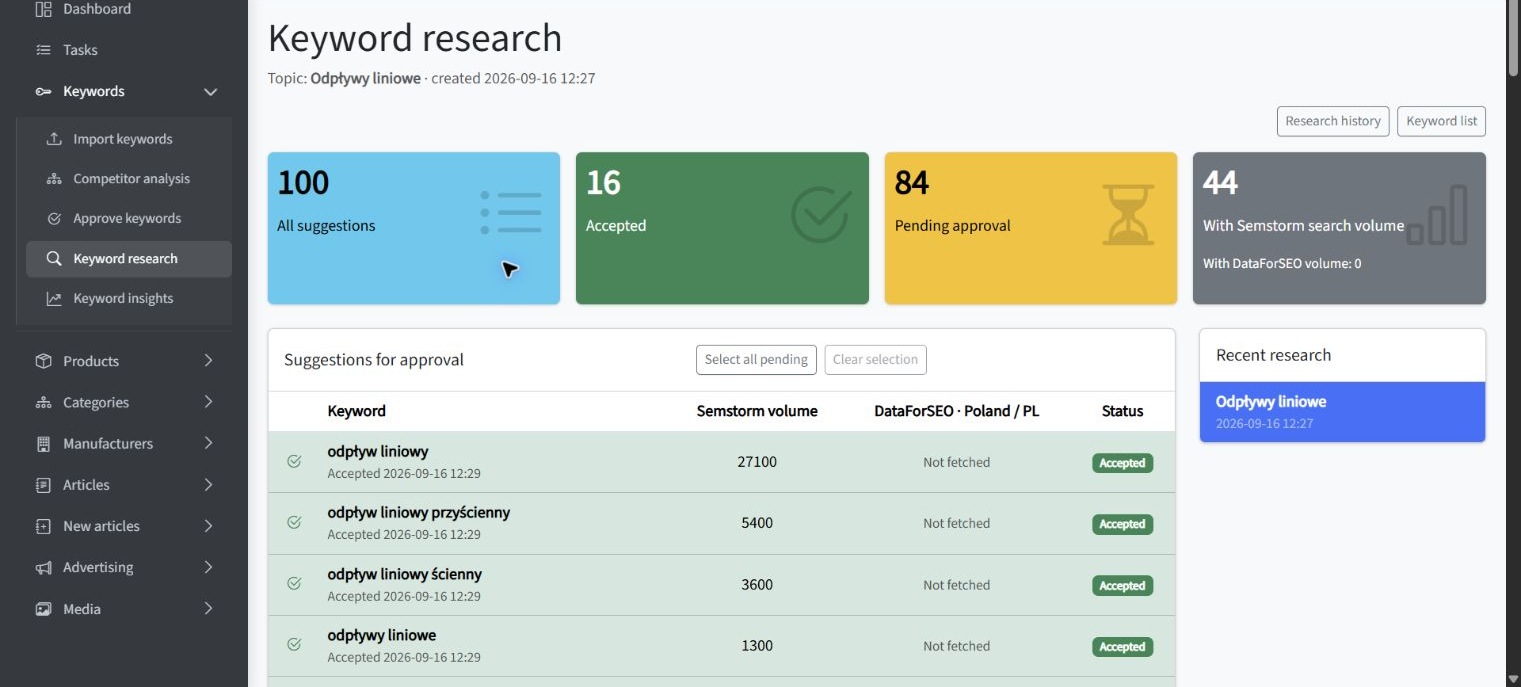
At the end of discovery, keep the raw list separate from the approved shortlist. Removing terms too aggressively at this stage can hide useful long-tail queries, but treating every suggestion as valid creates unnecessary noise.
Step 4: Analyze Search Intent
Search intent describes what a person expects to accomplish when using a query. Common labels such as informational, commercial, transactional, and navigational are useful starting points, but they are not enough to determine the correct page.

Inspect the current results to identify the dominant content type, format, angle, audience, and expected next action. Ask whether Google mainly shows product pages, category pages, service pages, tutorials, comparison articles, tools, videos, or a mixture of formats.
For each important keyword, evaluate the following evidence:
- Content type: article, category, product, service, tool, video, or landing page.
- Format: guide, list, comparison, definition, template, review, or step-by-step tutorial.
- Angle: beginner, advanced, affordable, local, fast, technical, or use-case specific.
- Audience: consumer, professional, buyer, researcher, or existing customer.
- Next action: learn, compare, calculate, contact, subscribe, or purchase.
Intent analysis protects you from targeting a query with the wrong asset. A detailed educational article is unlikely to satisfy a strongly transactional search dominated by category or product pages. In the same way, a short sales page may not satisfy a query that requires explanation and comparison.
For a focused process, use the guide on how to analyze search intent. Recheck intent before creating a new page or substantially changing an existing one because result composition can evolve.
Step 5: Evaluate Search Demand, Competition, and Business Relevance
Search volume is useful, but it should not make the decision alone. Keyword evaluation should balance demand with intent, relevance, ranking feasibility, expected business value, and the resources needed to compete.
Assess search demand in context
Search-volume figures are estimates and may hide seasonality, regional differences, close variants, or changes in terminology. Compare data from a consistent source, check trends where relevant, and consider the total demand represented by a topic rather than only one exact phrase.
A keyword with modest volume may belong to a larger group of closely related queries. A page that satisfies the whole topic can earn visibility across many variations, provided those variations share compatible intent.
Examine the actual competition
Do not treat a tool’s difficulty score as a complete judgment. Inspect the ranking pages and domains. Compare their relevance, content quality, authority, page type, internal linking, and ability to satisfy the query.
A realistic difficulty review should consider:
- The strength and specialization of the ranking domains.
- The quality and intent match of individual pages.
- The depth and clarity required to satisfy the topic.
- The backlink and internal-link support behind competitors.
- The presence of strong brands, marketplaces, or official sources.
- Your website’s existing topical coverage and visibility.
A high-volume query may be a weak target if dominant results are substantially stronger and the business has no distinctive value to add. A smaller query may be more attractive when current results are unfocused, outdated, or poorly matched to the audience.
Score business relevance separately
Business relevance is not the same as ranking difficulty. Ask whether a person using the query could reasonably benefit from your offer and whether the intended page can provide a natural next step.
A simple relevance scale can make decisions more consistent:
- Direct relevance: the query clearly describes the offer, category, or purchasing need.
- Supporting relevance: the query addresses a problem or decision closely connected to the offer.
- Contextual relevance: the topic may attract the right audience but has an indirect conversion path.
- Low relevance: the term has demand but little meaningful connection to the business.
The following example shows a review stage in which suggested terms can be compared using volume and relevance information, then approved or rejected. The relevance score helps filter for fit; it should not be interpreted as a keyword-difficulty metric.
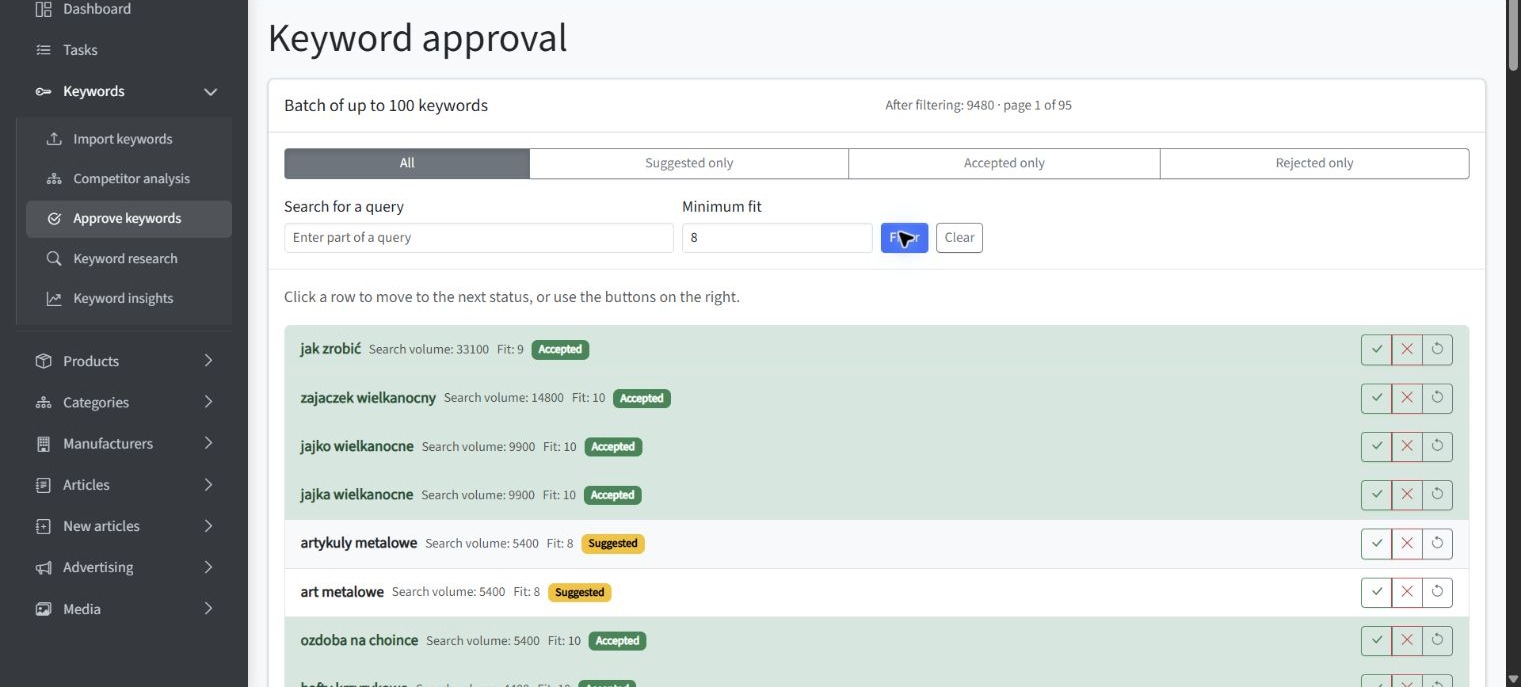
Keep the underlying reasoning visible. A score can support consistent review, but it should not replace judgment when a strategically important topic has limited data or an indirect conversion path.
Step 6: Find Keywords Your Competitors Rank For
Competitor analysis can reveal topics that seed-based discovery misses. However, the most useful search competitors are not always your known commercial rivals. A publisher, marketplace, directory, or specialist website may compete for the same organic results without selling the same offer.
Identify competitors at the query and topic level. Review the domains that repeatedly appear for your priority themes, then examine the pages and keywords responsible for their visibility.
Useful competitor signals include:
- Relevant keywords for which several competitors rank but your site does not.
- Competitor pages gaining visibility across an important topic.
- Queries where competitors hold weak or poorly matched positions.
- Topics supported by strong internal-link structures.
- Different page formats being used for the same stage of the customer journey.
A competitor ranking is evidence that an opportunity exists, not proof that you should pursue it. Exclude keywords that do not match your audience, expertise, offer, or realistic ability to compete.
Use competitor keyword research to distinguish genuine gaps from irrelevant noise and to build a practical competitor SEO tracking process. The aim is to identify unmet demand and weak coverage, not to reproduce another website’s content plan.
Step 7: Prioritize the Best SEO Opportunities
Keyword prioritization turns a validated list into an action plan. Without it, teams tend to choose topics based on the largest volume, the easiest metric, or the most recent idea.
Compare opportunities across several factors:
- Business value: the connection between the query and a meaningful outcome.
- Intent fit: whether the business can provide the expected page experience.
- Search demand: the estimated size and consistency of the opportunity.
- Current visibility: whether an existing page already ranks or receives impressions.
- Ranking feasibility: the strength of competing pages and domains.
- Required effort: the cost of creating, improving, consolidating, or promoting the page.
- Strategic value: the contribution to a priority topic, audience, or product area.
Existing pages ranking near useful positions often deserve different treatment from keywords requiring entirely new assets. Improving an established page may produce results sooner, while a new strategic topic may require a longer sequence of supporting pages and links.
A balanced roadmap normally includes quick improvements, commercially valuable topics, and longer-term authority-building opportunities. Use an SEO opportunity analysis to prioritize keyword opportunities transparently instead of allowing search volume to dominate every decision.
Numerical scoring can make assumptions comparable, but it should not create false precision. Document why a keyword received its priority and what evidence would justify changing that decision.
Step 8: Group Related Keywords into Topics
Do not create a separate page for every keyword variation. Search engines can understand naturally written pages that cover a coherent subject, and users rarely need multiple pages that differ only by singular forms, word order, or minor modifiers.

Group keywords when the same page can satisfy their dominant expectations without becoming unfocused. Shared wording is helpful, but intent and result overlap provide stronger evidence.
When evaluating a group, ask:
- Do the keywords lead to similar types of pages in the search results?
- Do many of the same URLs rank for the queries?
- Would one visitor reasonably expect the page to answer all variations?
- Can the terms be covered without forcing unrelated sections into the page?
- Do the queries lead to the same commercial or informational next step?
Separate keywords when the dominant intent, audience, page type, or required depth differs. For example, a definition, a software comparison, and a service request may belong to the same broad topic but still require distinct pages.
Choose one primary keyword for planning and measurement, then retain secondary terms that represent meaningful subtopics or natural variations. The primary term should clarify the page’s central purpose rather than limit the language used in the content.
Step 9: Map Keywords to Existing or New Pages
A keyword map connects research with implementation. Each approved group should have a target URL, intended page type, priority, status, and next action.

Audit existing pages before proposing new ones. A relevant URL may already have authority, links, impressions, or rankings that can be improved. Creating another page for the same intent can split signals and produce keyword cannibalization.
For each keyword group, choose one of four main actions:
- Optimize: improve an existing page that already matches the intent.
- Create: produce a new page where the site has a genuine content gap.
- Consolidate: merge overlapping pages that compete for the same purpose.
- Monitor: retain the opportunity for later because demand, value, or feasibility is uncertain.
A useful map should record the primary keyword, supporting terms, intent, target audience, page type, current URL, proposed URL where needed, priority, and implementation status.
Follow a structured process to map keywords to the right pages. The map should remain a maintained planning document, not a spreadsheet that is abandoned after the initial research project.
Step 10: Apply Keywords Through On-Page Optimization
On-page optimization applies the approved keyword group while preserving clarity and usefulness. It is not the repeated insertion of an exact phrase. The page should communicate its purpose naturally to visitors and search engines.
Review the elements that influence how the page is understood:
- The page title and main heading.
- The introductory explanation and core page copy.
- Descriptive subheadings that reflect important subtopics.
- Internal links and their anchor text.
- Image context and alternative text where relevant.
- The title and description presented in search results.
- The page’s relationship to supporting content.
Google recommends clear, concise, page-specific titles and well-organized, useful content written for readers. Headings can help visitors navigate the page, while relevant internal links connect users and search engines to related resources.
Use the primary keyword where it accurately describes the page, but do not force it into every section. Supporting terms should appear when the subject requires them. If a phrase sounds unnatural or introduces a different intent, reconsider the keyword group rather than weakening the content.
Optimization also requires alignment between the search result and the landing page. A title that implies a complete guide should lead to a sufficiently complete guide. A transactional title should lead to a page where the expected action is accessible.
Step 11: Track Rankings and Refresh Your Research
Keyword research is not finished when a page is published. Demand changes, competitors release new pages, search intent evolves, and business priorities shift. Tracking should reveal whether the original assumptions remain valid.
Monitor more than one ranking position. Review groups of related queries, impressions, clicks, click-through rate, landing pages, conversions, and changes in the search results. Average position can provide context, but it should not be treated as a complete performance measure.
Set a review schedule based on the importance and volatility of the topic. Priority commercial pages may need frequent attention, while stable supporting articles can be reviewed less often.
Useful review triggers include:
- A meaningful rise or decline in impressions or clicks.
- A page beginning to rank for unexpected but relevant queries.
- Multiple pages appearing for the same keyword group.
- A competitor gaining visibility with a new or substantially improved page.
- A change in the dominant result type or search intent.
- A product, service, market, or business objective changing.
When performance changes, diagnose the cause before rewriting the page. The issue may involve intent, content quality, internal links, competition, indexing, seasonality, or a wider change in demand.
Common Keyword Research Mistakes
Most keyword research problems come from treating one metric or tool as the decision-maker. Avoid the following mistakes:
- Choosing keywords only by search volume: demand without relevance or intent can produce low-value traffic.
- Trusting difficulty scores without reviewing results: a comparative metric cannot describe every competitive factor.
- Creating one page per variation: closely related terms may be better served by one focused page.
- Ignoring existing URLs: unnecessary new pages can duplicate targeting and divide authority.
- Copying competitor keywords indiscriminately: another site’s priorities may not match your audience or offer.
- Confusing relevance with ranking feasibility: a term can be valuable but difficult, or easy but commercially weak.
- Using automation without approval: generated suggestions still require intent, relevance, and quality review.
- Stopping after publication: rankings and business priorities change, so the keyword map must be maintained.
Another common mistake is confusing completion with impact. Publishing many pages may increase output, but it does not prove that the chosen topics are relevant, competitive, or capable of supporting business outcomes.
A Repeatable Keyword Research Checklist
Use the following checklist to turn how to do keyword research into a controlled, repeatable workflow:
- Define the business goal, audience, market, and desired visitor action.
- Build seed topics from products, services, problems, use cases, and customer questions.
- Expand the list through search results, Google Search Console, SEO tools, and competitor pages.
- Review the dominant search intent, content type, format, audience, and expected next step.
- Compare demand, relevance, business value, competition, current visibility, and required effort.
- Reject suggestions that do not fit the offer or cannot be served credibly.
- Group keywords that can be satisfied by the same focused page.
- Audit existing URLs before recommending new content.
- Assign each group to a page to optimize, create, consolidate, or monitor.
- Apply the approved terms through natural on-page optimization and relevant internal links.
- Measure query and page performance after implementation.
- Review priorities as demand, rankings, competitors, and business goals change.
Research should result in approved website actions and ongoing measurement, not an isolated spreadsheet. A connected SEO workflow can help move opportunities through analysis, prioritization, content work, controlled review, publishing, and performance monitoring.
Automation can support discovery and execution, but accountability remains necessary. For more context, review how an SEO automation workflow handles keyword selection, optimization, and measurement.
Key Conclusions
The most important principles of effective keyword research are:
- Treat keyword research as a sequence of decisions, not a volume export.
- Balance demand with intent, relevance, feasibility, effort, and business value.
- Use search results, first-party data, tools, and competitor pages as complementary evidence.
- Group variations when one page can satisfy the same dominant intent.
- Audit existing pages before creating new ones.
- Finish with a keyword map that defines the target URL and next action.
- Revisit the plan when rankings, demand, competitors, or business priorities change.
Summary
Successful keyword research for SEO does not begin or end with a search-volume figure. It starts with business goals, expands through several discovery sources, tests each idea against search intent and competitive evidence, and finishes with prioritized keyword groups assigned to suitable pages.
The practical decision rule is simple: target a keyword only when you understand who is searching, what they expect, why the opportunity matters, and which page can satisfy that need. If those questions cannot be answered, the keyword is not ready for implementation.