

WordPress SEO is often treated as a configuration project: install a plugin, complete a checklist and wait for rankings to improve. That approach is incomplete. Technical setup creates the conditions for search visibility, but sustainable growth depends on an ongoing WordPress SEO workflow for selecting opportunities, preparing changes, reviewing them, publishing safely and measuring the results.
This article focuses on that operational process rather than attempting to cover every WordPress setting. It is designed for teams managing service websites, B2B sites and substantial content libraries where isolated reports and occasional edits are no longer enough.
Why a WordPress SEO Workflow Must Be Ongoing
A business website does not remain static after its initial optimization. Services change, new competitors enter search results, customer terminology evolves and previously useful articles become incomplete. The site itself also grows, which can create overlapping pages, outdated links and inconsistent metadata.
Google recommends reviewing previously published content and updating or removing material when appropriate. Its guidance also emphasizes useful, well-organized content and relevant links between resources. These are recurring responsibilities, not one-time setup tasks.
A practical workflow therefore needs to answer six questions repeatedly: which pages deserve attention, which searches are relevant, what should change, who must approve the change, how should it be published and what evidence will determine the next action?
This distinction prevents a common failure mode: producing a large audit, fixing a few visible issues and then returning to unplanned publishing. Reports are inputs. The workflow turns those inputs into controlled decisions.
Separate Technical Setup from Content Operations
Technical SEO and content operations are connected, but they are not the same type of work. Technical setup determines whether important pages can be crawled, indexed and rendered correctly. Content operations determine whether those pages answer useful searches, represent the offer accurately and guide visitors toward an appropriate next step.

Before scaling content updates, confirm that the site has a dependable technical baseline. This includes checking indexability, redirects, canonicalization, sitemaps, internal navigation and major performance problems. The technical SEO basics checklist provides a useful starting point for this review.
Once critical technical barriers have been addressed, create a separate operational queue for content work. Mixing every technical warning, editorial opportunity and business request into one backlog makes prioritization difficult. A page with a minor metadata issue should not automatically take precedence over a high-value service page that attracts impressions but fails to explain the service clearly.
Ownership should also be explicit. Developers can manage template and indexing problems, while subject specialists verify factual accuracy. An SEO or content lead can map search intent, prepare recommendations and coordinate measurement. One person may cover several roles in a smaller business, but the decisions should still remain distinct.
Choose Pages and Keywords Worth Improving First
The first operational step in a WordPress SEO workflow is not editing. It is selection. Start by grouping URLs according to their purpose, such as service pages, industry pages, location pages, case studies and educational articles. This makes it easier to compare pages with similar business roles instead of treating every URL as an equal opportunity.
Prioritize pages by combining business importance with search evidence and content condition. A sensible candidate may be a commercially important page with growing impressions, a page ranking for relevant queries without earning many clicks, or an established article that can support a service page after a focused update.
Keyword volume alone is not a sufficient selection rule. Review whether the phrase matches the page’s purpose, the organization’s actual offer and the likely intent of the searcher. Reject keywords that would require the page to promise a service, product or level of expertise the business does not provide. Keywords should be approved before they become headings, briefs or optimization targets.
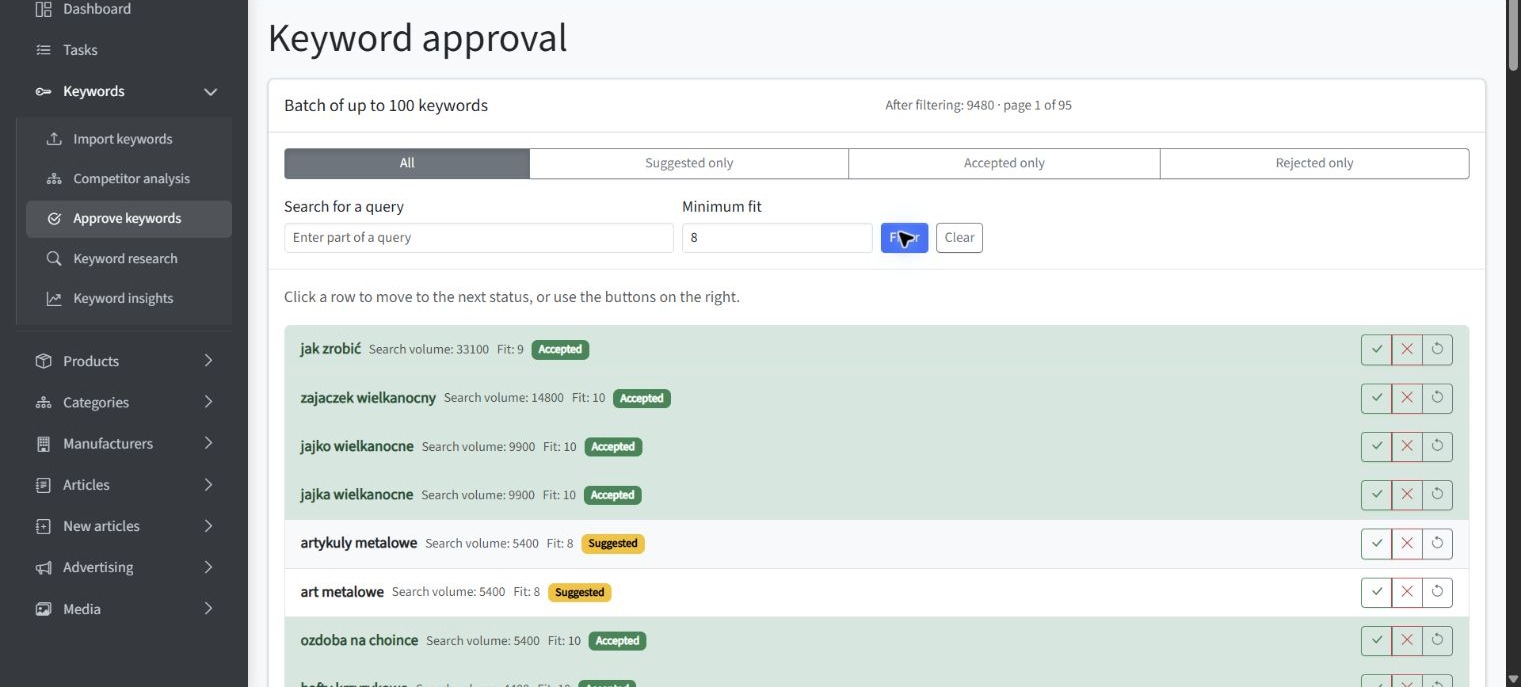
A consistent approval process can be organized into the following sequence.
- Identify a page group. Select a manageable set of URLs with a shared role or template.
- Collect evidence. Review current queries, impressions, clicks, conversions where available and obvious content gaps.
- Map search intent. Decide whether each relevant phrase belongs on an existing page, requires a new page or should not be targeted.
- Verify business fit. Confirm that the organization can satisfy the need represented by the query.
- Approve a primary direction. Record the target topic, supporting phrases, page purpose and reason for prioritization.
This sequence reduces two risks: optimizing pages for attractive but irrelevant demand and creating new pages when an established URL could be improved instead. For a broader method of evaluating and assigning queries, follow the keyword research and mapping process.
Review Service Pages, Articles and Existing Content Differently
A useful review begins with the page’s role. Service pages and informational articles can support each other, but they should not be assessed against identical criteria.
Service Pages Need Commercial Clarity
A service page should make the offer understandable before it attempts to cover every related keyword. Check whether it identifies the problem, explains the service, sets reasonable expectations and gives the visitor a clear next action. Search optimization should strengthen this purpose rather than dilute it with generic educational text.
Compare the page’s current queries with its actual content. If it receives impressions for a relevant service variation that is only mentioned briefly, the appropriate update may be a clearer section or supporting page. If the query reflects a different need, forcing it into the page can weaken both relevance and conversion clarity.
Articles Need a Defined Role in the Content System
An article should answer a specific question while connecting naturally to related expertise or services. Review whether it still matches current search intent, whether examples remain accurate and whether its internal links lead to the best available destinations.
Large libraries should also be reviewed for overlap. Several weak articles addressing nearly the same question may compete for attention and maintenance resources. Depending on their purpose and performance, the right decision may be to differentiate them, consolidate useful material or retire an obsolete page with an appropriate redirect.
Content clusters can help organize this work around connected problems rather than isolated keywords. For a process-oriented example, see Spioch.eu: content strategy for organic growth. The example demonstrates the value of systematic, cluster-based content work, but it predates SEOAssistant and should not be interpreted as evidence of the current application’s performance.
If drafts or recommendations are prepared with AI assistance, review should focus on risk rather than simply rereading every sentence with equal attention. Verify claims, offer details, examples, links, search intent and any language that could affect customer expectations. The guide to review AI-generated SEO content explains how to structure that control step.
Prepare Metadata, Headings and Internal Links as One Update
Once a page has been selected, prepare a complete change proposal. Updating only the page title or adding a phrase to one paragraph often leaves the underlying mismatch unresolved. The metadata, visible heading structure, main content and internal links should communicate the same page purpose.
Write Metadata for the Actual Page
Prepare a concise, descriptive title that distinguishes the page from other URLs on the site. Avoid repeated boilerplate and keyword lists. Google uses several sources when generating title links, including the title element, visible page title, headings and link text, so these signals should remain consistent.
A meta description should summarize the specific page and help a suitable searcher decide whether to visit. It is not a guaranteed search snippet: Google primarily creates snippets from page content and may use the meta description when it is a better representation. This is why the visible content still needs to support the description’s message.
Use Headings to Clarify the Decision Path
Headings should organize the information a visitor needs rather than serve as storage for keyword variations. On a service page, that may mean moving from the problem and service scope to process, suitability, limitations and next steps. In an article, headings can move from the core question through conditions, options, risks and practical action.
Review the page as a complete argument. A heading may be individually relevant but still unnecessary if the section repeats an earlier point or distracts from the page’s main purpose.
Add Internal Links with a Defined Function
Internal links should help readers continue a relevant task, understand a supporting concept or reach an appropriate commercial page. Use descriptive anchor text that tells the reader what the destination covers. Google also recommends crawlable links with meaningful anchor text because they help people and search systems understand and discover connected pages.
Do not add links solely to increase their number. Each link should have a reason: supporting a claim, explaining a prerequisite, connecting an article to the offer or directing the reader to a logical next step.
Use Versioned Changes and Human Approval
SEO recommendations should move through a controlled review process instead of being applied as disconnected live edits. Prepare each proposal with the original state, recommended version, target page, rationale and reviewer. This allows the team to discuss a specific change rather than approve a vague instruction such as “improve the page for SEO.”

WordPress revisions provide a record of saved drafts and published updates, while roles and capabilities can separate editing responsibilities from publication rights. The exact approval design will depend on the site and team, but access should reflect responsibility rather than convenience.
For teams that need to move from analysis and prioritization through content preparation, review and controlled publication, a connected SEO workflow can reduce the gaps created by separate reports, documents and editing tools. The important capability is not automatic publication. It is maintaining context as a recommendation becomes an approved website change.
Before publication, the reviewer should complete a short sequence of checks.
- Verify accuracy. Confirm service details, factual claims, terminology and examples.
- Check intent. Make sure the revised page still serves the intended visitor and business purpose.
- Compare versions. Identify what was added, removed or materially reframed.
- Test links and presentation. Confirm that links, headings and key page elements work in the rendered version.
- Approve publication. Record the decision, publication date and pages affected.
For higher-risk updates, publish in a smaller batch first. This is especially useful when several URLs share a template or when the same recommendation will be applied across a large page group. A controlled rollout makes problems easier to identify and reverse.
Worked Example: Publishing This Site’s Shoper Guide
On 28 October 2026, we used SEOAssistant to prepare the Shoper SEO guide on this WordPress site. The review added two concrete examples from existing application screenshots: a manufacturer review and product priority rules. We checked the descriptions against the visible screens instead of treating generated wording as verified product documentation.
- Review in SEOAssistant: correct the draft and preserve its screenshot blocks and relevant illustrations.
- Approve and export once: locate the resulting WordPress entry before requesting another export. In this instance, export created a draft rather than a public post.
- Finish the WordPress check: verify the real destinations of internal links, choose appropriate existing categories and replace an overly long image ALT with a concise description.
- Check the public result: confirm the article opens without a login and that all seven images, including both interface screenshots, load.
This demonstrates an editorial and publishing process, not a measured ranking gain. Search impact needs a later review against a recorded baseline.
Measure Search Performance After Publication
Measurement should be planned before the page is changed. Record the publication date, target queries, baseline period and expected direction of improvement. Then compare appropriate periods in Google Search Console rather than checking rankings immediately after publication.
The Search Console Performance report includes clicks, impressions, average click-through rate and average position. It also supports comparisons between periods and analysis by dimensions such as page, query, country and device. Assess trends in clicks and impressions alongside average position, rather than treating position as a complete result.
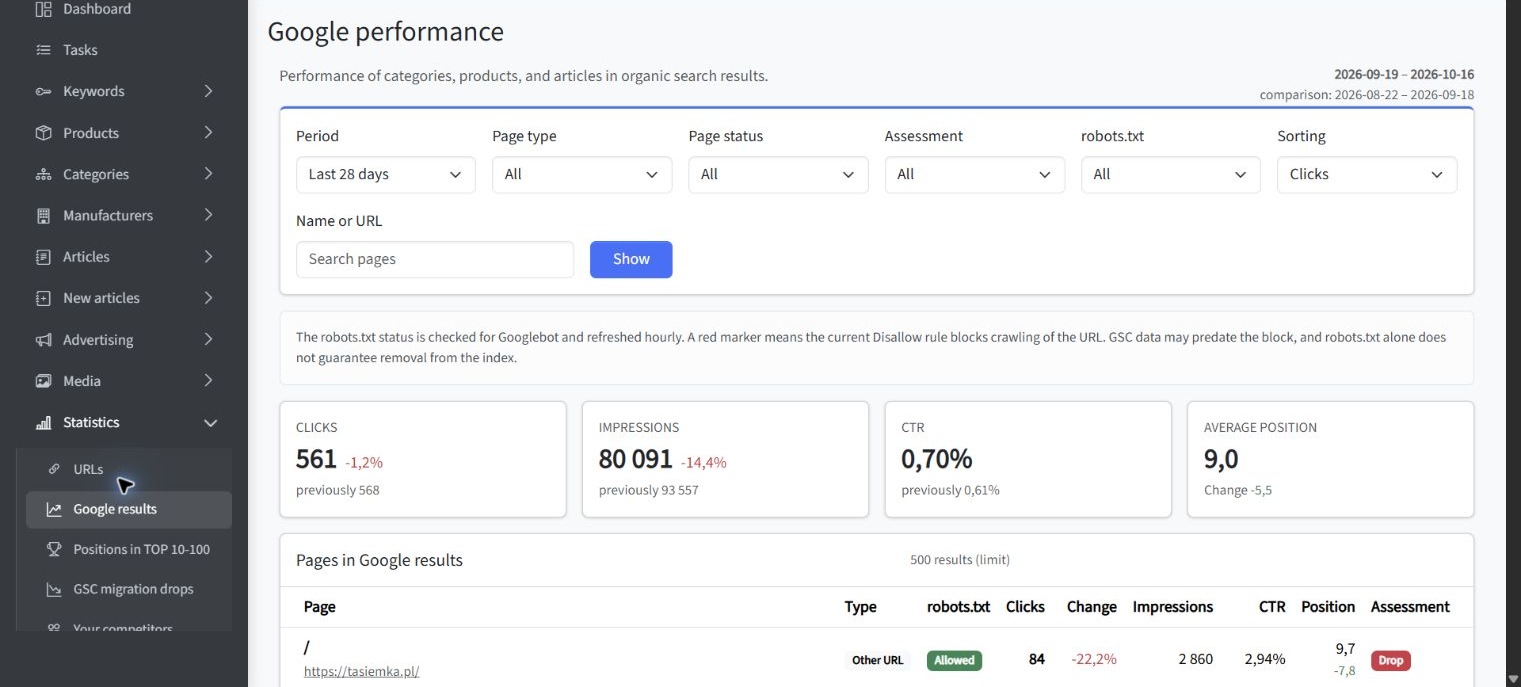
Interpret these metrics together. Higher impressions may indicate that the page is appearing for more searches, while a weaker click-through rate may suggest that the query mix changed or that the search presentation needs review. More clicks are positive, but they should still be evaluated against relevance, engagement and business outcomes where those data are available.
A comparison does not automatically prove that the content update caused the result. Seasonality, brand activity, competitor changes, search result features and broader market demand can all affect performance. Annotating publication dates and reviewing query-level changes helps the team form a more credible interpretation.
A useful review should end with a decision. Keep the update, revise a specific element, investigate a technical problem or allow more time for evidence to accumulate. The guide on how to measure SEO performance provides additional context for selecting and interpreting metrics.
Build a Repeatable WordPress SEO Optimization Cycle
The final goal is not to create more reports. It is to establish a cycle that the available team can sustain. Frequency should reflect the number of pages, rate of website change and review capacity. A smaller service site may use a monthly cycle, while a large content library may maintain a continuous queue with regular approval and measurement meetings.

A complete cycle can follow these stages.
- Analyze. Review technical status, search performance, page groups and content condition.
- Prioritize. Select opportunities using business value, relevance, evidence and effort.
- Prepare. Draft coordinated changes to content, metadata, headings and internal links.
- Review. Verify accuracy, brand alignment, search intent and implementation risk.
- Publish. Apply approved, versioned changes and record the publication details.
- Measure. Compare performance and use the findings to select the next action.
Automation can support data collection, recurring checks and draft preparation, but it should not remove accountability for keyword selection, factual verification or publication. A practical SEO autopilot workflow automates repeatable tasks while keeping consequential decisions visible to the team.
As the cycle develops, evaluate where work repeatedly slows down. The bottleneck may be opportunity selection, subject-matter review, preparation of consistent updates or the connection between articles and commercial pages. Also consider the resources available and the types of pages that repeatedly need improvement.
If these bottlenecks are limiting progress, you can check whether SEOAssistant.pro could help with this on your website. The assessment identifies opportunities and where the application may fit your website’s workload. It is a starting point for deciding what to improve, rather than proof that changes have been implemented or that rankings will rise.
Key Takeaways
The most important conclusions for organizing a dependable WordPress SEO process are:
- A WordPress SEO workflow is an ongoing operational cycle, not a replacement for technical setup.
- Pages should be prioritized by business value, search evidence, relevance and content condition.
- Keywords need human approval before they shape page content or metadata.
- Service pages and articles require different review criteria because they serve different visitor needs.
- Metadata, headings, visible content and internal links should support one coherent page purpose.
- Versioned proposals and defined publication rights reduce the risk of uncontrolled edits.
- Performance should be measured across suitable periods and interpreted with context.
- Automation is most useful when it supports repeatable work without replacing review and accountability.