Does Google Penalize AI-Generated Content? What the Guidelines Actually Say

Short answer: no. Google does not penalize content simply because artificial intelligence helped create it.

That does not mean every AI-generated page is safe, useful, or likely to rank. Google acts against large-scale content created primarily to manipulate search results while offering little or no value to users.

The most useful question is therefore not:

Was this written by a human or by AI?

It is:

Does this page genuinely help the person who found it?

This distinction matters for companies using AI to improve product descriptions, category pages, guides, landing pages, and older content already published on their websites.

What does Google officially say about AI content?

In its guidance on generative AI content, Google explains that generative AI can be useful for researching a topic and adding structure to original material.

At the same time, publishers are expected to focus on accuracy, quality, and relevance. This applies not only to the visible copy, but also to automatically generated titles, meta descriptions, structured data, and image alternative text.

Using AI is not, by itself, a violation of Google Search policies. The problem begins when automation is used to publish large numbers of pages without adding meaningful value.

The same principle applies to human-written copy. Poor content does not become helpful simply because a person typed it.

Google evaluates the result, not the writing tool

A business can create content in many ways:

  • write it entirely in-house,
  • hire a copywriter or agency,
  • use AI as a writing assistant,
  • generate drafts from company and website data,
  • combine an expert, automation, and editorial review.

The production method alone does not determine quality.

Google says its systems aim to reward helpful, reliable, people-first content. Its helpful content guidance asks publishers to consider whether a page:

  • contains original information, analysis, or insight,
  • covers the subject thoroughly enough to satisfy the reader,
  • adds something beyond an obvious summary of other sources,
  • would be useful enough to save, recommend, or share,
  • is carefully produced and factually reliable,
  • shows genuine knowledge or experience of the subject.

AI-assisted content can meet these criteria. Human-written content can fail every one of them.

When can AI content become a problem?

The biggest risk does not come from a particular language model. It comes from the way automation is used.

Google’s spam policies describe scaled content abuse: producing many pages primarily to manipulate rankings while providing little or no value. Google explicitly says this can involve content created by people, automation, or a combination of both.

Risk increases when a company:

  • publishes a separate page for every possible keyword variation,
  • creates hundreds of nearly identical product or category descriptions,
  • rewrites competitors’ pages without adding its own knowledge,
  • publishes facts that have not been verified,
  • generates content without understanding the products or offer,
  • uses one generic template across unrelated subjects,
  • never analyses or updates pages after publication.

These practices can be problematic whether the content comes from AI, a content farm, freelancers, or an agency.

“Unique” does not automatically mean valuable

Generative AI can produce sentences that do not duplicate any existing page. Technical uniqueness, however, is not the same as usefulness.

A thousand original words can still fail to answer a single important customer question.

A good ecommerce category description should help a buyer understand:

  • which products belong in the category,
  • how the available options differ,
  • which option suits a particular use case,
  • which parameters matter before purchase,
  • what common mistakes to avoid,
  • what customers most often ask before deciding.

A product description should use the real characteristics of that product rather than polished generalities that could be attached to hundreds of other items.

This is why a prompt such as “write an SEO-optimized category description” is not a complete SEO process.

Can content be generated mostly by AI?

Yes. The percentage written by AI is not the decisive criterion.

A largely automated draft can be useful when the system receives trustworthy data, sufficient business context, a clearly defined search intent, and rules that prevent it from inventing information. It may even be prepared more consistently than copy written manually without research.

AI does not automatically know:

  • the actual features and limitations of your products,
  • how your company operates,
  • what your customers ask your sales team,
  • which claims your business can support,
  • what changed recently in your range or industry.

Value is not created merely by generating fluent sentences. It comes from selecting the right data, understanding the user’s intent, and keeping the text aligned with reality.

How SEOAssistant approaches AI-assisted content

SEOAssistant is not designed to produce the highest possible number of disconnected articles.

The system is being developed around the context of a specific website: its products, categories, existing pages, Google visibility, Search Console data, selected keywords, and competitive environment.

The intended workflow is:

  1. Analyse the current page and its search-performance data.
  2. Select a topic and query that belong to that particular page.
  3. Use the website’s products, categories, offer, and existing knowledge as context.
  4. Prepare a page-specific revision rather than generic copy.
  5. Check the semantic scope and important missing subjects.
  6. Show a diff between the current and proposed version.
  7. Allow the change to be reviewed or, where the workflow permits it, move through subsequent stages automatically.
  8. Return to published pages as their results, competition, and search demand change.

We are working toward an increasingly complete cycle in which content is not generated once and forgotten. It should evolve with the business, the search market, user behaviour, competitors, and future changes in search systems.

Automation does not have to replace knowledge of the business. It can help apply that knowledge consistently across far more pages and revisit content that would otherwise remain unchanged for years.

Why a simple AI writer is not enough

A language model can produce a plausible article in seconds. That is only one small part of SEO work.

The process also requires:

  • choosing the right page,
  • understanding its current visibility,
  • identifying the search intent,
  • selecting meaningful topics and queries,
  • comparing the page with competing results,
  • finding genuinely missing information,
  • keeping claims consistent with the real offer,
  • updating previously published content,
  • measuring what happens after implementation.

Without these steps, AI merely makes it faster to publish average content. With them, it can help scale a well-designed SEO process.

Should you use an AI content detector?

AI detectors estimate authorship from statistical language patterns. Their scores are not proof of who wrote a text and they are not a measure of content quality.

A peer-reviewed study, “GPT detectors are biased against non-native English writers”, found serious false-positive problems when detectors evaluated English essays written by non-native speakers.

A separate practical evaluation of AI-generated text detectors found that performance can fall substantially across different models, domains, and relatively modest changes to the text.

A “98% human” result does not prove that a person wrote the content. A “98% AI” result does not prove that the page is spam or that Google will rank it poorly.

You can create a useless article that passes as human. You can also publish a genuinely useful page that a detector labels as AI.

Instead of optimizing for detector scores, check whether the content is accurate, relevant, specific to the business, meaningfully different from competing pages, and useful to the reader.

Do you have to disclose the use of AI?

Google suggests considering an explanation of how automation was used when readers could reasonably be expected to care about the production process. This is not the same as a universal requirement to label every sentence assisted by AI.

Context matters. Transparency is particularly valuable for medical or financial advice, original research, product testing, and other subjects where authorship, expertise, and methodology affect trust.

For a category description, the most important questions will usually be whether the information is correct and whether it helps customers choose.

Other Google services, including Merchant Center, may have separate rules. Organic Search guidance should not automatically be treated as a policy for advertising, product feeds, or generated images.

A practical pre-publication checklist

  1. Does the page answer a real user need?
  2. Are its claims consistent with the actual offer?
  3. Does it use knowledge specific to this company, service, or product?
  4. Does it add something beyond generic information already available elsewhere?
  5. Would a subject-matter expert consider it accurate?
  6. Does it avoid invented specifications, data, and promises?
  7. Does it match the search intent?
  8. Does it help the visitor solve a problem or make a decision?
  9. Is it published on the right page?
  10. Will its results be monitored and the content revisited?

If the answers are positive, the tool used to prepare the first draft becomes a secondary question.

Does Google penalize AI content? The conclusion

Google does not prohibit the use of artificial intelligence in content creation. Nor does it guarantee rankings because a text is long, technically unique, or written entirely by a person.

The risk begins when automation is used to mass-produce pages with little real value, primarily to capture search traffic.

Used well, AI can help analyse data, improve existing pages, organise company knowledge, and create content grounded in the context of a real business.

So the right question is not whether Google likes AI content.

Can AI help us create and continuously improve content that genuinely serves users?

If the answer is yes, artificial intelligence is not a shortcut around SEO work. It becomes a way to perform that work more consistently and at greater scale.

See what SEOAssistant would do next

SEOAssistant analyses existing pages, search visibility, keywords, and development opportunities. It then proposes concrete changes that can be reviewed before publication.

See how to review AI-generated SEO content or start with a free website analysis.
How to Review AI-Generated SEO Content Without Reading Everything Twice

AI has made drafting content faster. It has not automatically made approving content easier.

When a system can prepare hundreds of product descriptions, metadata updates or category revisions, the bottleneck moves. The question is no longer only, “How do we create this content?” It becomes, “How do we decide whether this specific change is accurate, useful and safe to publish?”

That distinction matters. Google’s current guidance does not treat the use of generative AI as an automatic problem. It asks website owners to focus on the accuracy, quality and relevance of automatically generated content. At the same time, Google’s spam policies warn against producing large volumes of unoriginal pages that add little value, regardless of whether they were created by AI, people or both.

The practical conclusion is simple: automation needs a quality-control system, not just a text generator.

The bottleneck moved from writing to deciding

Imagine an ecommerce team with 200 product revisions waiting for review.

If each reviewer has to open the existing page, read it from the beginning, open the proposed version, read that from the beginning and mentally compare both, the workflow does not scale. AI may have saved time during drafting, but the team pays much of it back during approval.

This is a common failure mode in AI content projects:

  1. generation becomes fast;
  2. the number of drafts increases;
  3. review remains document-based and manual;
  4. the approval queue grows;
  5. changes become stale before they reach the website.

The solution is not to remove review immediately. It is to redesign review around decisions rather than documents.

What should an SEO review screen answer?

A useful review interface should help a person answer four questions quickly:

  1. What changed? Which fields and fragments are different?
  2. What stayed unchanged? Were the product identity, URL and source facts preserved?
  3. Is the proposal credible? Does it match the product, business and search intent?
  4. What happens next? Can the reviewer accept, reject, edit or escalate the revision without leaving the workflow?

This is why a side-by-side comparison and a visual diff are operational features rather than cosmetic ones.

The current version provides the baseline. The proposed version shows the intended outcome. Red highlighting identifies removals, green highlighting identifies additions, and unchanged fragments remain visually neutral. The reviewer can focus attention on the actual intervention instead of rediscovering the entire page.

A real product revision from AP Komfort

AP Komfort is a Polish ecommerce store specializing in kitchen and bathroom equipment. Its SEOAssistant workspace provides a useful example because the review process is being applied to real product data at meaningful scale.

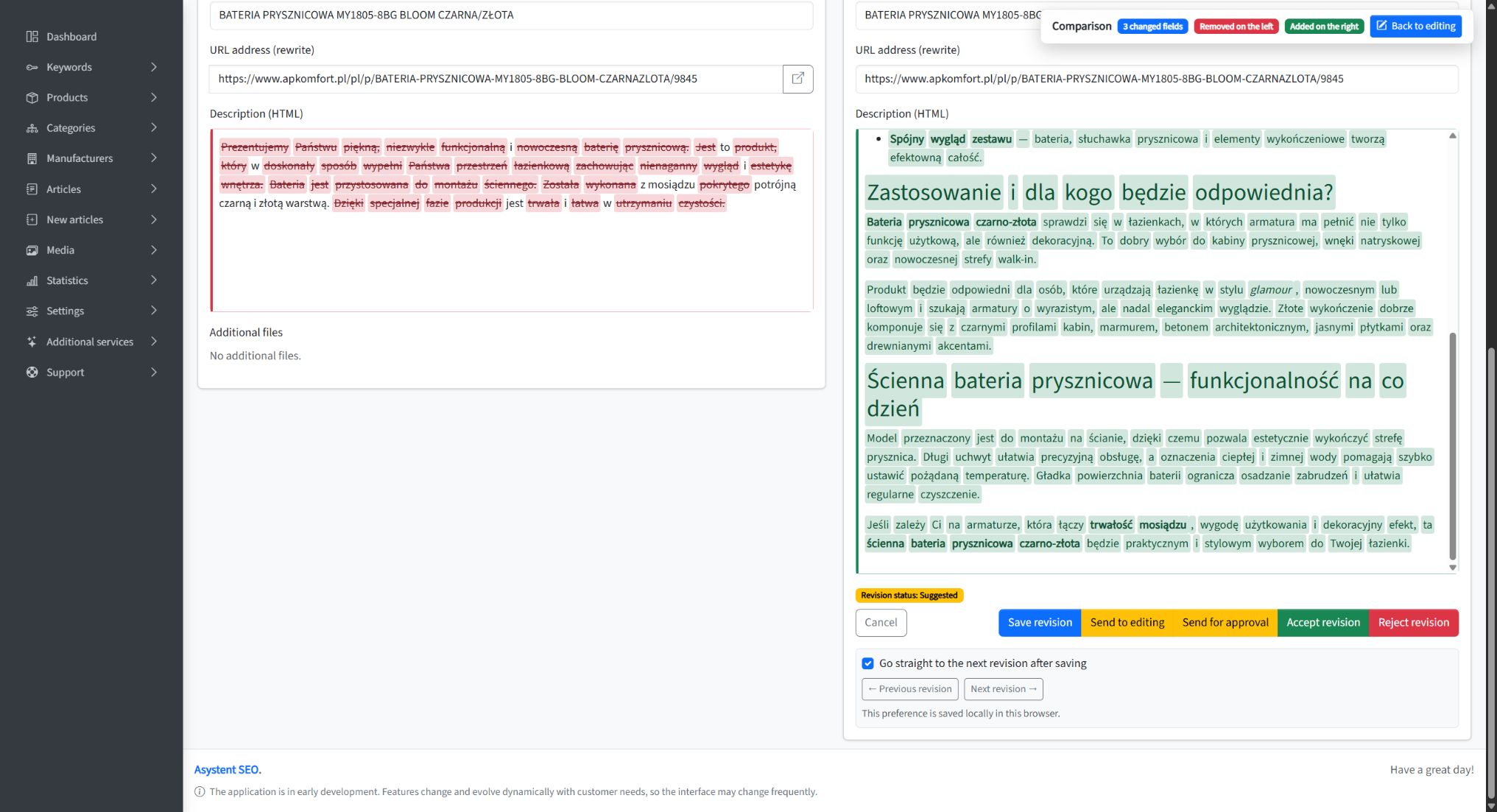
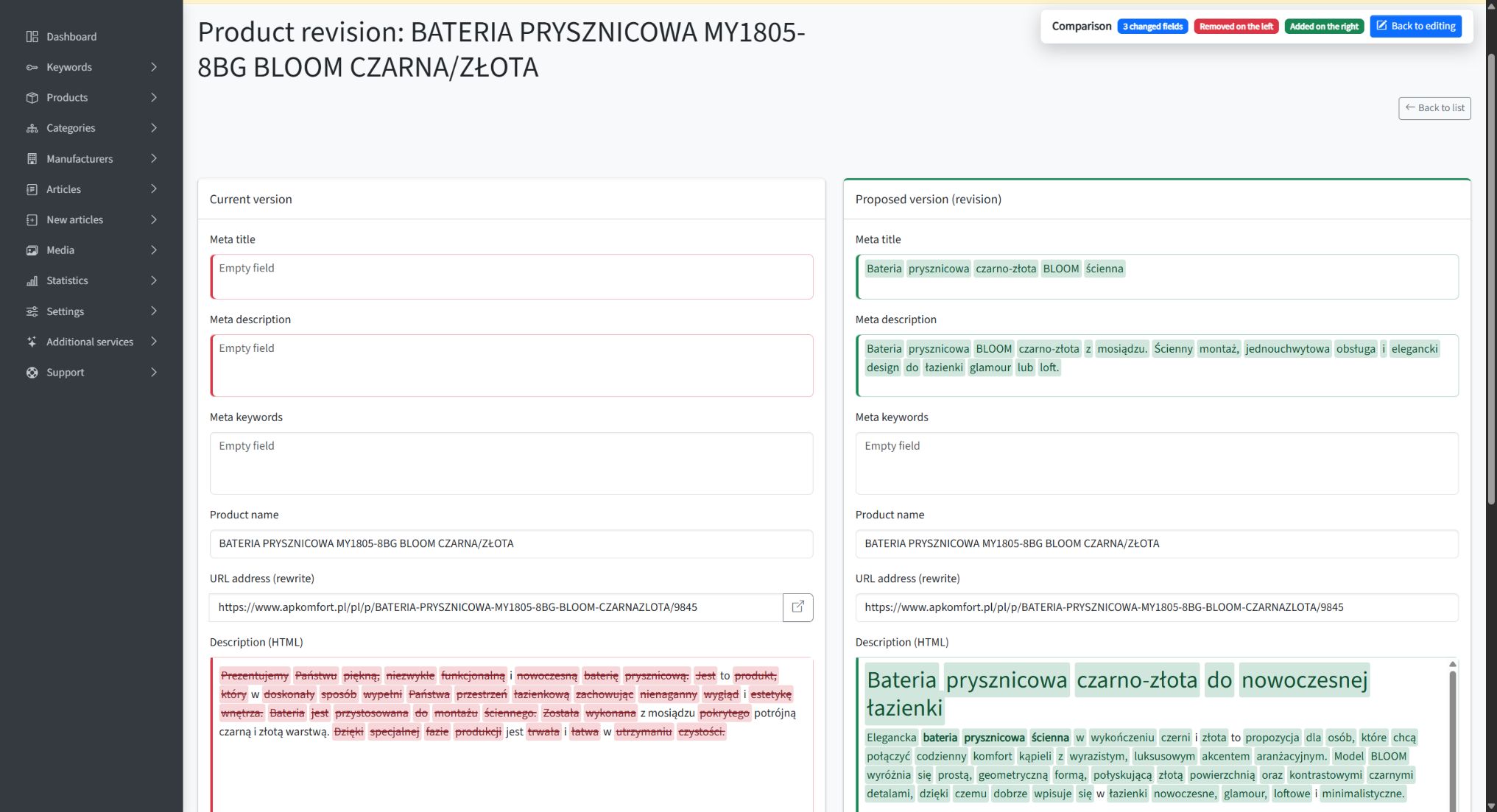
The revision below concerns a black-and-gold BLOOM shower tap available from AP Komfort. SEOAssistant identifies three changed fields:

  • the previously empty meta title receives a focused proposal;
  • the previously empty meta description receives a product-specific summary;
  • the short existing description is replaced with a more structured product description.

The product name and URL remain unchanged. That is visible without opening another system or comparing two browser tabs.

Side-by-side AP Komfort product revision with removed text in red and additions in green

A real AP Komfort product revision in comparison mode. Empty metadata fields are filled on the right, while the existing and proposed descriptions are compared directly.

The comparison is also read-only. Diff highlighting does not become part of the content, and a reviewer can return to editing when a change is required. This separation is important: the comparison layer should support a decision without silently modifying the proposal.

Use a two-pass review instead of rereading everything

A visual diff becomes most useful when the team has a repeatable way to read it. We recommend separating the review into two passes.

Pass 1: verify the scope of the change

Start with structure, not prose.

Check:

  • which fields changed;
  • whether the product name and URL stayed stable;
  • whether new headings or sections were added;
  • whether the proposal removes important source information;
  • whether metadata and on-page content still describe the same item;
  • whether the size of the rewrite is appropriate for the task.

This first pass should reveal unexpected scope. A request to improve a meta description should not quietly rewrite a product specification. A content expansion should not rename a product or change its canonical URL unless that was explicitly intended.

Pass 2: verify the risky claims

Next, review the fragments that can affect trust, conversion or compliance.

For ecommerce content, these usually include:

  • materials and construction;
  • measurements and compatibility;
  • included accessories;
  • installation method;
  • warranties, certifications and standards;
  • availability, delivery or price claims;
  • claims about durability, safety or performance;
  • the intended use of the product.

In the AP Komfort example, the reviewer can see that the proposal retains source facts such as brass construction, a black-and-gold finish and wall installation. The review can therefore focus on whether the newly added benefits and use cases are supported, rather than checking every unchanged word.

This is where human judgment still matters. A diff can show that a claim is new. It cannot prove that the claim is true.

Review the purpose, not only the wording

Good AI content review is not a grammar check.

A text may be fluent and still fail because it:

  • targets the wrong search intent;
  • repeats generic phrases that could describe any product;
  • introduces unsupported claims;
  • overuses a keyword;
  • hides important purchasing information;
  • conflicts with the brand’s preferred terminology;
  • adds length without adding value.

This aligns with Google’s emphasis on helpful, reliable and people-first content. Google explicitly recommends focusing on accuracy, quality and relevance when generative AI is used, including for titles, descriptions, structured data and image alt text. Its scaled-content policy is concerned with pages created primarily to manipulate search visibility without helping users—not with the mere presence of AI in a workflow.

The reviewer should therefore ask: Does this revision make the page more useful to the person considering this product?

That question is more valuable than asking whether the copy “sounds AI-generated.”

Approval states make responsibility visible

Review is not one universal action. A useful workflow needs more than an Accept button.

In SEOAssistant, the reviewer can:

  • save a revision;
  • send it back to editing;
  • send it for approval;
  • accept it;
  • reject it;
  • continue directly to the next revision.
AP Komfort revision with editing, approval, acceptance and rejection actions

The decision layer remains attached to the proposal: edit, escalate, accept, reject or continue to the next revision.

These states separate different responsibilities. A content specialist can improve the proposal without publishing it. A person responsible for the account can approve it. A rejected revision remains a visible decision rather than disappearing into email or chat.

This matters when several people participate in the process—and it becomes essential when automation performs the first draft.

At scale, review must operate as a queue

One well-designed comparison screen solves the single-document problem. It does not yet solve the volume problem.

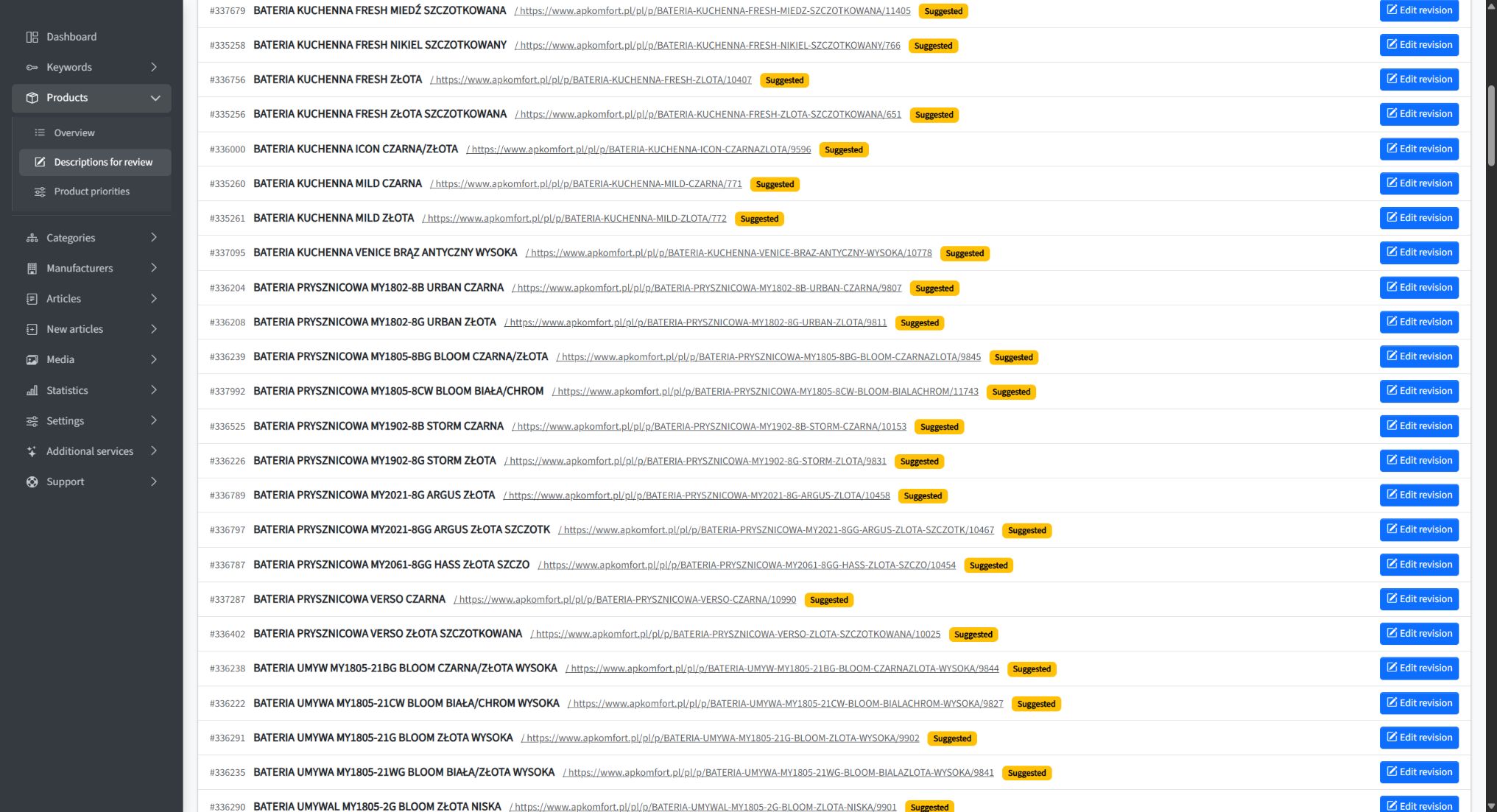
At the time of capture, the AP Komfort workspace contained 222 suggested product revisions waiting in the review queue. Each item had a visible status and a direct route into its revision.

AP Komfort queue containing product revisions ready for review

A review queue turns generated drafts into managed work. Each revision has a visible status and a direct editing path.

A queue adds the operational layer:

  • the team knows how much work is waiting;
  • revisions can be filtered by status;
  • audit modes can support different review perspectives;
  • reviewers can move through items without rebuilding their context;
  • no proposal needs to be tracked in a separate spreadsheet.

The queue also exposes an important planning signal. If suggestions accumulate faster than they are approved, the answer may be better prioritization or more selective generation—not simply generating even more content.

When can the final review become optional?

The long-term goal does not have to be permanent manual approval for every field on every page.

Review can become lighter when a workflow has earned trust. That usually means:

  • source data is structured and reliable;
  • the same content type has produced consistently acceptable revisions;
  • the generation rules and templates are stable;
  • the affected fields are low risk;
  • every change remains traceable;
  • published results are monitored;
  • the team can still sample completed work and intervene when needed.

For example, a business may eventually allow proven metadata updates to publish automatically while continuing to review full descriptions. Another may automatically process low-risk products but require approval for regulated categories or pages containing technical claims.

Full review should usually remain in place when:

  • a new prompt, model, template or data source is introduced;
  • the system starts working with a new content type;
  • the page includes legal, medical, financial or safety-sensitive information;
  • claims depend on facts that are missing from structured data;
  • the brand voice or merchandising strategy is changing;
  • the cost of an incorrect publication is high.

This is controlled autonomy: reduce human intervention where the evidence supports it, while keeping stronger controls where risk remains.

A lightweight operating model for AI SEO review

Teams can implement the process in five stages:

1. Define what the system may change

Specify the eligible page types, fields, source data and prohibited claims before generating revisions.

2. Generate proposals as versioned changes

Keep the current version and the proposal separately. Never overwrite the source page merely because a draft exists.

3. Review through scope and risk

Use the first pass to check what changed and the second pass to validate the facts and business impact.

4. Record the decision

Acceptance, rejection and return-to-editing should remain visible as workflow states rather than informal messages.

5. Earn automation gradually

Use review outcomes to identify repeatable, low-risk actions. Automate those actions selectively and continue sampling their quality.

The goal is fewer blind decisions, not fewer people

AI content automation works best when it reduces repetitive effort without hiding responsibility.

The person reviewing a revision should not need to recreate the draft, manually compare two documents or wonder which version was published. The system should prepare the proposal, expose the exact changes, preserve the current version and make the available decisions explicit.

That is how human review stops being a permanent bottleneck. It becomes a configurable quality-control layer—strong where risk is high, lighter where the process is proven and optional where the customer deliberately chooses automation.

For the broader workflow behind this model, read What “SEO on Autopilot” Actually Means.

Sources