When Is SEO Worth It for Your Business?

If you own a website, you have probably heard that you “need SEO.” That does not necessarily mean SEO should be your next investment.

SEO is valuable when it supports a real business opportunity: people search for what you offer, those visitors can become profitable customers, and your company is prepared to improve the website consistently. If one of these conditions is missing, another marketing activity may deserve priority.

The useful question is therefore not simply:

Can this website rank in Google?

It is:

Is there enough relevant demand, business value and execution capacity to make SEO worth pursuing?

What are you actually investing in when you invest in SEO?

SEO helps search engines understand your website and helps potential customers discover it when they search for relevant information, products or services. Google does not charge websites for appearing in organic search results, but developing that visibility still requires work.

That work may include:

  • researching how customers search;
  • improving service, product and category pages;
  • fixing technical obstacles;
  • creating genuinely useful content;
  • strengthening the structure and internal linking of the website;
  • measuring performance and improving pages over time.

Unlike an advertising campaign, SEO normally leaves you with an improved website. The pages, content, structure and accumulated search data remain part of the business.

This does not make organic traffic “free.” It means the investment goes into building and improving your own digital asset instead of paying separately for every visit.

SEO is worth considering when people already search for what you sell

The clearest opportunity exists when potential customers are already searching for your products, services or the problems you solve.

A bathroom retailer may find searches for specific product types, sizes, materials and brands. An accountant may find searches related to company formation, tax services and local accounting support. A specialist B2B supplier may discover smaller numbers of searches, but each relevant enquiry may carry substantial value.

Demand does not need to consist of one large, obvious keyword. It is often distributed across hundreds or thousands of more specific searches.

That is why the first step should be research rather than writing random articles. Useful inputs include:

  • the queries already visible in Google Search Console;
  • the products and services generating the best customers;
  • questions asked during sales conversations;
  • competitor visibility;
  • estimated search demand;
  • the commercial relevance of each topic.

Search volume alone is not enough. A phrase searched 50 times per month by the right buyers may be more valuable than a broad phrase searched 5,000 times by people who are unlikely to purchase anything.

SEO makes more sense when a conversion has measurable value

Traffic is not the final objective. The website needs to turn at least some of that traffic into enquiries, bookings, purchases or another meaningful business result.

A simple way to begin evaluating the economics is:

Monthly SEO investment ÷ contribution margin from one conversion = additional conversions needed to cover the investment

For example, if a company invests €1,000 per month and earns an average contribution margin of €250 from a new customer, it needs four additional customers to cover that monthly investment.

This is not an SEO forecast. It does not predict rankings or guarantee four customers. It simply shows whether the commercial opportunity is realistic enough to investigate.

The calculation becomes especially useful when combined with current organic traffic, existing conversion rates, average order value, customer lifetime value, profit margin and the size of the available search market.

Businesses with high-value enquiries may justify SEO with relatively few additional conversions. Ecommerce businesses with lower margins may need more transactions, but they can often develop visibility across a much larger set of products and categories.

SEO is a better fit when the offer is already proven

SEO tends to work best when the business already understands what it sells, who buys it and why customers choose it.

A stable offer makes it easier to select commercially relevant searches, create accurate landing pages, answer real customer questions, prioritize valuable products or services and measure whether the resulting traffic supports the business.

If the company is still changing its product, pricing and target customer every few weeks, a faster feedback channel may be more useful initially. Paid advertising, direct outreach or customer research can help validate the proposition before the company commits to a larger organic search programme.

SEO can support a young business, but it should not become a substitute for confirming that customers actually want the offer.

SEO is worth it when you can think beyond the next few days

SEO is usually a poor response to an emergency sales target.

Some changes can influence search performance relatively quickly, particularly when a website already has authority and relevant pages. Other improvements take much longer to be discovered, assessed and reflected in search results.

Google itself explains that the effect of website improvements may become visible within days in some cases, while broader changes can take several months. It also makes clear that no particular result is guaranteed. Google Search Central explains how long improvements may take.

That makes SEO better suited to companies that want to build a source of demand over time.

The value comes from repeated cycles:

  1. Identify an opportunity.
  2. Improve the appropriate page.
  3. Allow search engines and users to respond.
  4. Measure what happened.
  5. Refine the page or move to the next priority.

A single optimization may or may not create a noticeable result. A disciplined process across the right pages can gradually expand the website’s overall search presence.

Your website must be capable of becoming a better answer

SEO cannot create a strong business proposition where none exists.

Before investing heavily, consider whether the website can genuinely become one of the most useful results for the searches being targeted.

That may require:

  • clearer descriptions of products and services;
  • accurate specifications and business information;
  • stronger category pages;
  • original expertise and examples;
  • transparent delivery, pricing or service information;
  • helpful comparisons and buying guidance;
  • a better mobile experience;
  • faster and more intuitive navigation.

Google’s own guidance emphasizes useful, reliable, people-first content rather than pages created primarily to manipulate rankings. The SEO Starter Guide also notes that helping visitors find, understand and evaluate your content is central to SEO.

In practical terms, the page should deserve to be found. Optimization helps connect that page with the right demand; it does not remove the need to provide real value.

SEO becomes particularly valuable as a website grows

The opportunity often increases with the number of meaningful pages a business can develop.

An ecommerce store may have product pages, product categories, manufacturers, buying guides, comparisons and answers to recurring customer questions.

A service business may have separate pages for individual services, industries, customer problems, locations, case studies and specialist questions.

This does not mean every possible page should be created. It means a larger, well-structured offer can provide more legitimate entry points from search.

The difficulty is choosing what to work on first. Creating hundreds of low-value pages is not a strategy. The business needs to connect search demand with its offer, identify gaps and prioritize pages with realistic commercial potential.

When should SEO not be the first priority?

There are several situations in which SEO may still matter eventually, but should not receive the next available marketing budget.

You need customers immediately

If the company needs leads this week, SEO alone is unlikely to be the right response. Paid campaigns, direct sales or communication with an existing audience can generate faster feedback.

SEO may begin in parallel, but it should not be presented as an instant source of revenue.

Nobody is searching for the product yet

A genuinely new category may have little existing search demand. Potential customers cannot search for a solution they do not yet know exists.

The company may first need to create awareness through advertising, partnerships, social media, events or direct outreach. SEO can then capture searches around the problem and support the category as awareness grows.

The offer has not been validated

If visitors arrive but consistently reject the proposition, increasing traffic will not resolve the underlying issue. Pricing, positioning, credibility or the product itself may require attention first.

The website does not convert

A confusing website can waste both organic and paid traffic. Before expanding visibility, the company may need to improve calls to action, navigation, trust signals, forms or checkout, product information and mobile usability.

The opportunity is temporary

A one-off event or extremely short promotion may end before SEO has time to influence visibility. Paid distribution is normally a better fit for a fixed, immediate deadline.

There is no capacity to implement improvements

An audit has little value if nobody can act on it.

SEO requires execution: pages need to be improved, content reviewed, technical issues addressed and results monitored. If every recommendation waits indefinitely, the business is buying analysis rather than progress.

A practical SEO readiness checklist

SEO is likely worth investigating if you can answer “yes” to most of these questions:

  • Do potential customers use Google to find products, services or information connected with the offer?
  • Is the offer already generating satisfied customers?
  • Does a new customer or sale have enough value to justify acquisition costs?
  • Can the website be improved with better information, pages or structure?
  • Can the company wait for results to develop rather than expecting immediate sales?
  • Can someone confirm business facts and approve important changes?
  • Can the organization implement and measure work consistently?

A “no” does not automatically disqualify SEO. It identifies the condition that may need to be resolved first.

How should a business start with SEO?

A sensible first step is not ordering 20 articles or optimizing every page at once. Start by establishing the opportunity.

1. Understand current visibility

Connect Google Search Console and identify which searches already generate impressions, which pages receive clicks, where relevant visibility is changing and which pages appear close to more valuable positions.

Existing search data can reveal opportunities faster than starting with assumptions.

2. Define the relevant search market

Build a set of topics and phrases that match the actual offer. Remove searches that attract the wrong customer, even if their reported volume looks attractive.

3. Match demand with the correct pages

Determine whether each opportunity belongs to an existing service page, a product or category, an article, a new landing page or a page that should not be created at all.

This prevents several pages from competing for the same purpose and reduces unnecessary content production.

4. Prioritize by business impact

Do not simply start with the keyword showing the largest volume. Consider commercial fit, current visibility, competition, page quality and the effort required to create a useful result.

5. Implement, measure and repeat

SEO is not completed when a recommendation is written. The improvement needs to reach the website, remain measurable and become an input into the next decision.

That continuous workflow is what we mean by SEO on autopilot: not uncontrolled publishing, but a process that keeps identifying and completing useful work.

If you are choosing between building organic visibility and buying immediate search traffic, read SEO vs Google Ads: Which Should You Invest In First?.

Where does SEOAssistant PRO fit?

SEOAssistant PRO is designed to reduce the operational gap between discovering an SEO opportunity and implementing it.

The platform analyzes website and search data, helps prioritize relevant work, prepares proposed improvements and keeps changes available for review before publication. Instead of leaving the website owner with another list of recommendations, it helps move the work through a repeatable cycle.

The owner does not need to become an SEO specialist. Their role is to confirm important business facts, define boundaries and decide what is ready to go live. The repetitive analysis and preparation can increasingly be handled by the system.

So, is SEO worth it for your business?

SEO is worth serious consideration when:

  • people search for what you sell;
  • those searches can lead to profitable customers;
  • your offer is proven;
  • your website can provide a genuinely useful answer;
  • you are prepared to build visibility over time;
  • there is a process for implementing improvements.

If those conditions are present, SEO can become more than another marketing expense. It can build a stronger website and a growing source of relevant demand.

If they are not present, the right decision may be to improve the offer, website or acquisition strategy first.

Not sure which situation applies to your company?

Start with a free website analysis and see where the strongest opportunities may be.
How to Automate Ecommerce Category SEO Without Losing Control

Automating category SEO should not mean publishing hundreds of generic descriptions. It should mean making a sequence of SEO decisions faster, more consistent and easier to verify.

Category pages have an unusually important role in ecommerce. They help shoppers browse a product range, connect the site’s navigation with individual products and give search engines context about how the catalogue is organised. Google explains that it uses the relationships created by menus and internal links to understand ecommerce site structure and the relative importance of pages.

That makes category optimisation a good candidate for automation—but also a risky place to automate only the writing.

If a system generates a description before it understands the category, its products and the search intent, it simply produces weak content faster. A useful workflow needs to separate keyword selection, content generation, review, publication and quality control.

This article shows how that staged process works in SEOAssistant, where human approval fits and how the workflow can develop into an increasingly autonomous optimisation cycle.

The examples below come from a live workflow used for AP Komfort, an ecommerce store specialising in kitchen and bathroom equipment. The screens are shared with the client’s permission.

Category SEO is not a copywriting task

A category page is not a miniature blog article.

Its primary job is to help a visitor understand what is available and move towards the right product. The SEO layer should reinforce that job by clarifying the category’s subject, supporting relevant commercial searches and connecting the page with the products and subcategories below it.

Before generating any content, a system therefore needs context such as:

  • the category name and its position in the category tree;
  • the products assigned to the category and its descendants;
  • the existing top and bottom descriptions;
  • the current metadata;
  • the website’s accepted keyword set;
  • any keyword already assigned as the primary target of another page;
  • the minimum catalogue size or other business rules required before optimisation.

This is the first difference between content generation and category SEO automation. The input is not simply a keyword and an instruction to “write 800 words.” The input is a structured view of what the category actually represents.

Step 1: start with an approved keyword pool

SEOAssistant does not begin category optimisation by asking a language model to invent phrases from scratch.

The current workflow starts with keywords that have already been accepted for the website. From that controlled pool, it excludes phrases already used as primary targets and searches for candidates that are semantically close to the category’s context.

That context includes the category path, the existing description and a sample of products from the category and its subcategory tree. The system first retrieves a shortlist of candidates and then asks the model to select:

  • one main keyword;
  • three supporting keywords.

A second evaluation checks the proposed set and records a score, a short explanation and possible alternatives. The result is saved as a proposal, not applied directly to the category.

This distinction matters. Semantic similarity can identify plausible phrases, but it does not know every merchandising decision, margin priority or naming convention used by the business. The system narrows the decision. A person can still verify whether the category is the right destination for that search intent.

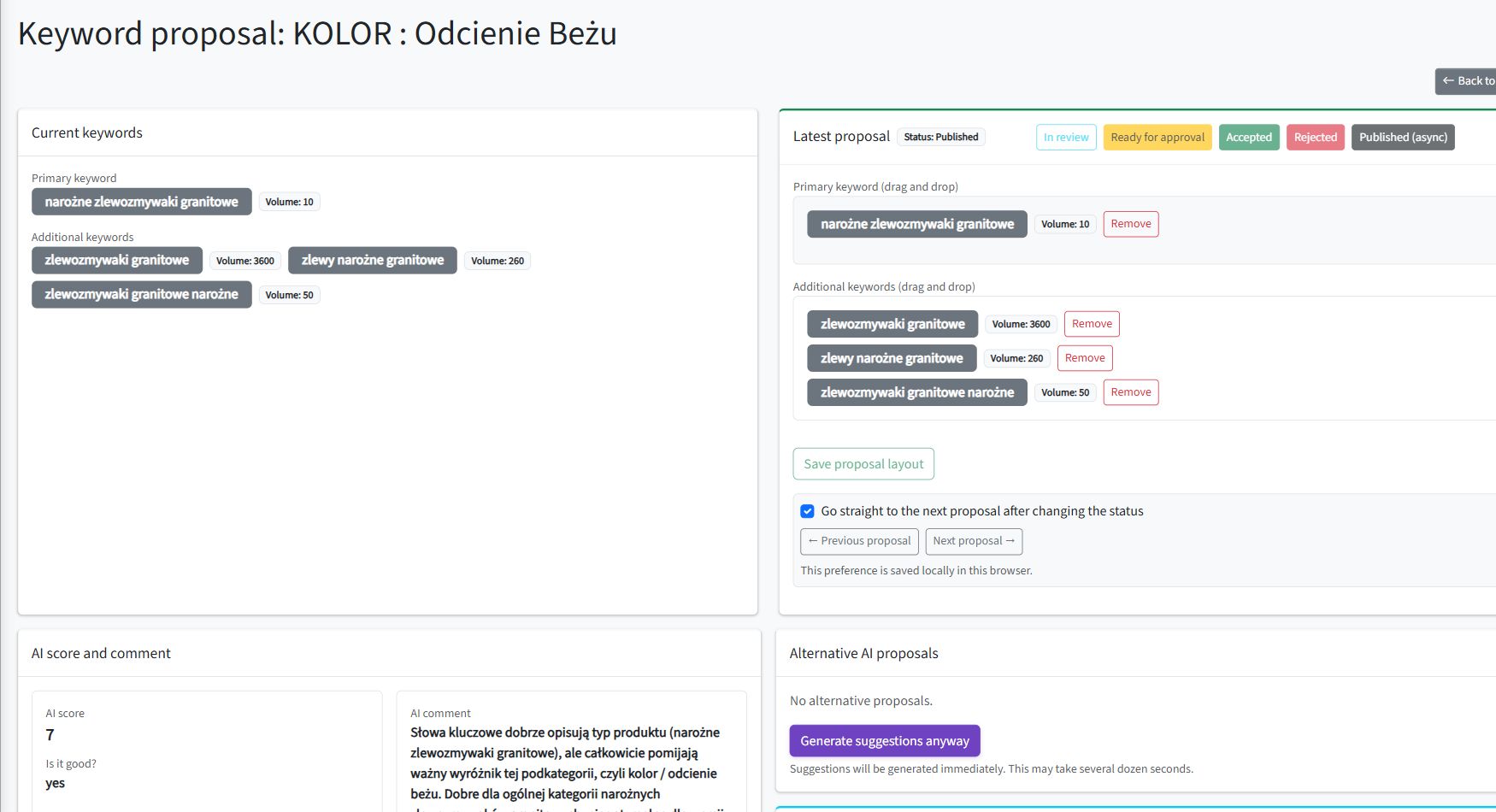
A category keyword proposal in SEOAssistant with the primary keyword, supporting phrases, search volumes, workflow status and AI evaluation

A live category keyword proposal for AP Komfort. The reviewer can see the current assignment, search volumes, workflow status and the model’s explanation in one place.

Step 2: review the keyword decision before generating content

Keyword selection deserves its own review stage because a wrong primary keyword affects every step that follows.

In the category keyword proposal view, the reviewer can compare the category’s current assignments with the proposed set. The interface exposes the main and supporting roles, available search-volume data, the model’s evaluation and any suggested alternatives.

The reviewer can:

  • replace the main keyword;
  • add or remove supporting phrases;
  • search the website’s keyword database;
  • add a new candidate when necessary;
  • send the proposal for review or approval;
  • accept or reject it;
  • continue to the next proposal in the queue.

Once accepted, the proposal is applied to the category and becomes the input for later analysis and content generation.

The benefit is not that AI makes the final decision. The benefit is that it reduces a large keyword database to a small, explainable choice that can be reviewed in context.

Step 3: generate a versioned category revision

After the category has enough context, SEOAssistant can prepare a content revision.

The generation process can use the category tree, products from the category and its descendants, producer information, the selected keywords, existing descriptions and website-level content instructions. It prepares separate fields for:

  • the short or top description;
  • the longer bottom description;
  • the SEO title;
  • the meta description.

Most importantly, the generated content is stored as a revision. It does not silently overwrite the live category.

That gives the workflow a clear baseline and proposal:

Current category → proposed revision → review decision → platform update

The automation settings can also limit which categories enter the process. For example, the system may focus on categories that have an assigned keyword, lack a description, do not contain an H2 heading or exceed a configured product threshold.

This is a more useful definition of automation than “generate content for every category.” Eligibility rules determine where the work is needed before the model is asked to write anything.

Step 4: review the actual change, not two complete documents

The category revision uses the same principle as the product workflow described in How to Review AI-Generated SEO Content Without Reading Everything Twice.

The reviewer should be able to see:

  • which fields changed;
  • what text was removed;
  • what was added;
  • whether the category name and URL remained outside the change;
  • whether metadata and on-page content still describe the same catalogue section.

A visual diff makes the decision faster because attention is directed to the intervention rather than the entire page. The reviewer can edit the proposal, send it for approval, accept it or reject it.

Only an accepted revision is sent to the connected ecommerce platform. After a successful update, the revision receives a published status and remains available as a record of what happened.

Step 5: audit structure and meaning separately

Publishing a syntactically correct description does not prove that the page is useful. SEOAssistant therefore separates two kinds of quality checks.

Structural SEO audit

The rule-based audit checks signals that can be measured directly, including:

  • whether the top and bottom descriptions are empty or too short;
  • whether headings, lists and internal links are present;
  • whether the selected keywords occur in relevant headings;
  • how many products are connected with the category;
  • whether links or images in the content appear invalid.

These checks are deterministic. They are useful for finding missing elements and enforcing consistent minimum standards across a large catalogue.

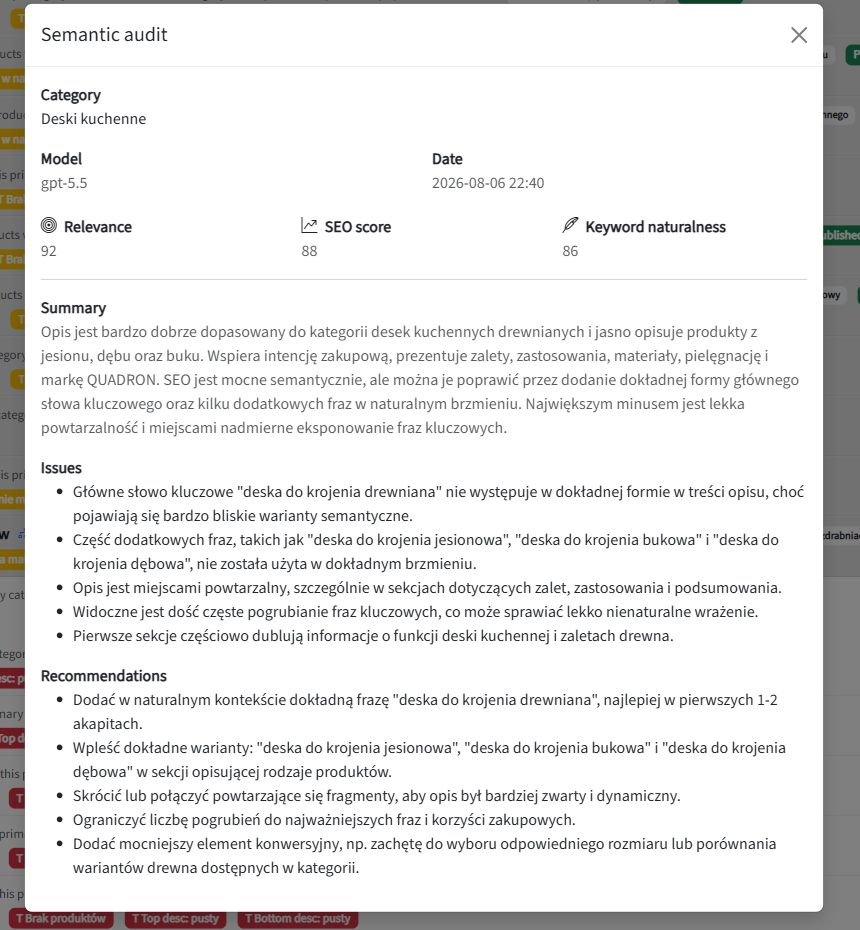
Semantic audit

The semantic audit asks a different set of questions:

  • Is the description genuinely about this category?
  • How relevant is it to the selected keywords?
  • Does it support SEO without forcing the phrases unnaturally?
  • Does it contain useful commercial or purchasing context?
  • What problems and recommendations should a reviewer see?

The result includes relevance, SEO and keyword-naturalness scores together with a summary, issues and recommendations. These signals appear in the category list and can be opened as a more detailed audit view.

The two layers complement each other. A page can contain an H2, a list and enough characters while still being generic. It can also be semantically relevant while missing basic structure or containing a broken internal link.

A semantic category audit in SEOAssistant showing relevance, SEO and keyword-naturalness scores, issues and recommendations

The semantic audit turns a broad quality judgment into a reviewable result: three scores, a summary, detected issues and concrete recommendations for the next revision.

From a staged workflow to an improving cycle

The category workflow connects the main operational stages:

  1. find a category that meets the automation rules;
  2. propose suitable keywords;
  3. review and apply the keyword assignment;
  4. create a versioned content proposal;
  5. review and publish the revision;
  6. run structural and semantic quality checks.

These stages are not intended to form a one-off project. Category SEO works best as a cycle that returns to the page after publication and asks what should happen next.

The next analysis may be triggered by a schedule, a material catalogue change, new Search Console data or a change in the quality rules used by the website. A recurring loop can then:

  • run a fresh structural and semantic audit after publication;
  • repeat the analysis after an appropriate interval or a material catalogue change;
  • compare the new result with the previous one;
  • combine content quality with Search Console performance;
  • decide whether the page needs another revision or can remain unchanged;
  • create that revision without overwriting the live version;
  • keep the next publication subject to the website’s chosen approval policy.
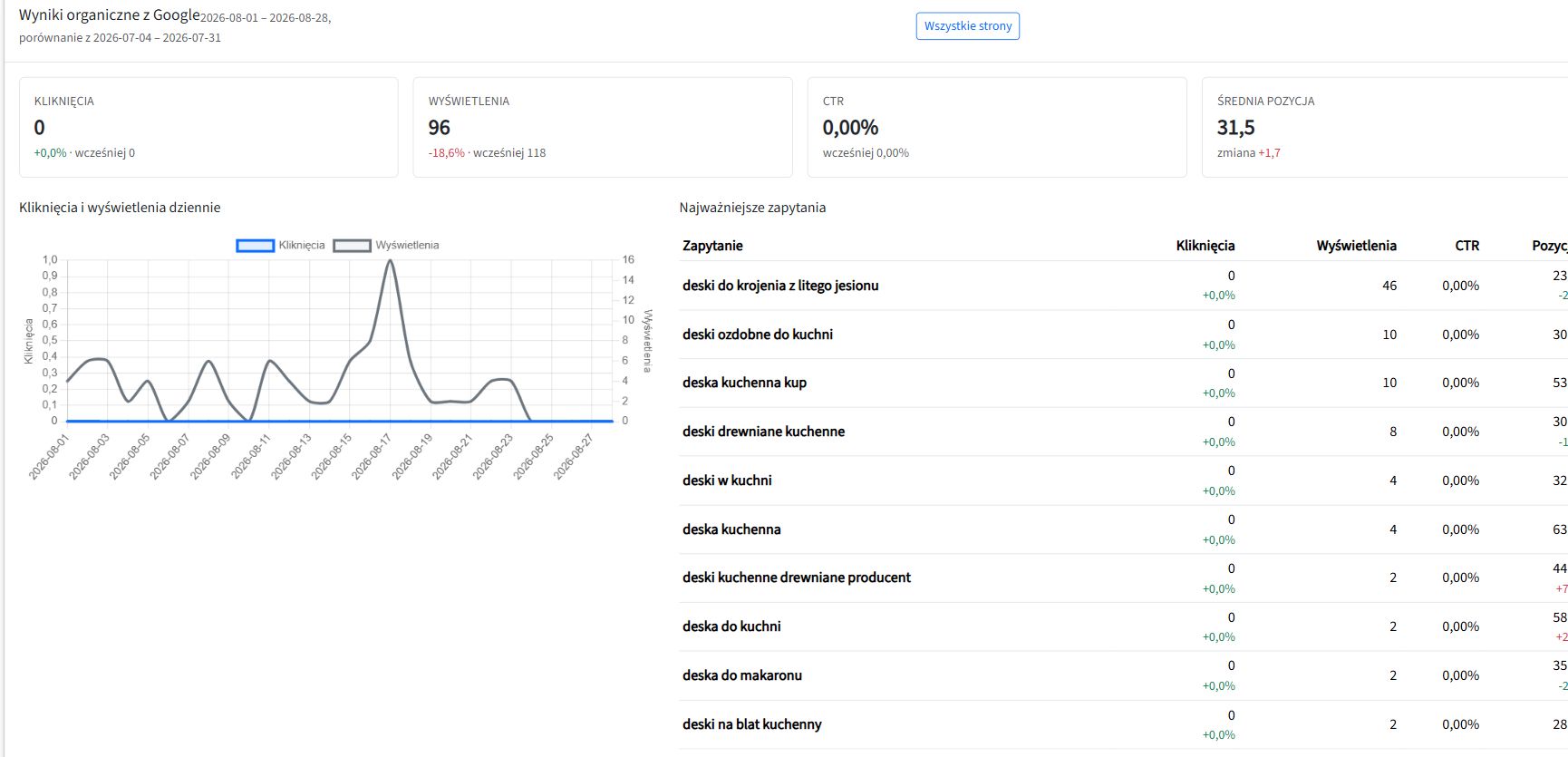
Google Search Console data inside an SEOAssistant category view, including impressions, average position and the most important search queries

Search Console data adds another feedback signal. Query-level impressions and positions help the next analysis respond to how the category is actually appearing in search—not only to what its description contains.

This orchestration matters because neither category pages nor the environment around them remain static. Products are added or removed, terminology changes, internal links break, search demand moves and a previously good description can become incomplete.

The cycle can also absorb future improvements without requiring the entire process to be redesigned. New ranking signals, better keyword-selection logic, updated content requirements, changes in search behaviour and improvements to the models can all influence the next analysis and the next proposal.

Because each change remains versioned, the system does not have to treat any description as final. It can analyse the current state again, apply the latest rules and prepare the next justified improvement. SEOAssistant is being developed around this model: the workflow becomes more connected over time, while the website keeps control over which decisions require human approval.

The target model: controlled autonomy

The goal is not necessarily to keep manual approval forever.

A mature workflow can reduce review when the category type, generation rules and source data have produced consistently reliable results. For example, a website might allow low-risk metadata improvements to publish automatically while continuing to review long category descriptions.

The decision should depend on evidence and risk:

  • Is the source catalogue reliable?
  • Are the selected keywords already approved?
  • Has this content template produced acceptable revisions before?
  • Does the category contain regulated, technical or safety-sensitive products?
  • Can every published change be traced and reversed?
  • Will the page be analysed again after publication?

This is controlled autonomy: automation performs more of the repeatable work, while the business chooses where human approval remains mandatory.

A practical category SEO operating model

Teams can use the same structure to build an optimisation cycle that becomes more capable over time.

1. Define eligible categories

Exclude empty, inactive or strategically irrelevant categories. Decide whether a minimum number of products is required.

2. Maintain an accepted keyword pool

Research and approve the phrases that are genuinely relevant to the website. Treat automated matching as assignment, not unrestricted keyword invention.

3. Review keyword proposals separately

Confirm the search intent and prevent two pages from targeting the same primary topic before generating content.

4. Generate versioned changes

Keep the live category and the proposal separate. Include metadata and both visible description areas in the same revision.

5. Review through a diff

Focus on changed fields and risky claims. Preserve an explicit accept, reject and return-to-editing workflow.

6. Audit structure and semantics

Use deterministic checks for measurable elements and semantic evaluation for relevance, usefulness and natural language.

7. Schedule reanalysis

Define when the page should be checked again: after publication, after a catalogue update, after a fixed interval or when search performance changes materially.

Automation should reduce uncertainty, not hide it

The most useful category SEO system is not the one that produces the largest number of descriptions. It is the one that makes every important decision visible:

  • why this category was selected;
  • why these keywords were proposed;
  • what content changed;
  • who approved it;
  • what was published;
  • whether the result still meets the quality standard.

SEOAssistant brings these stages into one reviewable workflow and continues to develop the connections between post-publication analysis, prioritisation and revision generation. This allows category optimisation to follow changes in the catalogue, search behaviour, algorithms and content standards instead of remaining a one-off exercise.

That is the difference between automated writing and SEO automation: writing creates a document; automation manages the decision before it, the change itself and the quality checks that follow.

For the broader operating model, read What “SEO on Autopilot” Actually Means.

Sources

How to Review AI-Generated SEO Content Without Reading Everything Twice

AI has made drafting content faster. It has not automatically made approving content easier.

When a system can prepare hundreds of product descriptions, metadata updates or category revisions, the bottleneck moves. The question is no longer only, “How do we create this content?” It becomes, “How do we decide whether this specific change is accurate, useful and safe to publish?”

That distinction matters. Google’s current guidance does not treat the use of generative AI as an automatic problem. It asks website owners to focus on the accuracy, quality and relevance of automatically generated content. At the same time, Google’s spam policies warn against producing large volumes of unoriginal pages that add little value, regardless of whether they were created by AI, people or both.

The practical conclusion is simple: automation needs a quality-control system, not just a text generator.

The bottleneck moved from writing to deciding

Imagine an ecommerce team with 200 product revisions waiting for review.

If each reviewer has to open the existing page, read it from the beginning, open the proposed version, read that from the beginning and mentally compare both, the workflow does not scale. AI may have saved time during drafting, but the team pays much of it back during approval.

This is a common failure mode in AI content projects:

  1. generation becomes fast;
  2. the number of drafts increases;
  3. review remains document-based and manual;
  4. the approval queue grows;
  5. changes become stale before they reach the website.

The solution is not to remove review immediately. It is to redesign review around decisions rather than documents.

What should an SEO review screen answer?

A useful review interface should help a person answer four questions quickly:

  1. What changed? Which fields and fragments are different?
  2. What stayed unchanged? Were the product identity, URL and source facts preserved?
  3. Is the proposal credible? Does it match the product, business and search intent?
  4. What happens next? Can the reviewer accept, reject, edit or escalate the revision without leaving the workflow?

This is why a side-by-side comparison and a visual diff are operational features rather than cosmetic ones.

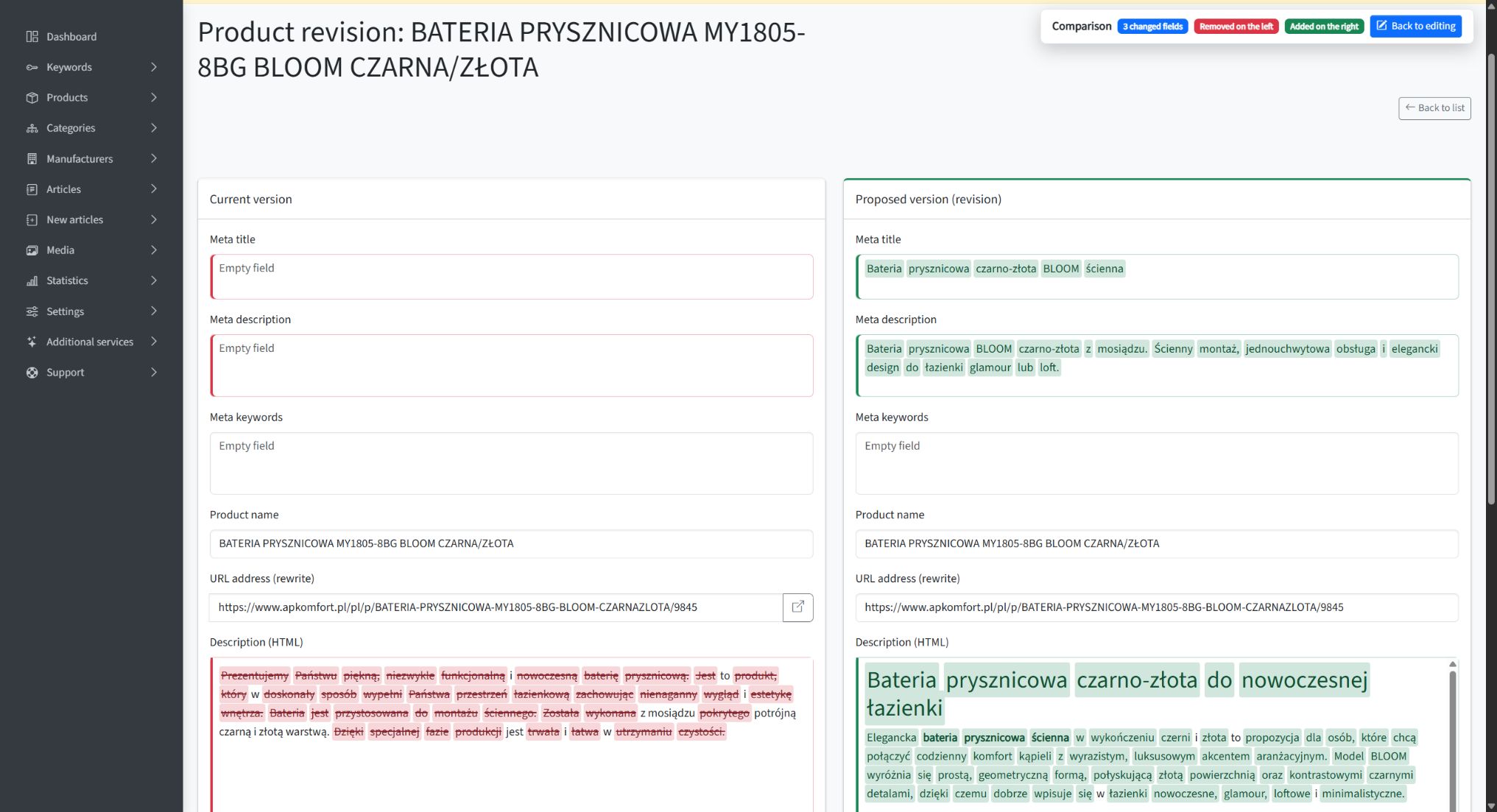
The current version provides the baseline. The proposed version shows the intended outcome. Red highlighting identifies removals, green highlighting identifies additions, and unchanged fragments remain visually neutral. The reviewer can focus attention on the actual intervention instead of rediscovering the entire page.

A real product revision from AP Komfort

AP Komfort is a Polish ecommerce store specializing in kitchen and bathroom equipment. Its SEOAssistant workspace provides a useful example because the review process is being applied to real product data at meaningful scale.

The revision below concerns a black-and-gold BLOOM shower tap available from AP Komfort. SEOAssistant identifies three changed fields:

  • the previously empty meta title receives a focused proposal;
  • the previously empty meta description receives a product-specific summary;
  • the short existing description is replaced with a more structured product description.

The product name and URL remain unchanged. That is visible without opening another system or comparing two browser tabs.

Side-by-side AP Komfort product revision with removed text in red and additions in green

A real AP Komfort product revision in comparison mode. Empty metadata fields are filled on the right, while the existing and proposed descriptions are compared directly.

The comparison is also read-only. Diff highlighting does not become part of the content, and a reviewer can return to editing when a change is required. This separation is important: the comparison layer should support a decision without silently modifying the proposal.

Use a two-pass review instead of rereading everything

A visual diff becomes most useful when the team has a repeatable way to read it. We recommend separating the review into two passes.

Pass 1: verify the scope of the change

Start with structure, not prose.

Check:

  • which fields changed;
  • whether the product name and URL stayed stable;
  • whether new headings or sections were added;
  • whether the proposal removes important source information;
  • whether metadata and on-page content still describe the same item;
  • whether the size of the rewrite is appropriate for the task.

This first pass should reveal unexpected scope. A request to improve a meta description should not quietly rewrite a product specification. A content expansion should not rename a product or change its canonical URL unless that was explicitly intended.

Pass 2: verify the risky claims

Next, review the fragments that can affect trust, conversion or compliance.

For ecommerce content, these usually include:

  • materials and construction;
  • measurements and compatibility;
  • included accessories;
  • installation method;
  • warranties, certifications and standards;
  • availability, delivery or price claims;
  • claims about durability, safety or performance;
  • the intended use of the product.

In the AP Komfort example, the reviewer can see that the proposal retains source facts such as brass construction, a black-and-gold finish and wall installation. The review can therefore focus on whether the newly added benefits and use cases are supported, rather than checking every unchanged word.

This is where human judgment still matters. A diff can show that a claim is new. It cannot prove that the claim is true.

Review the purpose, not only the wording

Good AI content review is not a grammar check.

A text may be fluent and still fail because it:

  • targets the wrong search intent;
  • repeats generic phrases that could describe any product;
  • introduces unsupported claims;
  • overuses a keyword;
  • hides important purchasing information;
  • conflicts with the brand’s preferred terminology;
  • adds length without adding value.

This aligns with Google’s emphasis on helpful, reliable and people-first content. Google explicitly recommends focusing on accuracy, quality and relevance when generative AI is used, including for titles, descriptions, structured data and image alt text. Its scaled-content policy is concerned with pages created primarily to manipulate search visibility without helping users—not with the mere presence of AI in a workflow.

The reviewer should therefore ask: Does this revision make the page more useful to the person considering this product?

That question is more valuable than asking whether the copy “sounds AI-generated.”

Approval states make responsibility visible

Review is not one universal action. A useful workflow needs more than an Accept button.

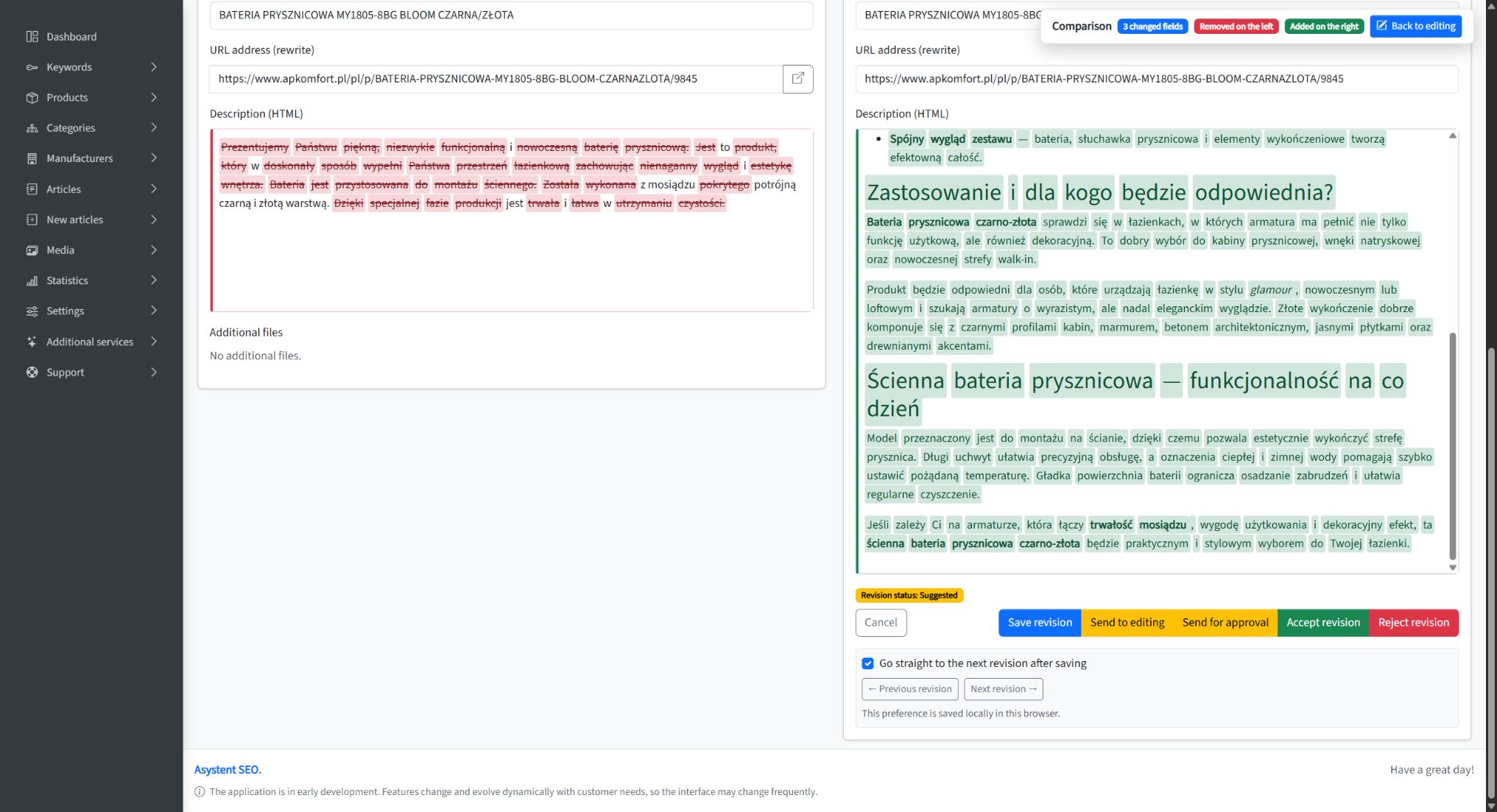
In SEOAssistant, the reviewer can:

  • save a revision;
  • send it back to editing;
  • send it for approval;
  • accept it;
  • reject it;
  • continue directly to the next revision.
AP Komfort revision with editing, approval, acceptance and rejection actions

The decision layer remains attached to the proposal: edit, escalate, accept, reject or continue to the next revision.

These states separate different responsibilities. A content specialist can improve the proposal without publishing it. A person responsible for the account can approve it. A rejected revision remains a visible decision rather than disappearing into email or chat.

This matters when several people participate in the process—and it becomes essential when automation performs the first draft.

At scale, review must operate as a queue

One well-designed comparison screen solves the single-document problem. It does not yet solve the volume problem.

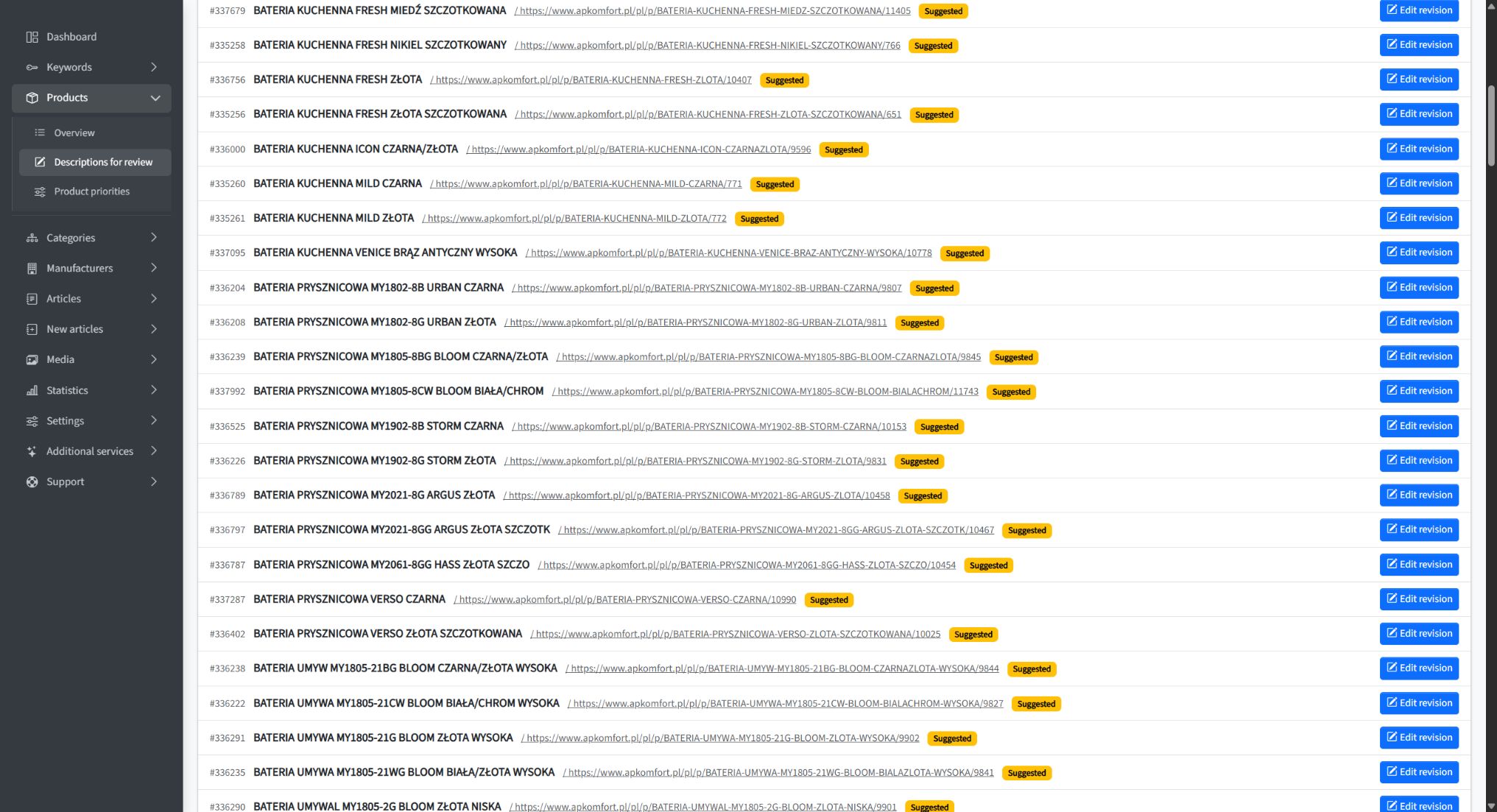
At the time of capture, the AP Komfort workspace contained 222 suggested product revisions waiting in the review queue. Each item had a visible status and a direct route into its revision.

AP Komfort queue containing product revisions ready for review

A review queue turns generated drafts into managed work. Each revision has a visible status and a direct editing path.

A queue adds the operational layer:

  • the team knows how much work is waiting;
  • revisions can be filtered by status;
  • audit modes can support different review perspectives;
  • reviewers can move through items without rebuilding their context;
  • no proposal needs to be tracked in a separate spreadsheet.

The queue also exposes an important planning signal. If suggestions accumulate faster than they are approved, the answer may be better prioritization or more selective generation—not simply generating even more content.

When can the final review become optional?

The long-term goal does not have to be permanent manual approval for every field on every page.

Review can become lighter when a workflow has earned trust. That usually means:

  • source data is structured and reliable;
  • the same content type has produced consistently acceptable revisions;
  • the generation rules and templates are stable;
  • the affected fields are low risk;
  • every change remains traceable;
  • published results are monitored;
  • the team can still sample completed work and intervene when needed.

For example, a business may eventually allow proven metadata updates to publish automatically while continuing to review full descriptions. Another may automatically process low-risk products but require approval for regulated categories or pages containing technical claims.

Full review should usually remain in place when:

  • a new prompt, model, template or data source is introduced;
  • the system starts working with a new content type;
  • the page includes legal, medical, financial or safety-sensitive information;
  • claims depend on facts that are missing from structured data;
  • the brand voice or merchandising strategy is changing;
  • the cost of an incorrect publication is high.

This is controlled autonomy: reduce human intervention where the evidence supports it, while keeping stronger controls where risk remains.

A lightweight operating model for AI SEO review

Teams can implement the process in five stages:

1. Define what the system may change

Specify the eligible page types, fields, source data and prohibited claims before generating revisions.

2. Generate proposals as versioned changes

Keep the current version and the proposal separately. Never overwrite the source page merely because a draft exists.

3. Review through scope and risk

Use the first pass to check what changed and the second pass to validate the facts and business impact.

4. Record the decision

Acceptance, rejection and return-to-editing should remain visible as workflow states rather than informal messages.

5. Earn automation gradually

Use review outcomes to identify repeatable, low-risk actions. Automate those actions selectively and continue sampling their quality.

The goal is fewer blind decisions, not fewer people

AI content automation works best when it reduces repetitive effort without hiding responsibility.

The person reviewing a revision should not need to recreate the draft, manually compare two documents or wonder which version was published. The system should prepare the proposal, expose the exact changes, preserve the current version and make the available decisions explicit.

That is how human review stops being a permanent bottleneck. It becomes a configurable quality-control layer—strong where risk is high, lighter where the process is proven and optional where the customer deliberately chooses automation.

For the broader workflow behind this model, read What “SEO on Autopilot” Actually Means.

Sources

What “SEO on Autopilot” Actually Means

“SEO on autopilot” should not mean pressing one button and hoping that AI-generated text produces rankings. A useful SEO autopilot is a controlled operating system: it finds opportunities, chooses the right pages, prepares changes, shows exactly what will be modified and moves approved work towards publication.

That is the direction behind SEOAssistant. The platform is designed to automate as much repetitive SEO execution as possible while keeping the level of human control appropriate for each customer.

SEO autopilot is a workflow, not a content generator

Most SEO tools stop after analysis. They identify missing keywords, thin pages or ranking gaps and leave someone with another spreadsheet of tasks. Generic AI writing tools start at the opposite end: they generate copy, but often without knowing which page should be changed, why the change matters or what should happen next.

A real SEO automation loop connects the whole process:

  1. build a relevant keyword market;
  2. decide which opportunities fit the business;
  3. connect each opportunity with the right product, category or article;
  4. prepare the proposed optimization;
  5. show the difference between the current and proposed version;
  6. publish approved changes and keep their history;
  7. measure the result and start the next cycle.

Without this loop, “automation” usually means producing more drafts. With it, automation means consistently completing more of the right SEO work.

Step 1: build the market you actually want to compete in

A real example comes from AP Komfort, a Polish online store specializing in kitchen and bathroom equipment.

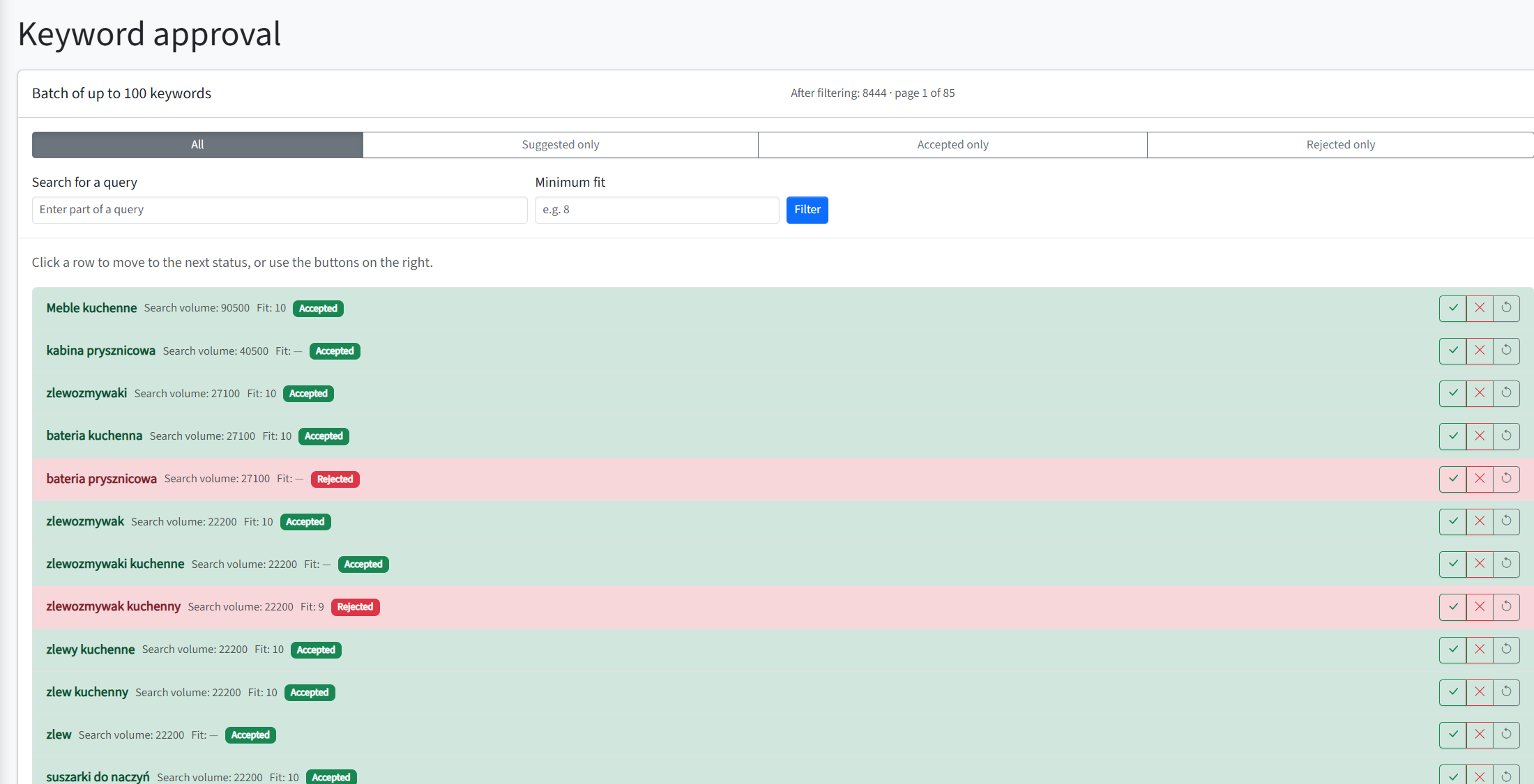
SEOAssistant builds a market of candidate search queries and presents each phrase together with signals such as search demand, business fit and its current approval status. The aim is not to accept every popular phrase. It is to teach the workflow which searches genuinely match the store’s products and commercial direction.

AP Komfort keyword approval screen showing search volume, business fit and accepted or rejected phrases
A real keyword market built for AP Komfort. Phrases can be accepted or rejected based on demand and their fit with the store’s offer.

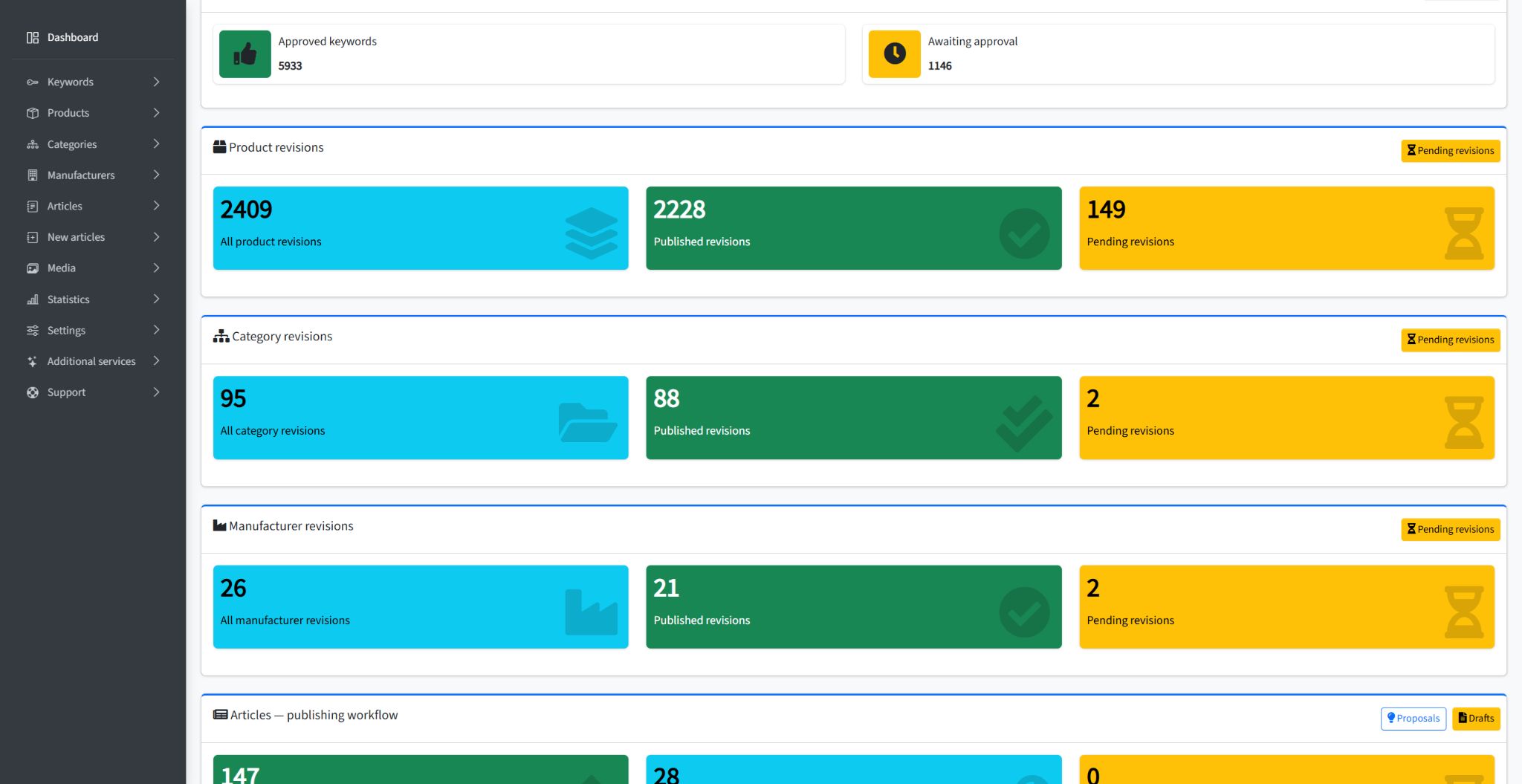
At the time of capture, the AP Komfort workspace contained 5,933 approved keywords and another 1,146 awaiting a decision. That accepted direction becomes the input for the next stages of the system.

Step 2: turn priorities into a repeatable production queue

Once the keyword scope is defined, SEOAssistant can connect demand with existing products, categories, manufacturers and editorial opportunities. It then prepares work according to the website’s data, templates and content rules.

For AP Komfort, this workflow had already produced 2,409 product revisions at the time of capture, including 2,228 published changes. It also included 88 published category revisions and 21 published manufacturer revisions.

SEOAssistant dashboard for AP Komfort showing approved keywords and published product, category and manufacturer revisions
SEOAssistant tracks the full optimization workflow — from keyword decisions to published revisions.

These numbers matter because they show the difference between an isolated AI prompt and an operating process. A prompt can generate one description. A process can coordinate thousands of decisions and revisions while preserving their status and history.

Step 3: prepare changes from real business inputs

SEO content should not begin with an empty text box. A useful proposal can draw on the existing page, product data, selected keywords, category context, templates, internal-linking rules and customer-specific instructions.

Depending on the page and opportunity, the resulting revision can cover metadata, product or category copy, article content and related on-site improvements. The goal is not to replace facts with plausible-sounding language. It is to use the available facts to prepare a stronger version that remains open to verification.

Step 4: make review fast enough to work at scale

Human approval only helps if reviewing a change takes less effort than recreating it. That is why SEOAssistant keeps the current and proposed versions side by side and provides a visual diff.

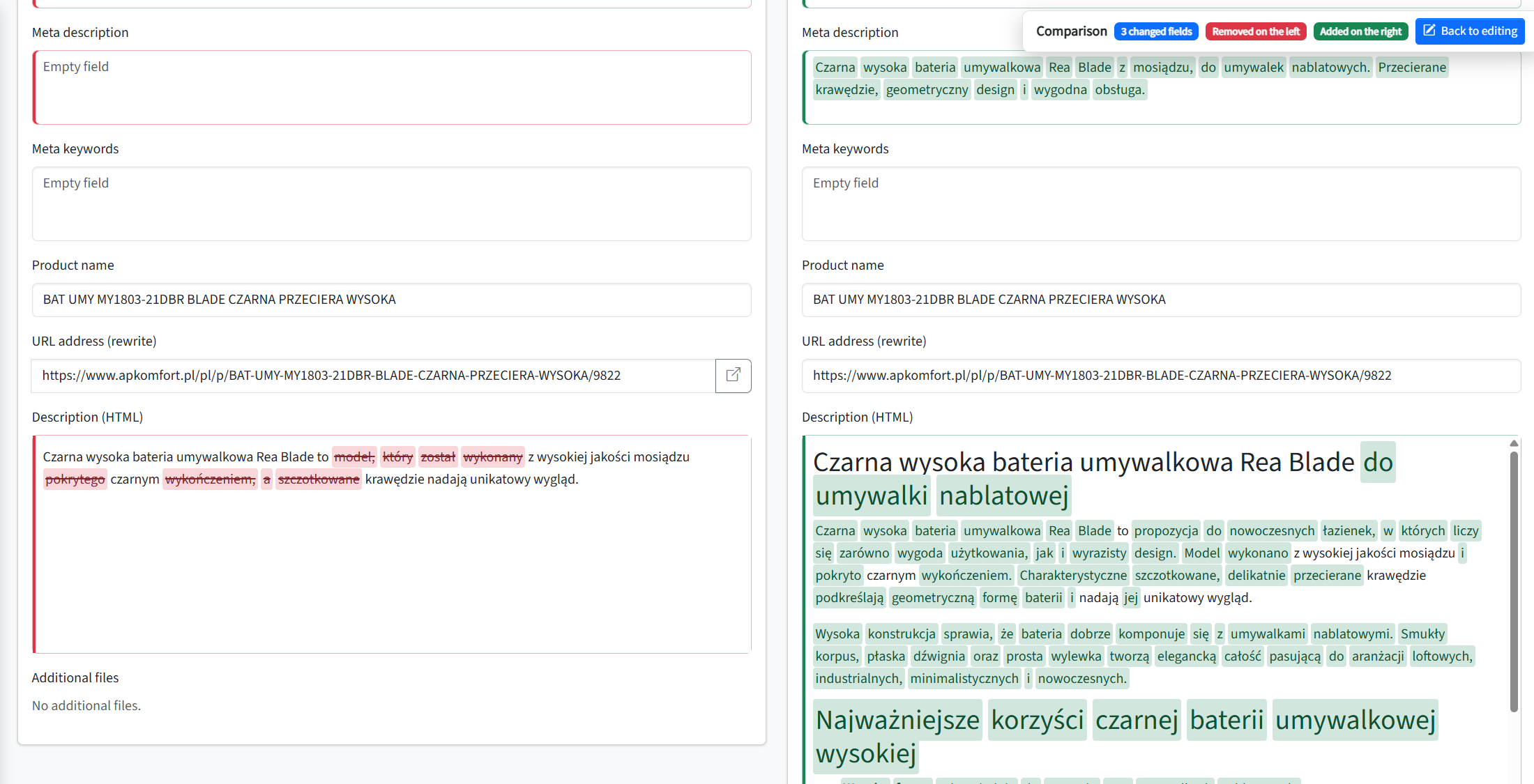
The example below is a real AP Komfort product revision awaiting approval. Removed fragments are marked in red and proposed additions in green, so a reviewer can immediately see what will change. The revision relates to a Rea Blade countertop basin tap available from AP Komfort.

Side-by-side AP Komfort product revision showing removed content in red and proposed additions in green
A real AP Komfort product revision awaiting approval. Removed content is highlighted in red and proposed additions in green.

The reviewer can accept the proposal, edit it, reject it or return it for another revision. This keeps factual responsibility visible without forcing the team to compare long documents manually.

Human review can be a setting, not a permanent bottleneck

Different organizations need different levels of control. A new customer may want every change reviewed. Another may only require approval for high-risk pages, while allowing proven types of metadata or content updates to move forward automatically.

SEOAssistant is moving towards this controlled-autonomy model: the workflow remains traceable, but the final review stage can become optional where the customer requests it and the process has been appropriately configured. The objective is not blind publishing. It is to automate each repeatable decision once the business is comfortable with the rules and quality level.

What happened after the workflow was introduced?

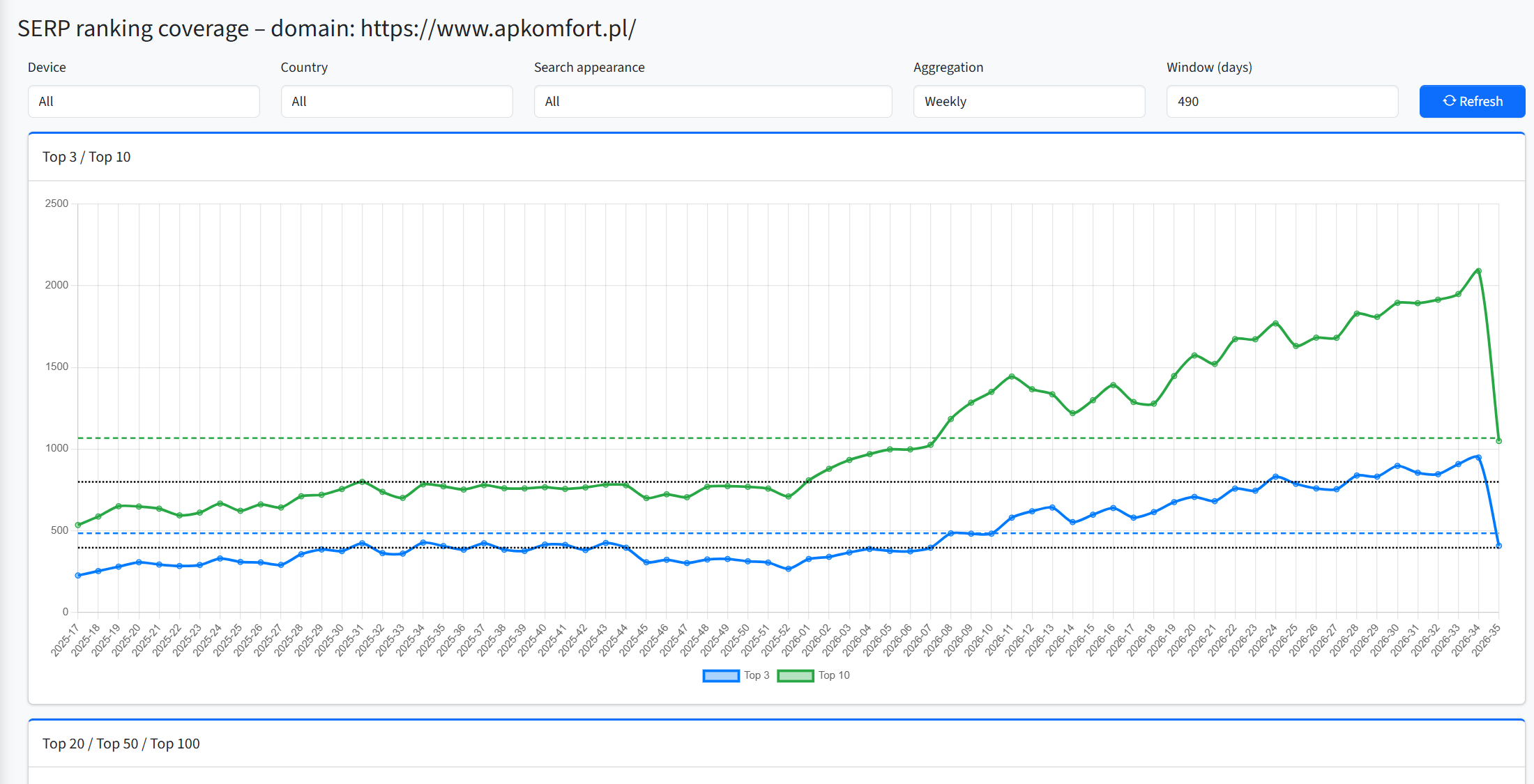
AP Komfort started working with SEOAssistant in December 2025. Since then, the store’s search visibility has followed a clear upward trend.

Comparing the December 2025 weekly average with the latest complete week shown on the chart:

  • the number of keywords ranking in Google’s Top 10 increased from approximately 753 to 2,090 — an increase of around 178%;
  • the number of keywords ranking in the Top 3 increased from approximately 303 to 948 — an increase of around 213%.
Weekly AP Komfort ranking coverage chart showing growth in keywords ranking in Google Top 3 and Top 10
AP Komfort’s weekly ranking coverage. The cooperation started in December 2025. The final point represents an incomplete current week and is excluded from the comparison.

This does not mean that one description or one metadata change produced the result. SEO growth is influenced by many factors. What the chart does show is that a sustained, increasingly automated operating process coincided with substantial growth across both Top 10 and Top 3 coverage. The final point represents the current incomplete week and is not included in the calculation.

For more context about the store and the earlier stages of the project, see the full AP Komfort SEO case study.

So what does “SEO on autopilot” actually mean?

It does not mean removing strategy, business knowledge or accountability from SEO. It means reducing the manual work required to turn those inputs into consistent execution.

The system should automate

  • collecting and organizing search opportunities;
  • matching keywords with relevant pages;
  • prioritizing repeatable SEO work;
  • preparing grounded revisions;
  • showing differences and tracking decisions;
  • coordinating approved publication;
  • measuring progress and restarting the cycle.

People should remain responsible for

  • business priorities and boundaries;
  • facts the source data cannot verify;
  • brand and legal requirements;
  • deciding which workflows still require approval;
  • changing the rules when the business changes.

The result is not SEO without people. It is an SEO operation in which people spend less time copying data, coordinating drafts and checking what changed — and more time setting direction.

Start with supervised automation, then earn autonomy

The safest route to SEO autopilot is gradual. Connect the data, define the rules, review early outputs and use the visible history to decide which parts of the process can run with less intervention.

That is how automation becomes operational rather than experimental: every completed cycle improves the available context, expands the set of trusted actions and makes the next review faster.

If you want to see which parts of your SEO workflow could be automated first, book a tailored SEOAssistant demo.