

Automating category SEO should not mean publishing hundreds of generic descriptions. It should mean making a sequence of SEO decisions faster, more consistent and easier to verify.
Category pages have an unusually important role in ecommerce. They help shoppers browse a product range, connect the site’s navigation with individual products and give search engines context about how the catalogue is organised. Google explains that it uses the relationships created by menus and internal links to understand ecommerce site structure and the relative importance of pages.
That makes category optimisation a good candidate for automation—but also a risky place to automate only the writing.
If a system generates a description before it understands the category, its products and the search intent, it simply produces weak content faster. A useful workflow needs to separate keyword selection, content generation, review, publication and quality control.
This article shows how that staged process works in SEOAssistant, where human approval fits and how the workflow can develop into an increasingly autonomous optimisation cycle.
The examples below come from a live workflow used for AP Komfort, an ecommerce store specialising in kitchen and bathroom equipment. The screens are shared with the client’s permission.
Category SEO is not a copywriting task
A category page is not a miniature blog article.
Its primary job is to help a visitor understand what is available and move towards the right product. The SEO layer should reinforce that job by clarifying the category’s subject, supporting relevant commercial searches and connecting the page with the products and subcategories below it.
Before generating any content, a system therefore needs context such as:
- the category name and its position in the category tree;
- the products assigned to the category and its descendants;
- the existing top and bottom descriptions;
- the current metadata;
- the website’s accepted keyword set;
- any keyword already assigned as the primary target of another page;
- the minimum catalogue size or other business rules required before optimisation.
This is the first difference between content generation and category SEO automation. The input is not simply a keyword and an instruction to “write 800 words.” The input is a structured view of what the category actually represents.
Step 1: start with an approved keyword pool
SEOAssistant does not begin category optimisation by asking a language model to invent phrases from scratch.
The current workflow starts with keywords that have already been accepted for the website. From that controlled pool, it excludes phrases already used as primary targets and searches for candidates that are semantically close to the category’s context.
That context includes the category path, the existing description and a sample of products from the category and its subcategory tree. The system first retrieves a shortlist of candidates and then asks the model to select:
- one main keyword;
- three supporting keywords.
A second evaluation checks the proposed set and records a score, a short explanation and possible alternatives. The result is saved as a proposal, not applied directly to the category.
This distinction matters. Semantic similarity can identify plausible phrases, but it does not know every merchandising decision, margin priority or naming convention used by the business. The system narrows the decision. A person can still verify whether the category is the right destination for that search intent.
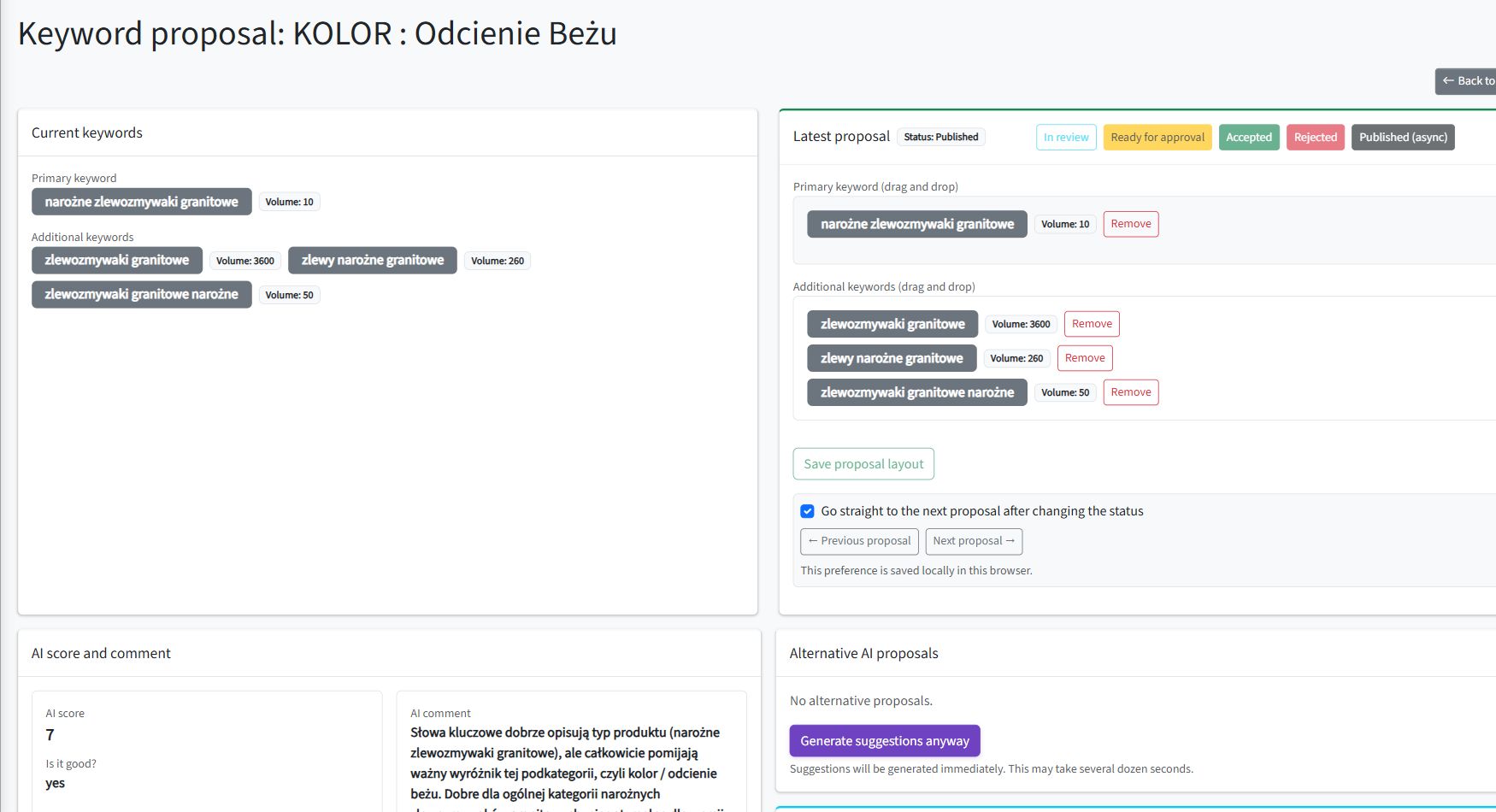
A live category keyword proposal for AP Komfort. The reviewer can see the current assignment, search volumes, workflow status and the model’s explanation in one place.
Step 2: review the keyword decision before generating content
Keyword selection deserves its own review stage because a wrong primary keyword affects every step that follows.
In the category keyword proposal view, the reviewer can compare the category’s current assignments with the proposed set. The interface exposes the main and supporting roles, available search-volume data, the model’s evaluation and any suggested alternatives.
The reviewer can:
- replace the main keyword;
- add or remove supporting phrases;
- search the website’s keyword database;
- add a new candidate when necessary;
- send the proposal for review or approval;
- accept or reject it;
- continue to the next proposal in the queue.
Once accepted, the proposal is applied to the category and becomes the input for later analysis and content generation.
The benefit is not that AI makes the final decision. The benefit is that it reduces a large keyword database to a small, explainable choice that can be reviewed in context.
Step 3: generate a versioned category revision
After the category has enough context, SEOAssistant can prepare a content revision.
The generation process can use the category tree, products from the category and its descendants, producer information, the selected keywords, existing descriptions and website-level content instructions. It prepares separate fields for:
- the short or top description;
- the longer bottom description;
- the SEO title;
- the meta description.
Most importantly, the generated content is stored as a revision. It does not silently overwrite the live category.
That gives the workflow a clear baseline and proposal:
Current category → proposed revision → review decision → platform updateThe automation settings can also limit which categories enter the process. For example, the system may focus on categories that have an assigned keyword, lack a description, do not contain an H2 heading or exceed a configured product threshold.
This is a more useful definition of automation than “generate content for every category.” Eligibility rules determine where the work is needed before the model is asked to write anything.
Step 4: review the actual change, not two complete documents
The category revision uses the same principle as the product workflow described in How to Review AI-Generated SEO Content Without Reading Everything Twice.
The reviewer should be able to see:
- which fields changed;
- what text was removed;
- what was added;
- whether the category name and URL remained outside the change;
- whether metadata and on-page content still describe the same catalogue section.
A visual diff makes the decision faster because attention is directed to the intervention rather than the entire page. The reviewer can edit the proposal, send it for approval, accept it or reject it.
Only an accepted revision is sent to the connected ecommerce platform. After a successful update, the revision receives a published status and remains available as a record of what happened.
Step 5: audit structure and meaning separately
Publishing a syntactically correct description does not prove that the page is useful. SEOAssistant therefore separates two kinds of quality checks.
Structural SEO audit
The rule-based audit checks signals that can be measured directly, including:
- whether the top and bottom descriptions are empty or too short;
- whether headings, lists and internal links are present;
- whether the selected keywords occur in relevant headings;
- how many products are connected with the category;
- whether links or images in the content appear invalid.
These checks are deterministic. They are useful for finding missing elements and enforcing consistent minimum standards across a large catalogue.
Semantic audit
The semantic audit asks a different set of questions:
- Is the description genuinely about this category?
- How relevant is it to the selected keywords?
- Does it support SEO without forcing the phrases unnaturally?
- Does it contain useful commercial or purchasing context?
- What problems and recommendations should a reviewer see?
The result includes relevance, SEO and keyword-naturalness scores together with a summary, issues and recommendations. These signals appear in the category list and can be opened as a more detailed audit view.
The two layers complement each other. A page can contain an H2, a list and enough characters while still being generic. It can also be semantically relevant while missing basic structure or containing a broken internal link.
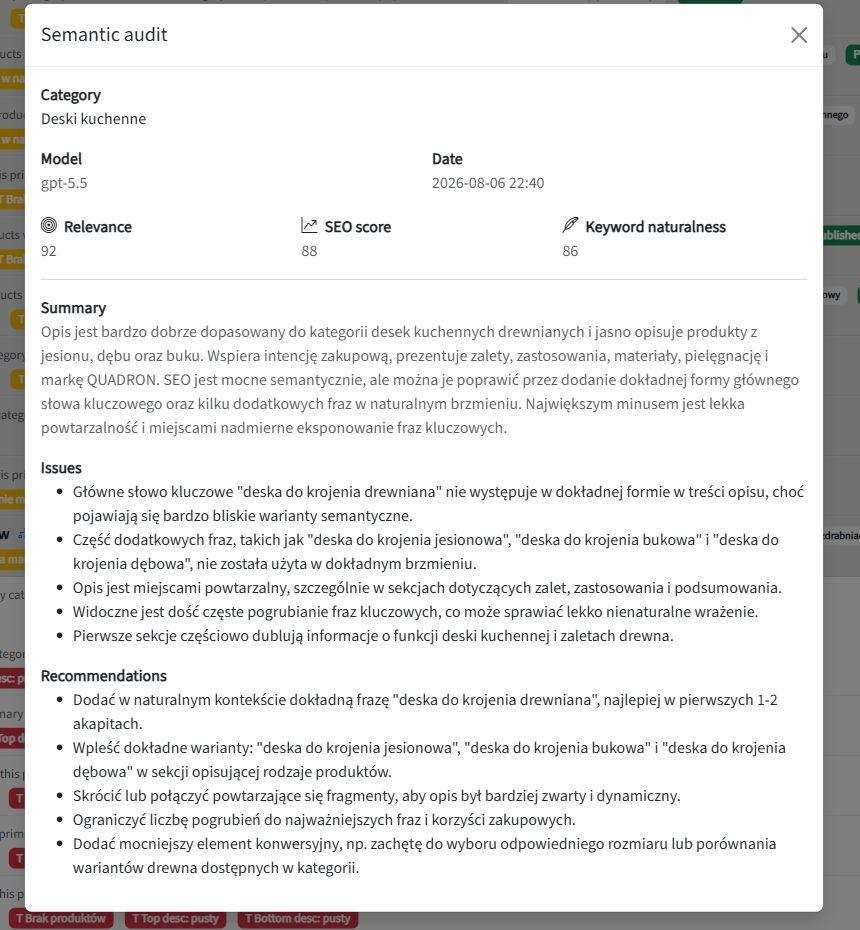
The semantic audit turns a broad quality judgment into a reviewable result: three scores, a summary, detected issues and concrete recommendations for the next revision.
From a staged workflow to an improving cycle
The category workflow connects the main operational stages:
- find a category that meets the automation rules;
- propose suitable keywords;
- review and apply the keyword assignment;
- create a versioned content proposal;
- review and publish the revision;
- run structural and semantic quality checks.
These stages are not intended to form a one-off project. Category SEO works best as a cycle that returns to the page after publication and asks what should happen next.
The next analysis may be triggered by a schedule, a material catalogue change, new Search Console data or a change in the quality rules used by the website. A recurring loop can then:
- run a fresh structural and semantic audit after publication;
- repeat the analysis after an appropriate interval or a material catalogue change;
- compare the new result with the previous one;
- combine content quality with Search Console performance;
- decide whether the page needs another revision or can remain unchanged;
- create that revision without overwriting the live version;
- keep the next publication subject to the website’s chosen approval policy.
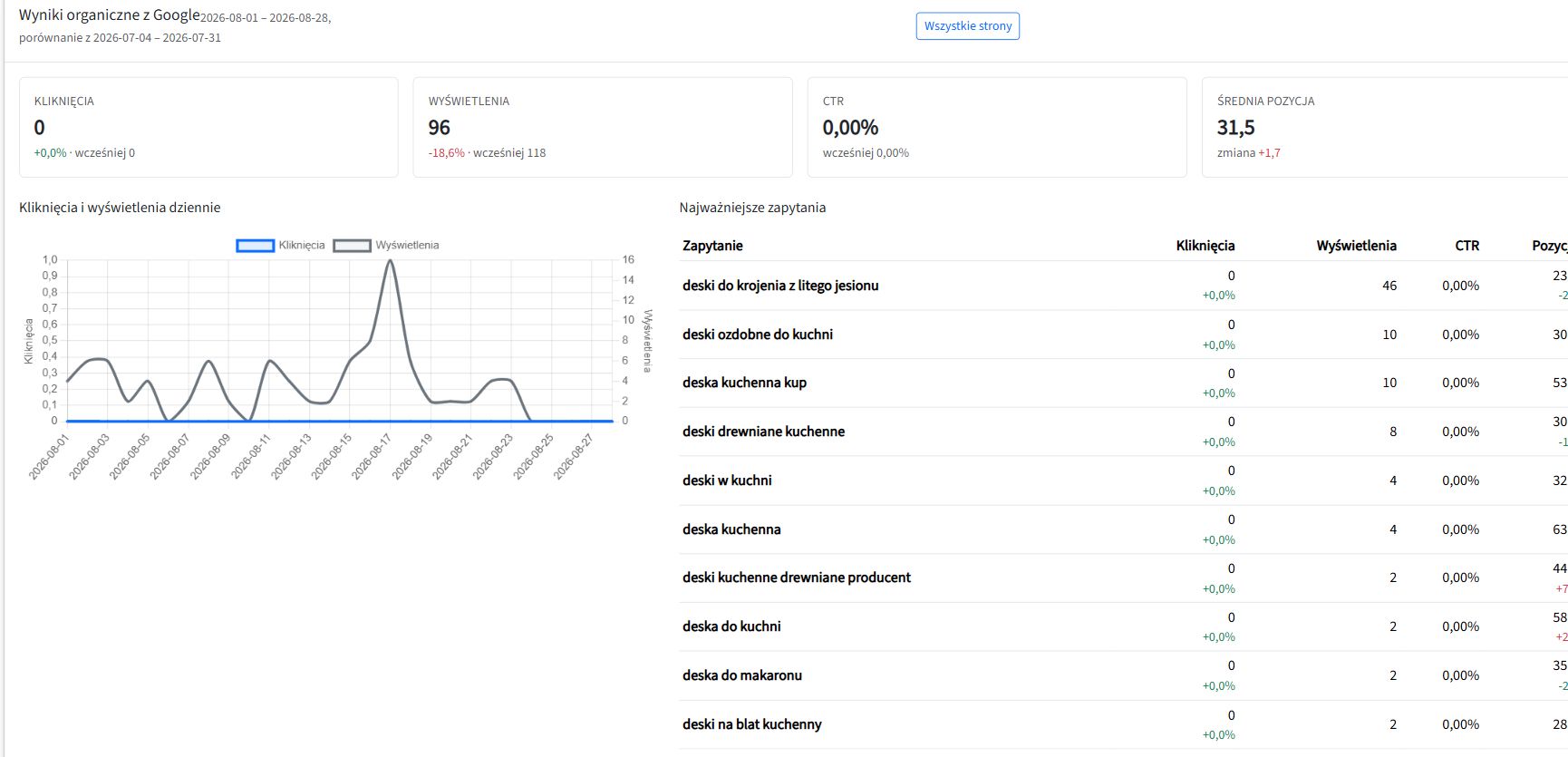
Search Console data adds another feedback signal. Query-level impressions and positions help the next analysis respond to how the category is actually appearing in search—not only to what its description contains.
This orchestration matters because neither category pages nor the environment around them remain static. Products are added or removed, terminology changes, internal links break, search demand moves and a previously good description can become incomplete.
The cycle can also absorb future improvements without requiring the entire process to be redesigned. New ranking signals, better keyword-selection logic, updated content requirements, changes in search behaviour and improvements to the models can all influence the next analysis and the next proposal.
Because each change remains versioned, the system does not have to treat any description as final. It can analyse the current state again, apply the latest rules and prepare the next justified improvement. SEOAssistant is being developed around this model: the workflow becomes more connected over time, while the website keeps control over which decisions require human approval.
The target model: controlled autonomy
The goal is not necessarily to keep manual approval forever.
A mature workflow can reduce review when the category type, generation rules and source data have produced consistently reliable results. For example, a website might allow low-risk metadata improvements to publish automatically while continuing to review long category descriptions.
The decision should depend on evidence and risk:
- Is the source catalogue reliable?
- Are the selected keywords already approved?
- Has this content template produced acceptable revisions before?
- Does the category contain regulated, technical or safety-sensitive products?
- Can every published change be traced and reversed?
- Will the page be analysed again after publication?
This is controlled autonomy: automation performs more of the repeatable work, while the business chooses where human approval remains mandatory.
A practical category SEO operating model
Teams can use the same structure to build an optimisation cycle that becomes more capable over time.
1. Define eligible categories
Exclude empty, inactive or strategically irrelevant categories. Decide whether a minimum number of products is required.
2. Maintain an accepted keyword pool
Research and approve the phrases that are genuinely relevant to the website. Treat automated matching as assignment, not unrestricted keyword invention.
3. Review keyword proposals separately
Confirm the search intent and prevent two pages from targeting the same primary topic before generating content.
4. Generate versioned changes
Keep the live category and the proposal separate. Include metadata and both visible description areas in the same revision.
5. Review through a diff
Focus on changed fields and risky claims. Preserve an explicit accept, reject and return-to-editing workflow.
6. Audit structure and semantics
Use deterministic checks for measurable elements and semantic evaluation for relevance, usefulness and natural language.
7. Schedule reanalysis
Define when the page should be checked again: after publication, after a catalogue update, after a fixed interval or when search performance changes materially.
Automation should reduce uncertainty, not hide it
The most useful category SEO system is not the one that produces the largest number of descriptions. It is the one that makes every important decision visible:
- why this category was selected;
- why these keywords were proposed;
- what content changed;
- who approved it;
- what was published;
- whether the result still meets the quality standard.
SEOAssistant brings these stages into one reviewable workflow and continues to develop the connections between post-publication analysis, prioritisation and revision generation. This allows category optimisation to follow changes in the catalogue, search behaviour, algorithms and content standards instead of remaining a one-off exercise.
That is the difference between automated writing and SEO automation: writing creates a document; automation manages the decision before it, the change itself and the quality checks that follow.
For the broader operating model, read What “SEO on Autopilot” Actually Means.