

Large websites do not usually fail at SEO because nobody can identify another title tag, internal link, or product description to improve. They fail because thousands of valid recommendations compete for limited development, content, review, and approval capacity. SEO at scale solves this operational problem by organizing pages into meaningful groups, prioritizing work by business impact, applying changes at the appropriate level, and measuring results through a controlled cycle.
The objective is not to automate every decision or optimize every URL. It is to create a system in which your team can identify the most valuable opportunities, prepare consistent changes, review the associated risks, publish in manageable batches, and use performance data to choose the next priority.
What SEO at Scale Means
SEO at scale is the process of managing organic search performance when a website has too many pages, markets, or recurring tasks for reliable URL-by-URL optimization. It is common in ecommerce catalogues, marketplaces, multi-location businesses, publishing platforms, and websites with extensive service or documentation sections.
The definition is operational rather than numerical. A website with 5,000 URLs may need a scalable process if it changes every day and has a small team. A more stable website with many more pages may remain manageable with fewer interventions. Google’s crawl-budget guidance is primarily for very large, frequently updated sites or sites with substantial numbers of discovered but unindexed URLs.
At scale, the unit of work changes. Instead of asking how to improve one page, you ask broader questions:
- Which page types contribute most directly to sales, leads, or other business outcomes?
- Which problems repeat across a template, component, or URL pattern?
- Which pages require individual content because their purpose or offer is genuinely different?
- How can the change be tested before it affects the full website?
- How will updated pages be separated from unchanged pages during measurement?
This approach preserves individual page quality while reducing unnecessary manual work. It also prevents SEO activity from becoming a backlog of disconnected recommendations with no clear order, owner, or definition of success.
Why URL-by-URL Optimization Stops Working
Manual optimization is useful when a website has a small set of strategic pages. It becomes unreliable when the same team must review thousands of products, categories, locations, articles, or manufacturer pages. Even a modest checklist becomes expensive when every step is repeated for every URL.
The resource problem is only part of the issue. URL-by-URL work can also produce inconsistent decisions. Different editors may use different title patterns, internal-linking rules, content structures, or standards for deciding whether a page needs additional copy. The website gradually becomes harder to maintain because each page is treated as an exception.
Large catalogues introduce further complications. Filters, sorting options, product variants, pagination, and tracking parameters can produce many URL versions. Google explains that faceted navigation can generate extremely large URL spaces. For duplicate and near-duplicate pages, consistent canonicalization signals help indicate the preferred version.
A scalable process therefore needs to distinguish between four different kinds of work:
- Shared technical fixes affecting templates, navigation, rendering, indexation, or URL rules.
- Shared content rules governing titles, descriptions, headings, product attributes, and reusable page sections.
- Individual page improvements required when search intent, product value, or available evidence differs substantially.
- Exceptions that must be excluded from a general rule and reviewed separately.
If repetitive work across product, category, or content pages is consuming more capacity than the team can provide, you can check whether SEOAssistant.pro could help with this on your website. The assessment considers your website’s structure, content and search visibility to identify opportunities and where the workflow may fit. It does not mean that changes have already been implemented.
Organize the Website by Page Type
The first practical step in SEO at scale is to stop treating the website as one undifferentiated list of URLs. Group pages according to their purpose, structure, and role in the customer journey. A typical ecommerce inventory might include product pages, category pages, manufacturer pages, buying guides, informational articles, campaign pages, account pages, and filtered listings.

Page type matters because two URLs can have similar traffic but require completely different evaluation criteria. A product page may be expected to support a purchase. A category page must help users explore an assortment. An article may attract early-stage demand and direct readers toward relevant commercial options. Combining all three in one report hides those distinctions.
Use purpose and templates to define groups
URL folders are a useful starting point, but they are not always sufficient. The same folder can contain pages produced by different templates, while one template may appear in several folders or markets. Grouping should therefore consider:
- the page’s commercial or informational purpose;
- the template and reusable components it uses;
- the fields available in the content management system;
- its position in the navigation hierarchy;
- its expected search intent and conversion action;
- its indexation and canonicalization rules.
Record a plain-language definition, inclusion rule, owner and exception list for each group. The resulting inventory should be understandable to SEO, content, ecommerce and development teams, not only to the person who created the spreadsheet.
Define success separately for each page type
Once groups exist, assign an explicit function to each one. For example, product pages may be assessed using eligible organic visibility, product availability, engagement, and transactions. Category pages may be evaluated through non-brand demand, clicks, assisted product discovery, and revenue. Articles may require visibility, qualified visits, internal-link engagement, and assisted conversions.
Site structure should also support these roles. Google’s ecommerce navigation guidance recommends crawlable paths from menus to categories, subcategories and products so that their relationships are understandable.
Clear page groups also make technical analysis more useful. Instead of reporting that 12 percent of the domain has a problem, you can determine whether it affects a high-value product template, an outdated article archive, or pages that should not be indexed at all.
Prioritize Opportunities by Business Impact
A large website will nearly always contain more possible SEO tasks than a team can implement. The goal is not to clear the entire backlog. It is to maintain a priority queue in which the expected business value, evidence, effort, risk, and scale of each opportunity are visible.
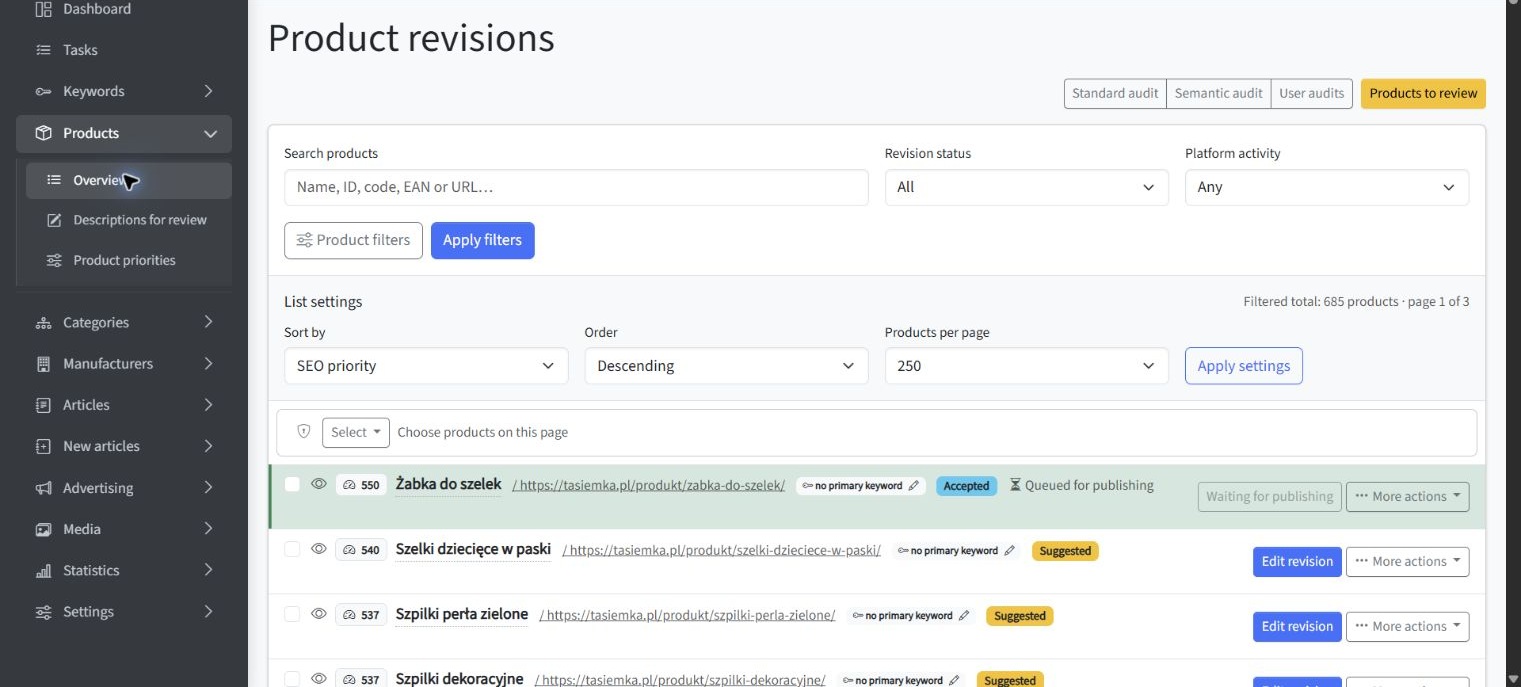
For an ecommerce catalogue, this may become a prioritized product-level work queue. Products can be filtered by revision status or recent activity, ranked by SEO priority, and opened for review when a suggested revision is ready.
Read the Product Queue Before Opening a Revision
The SEOAssistant screen above shows two independent decisions. The list is sorted by SEO priority in Descending order, while each row has its own revision state. One row is Accepted and Queued for publishing; other rows are Suggested and offer Edit revision.
- Use Revision status and Platform activity to narrow the work you intend to review.
- Check the Sort by and Order controls to understand why those products appear first.
- Open a suggested revision and verify its factual content before approval.
- After approval, verify the publication result on the destination website.
This is a reading of the historical interface shown, not a live report for your catalogue. A high priority is a reason to review a product; it is not approval to publish it, and a queued row is not proof of a public change.
A useful prioritization model considers several dimensions together:
- Business value: Does the page group generate revenue, qualified leads, bookings, or another important outcome?
- Search opportunity: Is there evidence of relevant impressions, rankings, demand, or declining visibility?
- Scale: How many eligible pages share the problem or opportunity?
- Fixability: Can the issue be corrected through a shared rule, or does it require individual research and editing?
- Implementation effort: Which teams, systems, and approvals are required?
- Risk: Could the change affect indexation, navigation, existing rankings, legal information, or conversion performance?
- Confidence: How strong is the evidence that the proposed action addresses the observed problem?
No single metric should determine the order. High traffic does not automatically mean high priority, and a large number of affected URLs does not guarantee meaningful impact. A smaller group of commercially important category pages may deserve attention before thousands of low-demand product variants.
Prioritization should also distinguish symptoms from causes. Rewriting individual titles may have limited value if the title-generation rule continues producing the same issue on every newly added page. Likewise, improving content cannot compensate for products that are inaccessible through crawlable internal links.
For a smaller-scale example of turning priorities into reviewed changes, see our WordPress SEO workflow. It follows an actual article from review through export and public verification.
Choose Page-Level or Template-Level Changes
The most important implementation decision is often whether to change an individual page or the system that produces a group of pages. Template-level SEO offers reach, but reach also increases risk. Page-level work offers precision, but it may not be economical across a large catalogue.

Use template-level changes for repeating problems
A shared change is usually appropriate when the problem has the same cause and the desired outcome follows a dependable rule. Examples include missing structural elements, inconsistent heading placement, an incorrect canonical pattern, non-crawlable pagination links, or a title formula that omits an important page attribute.
Template work can also cover reusable content sections, provided that the information remains accurate and useful for every eligible page. The rule must define where the component appears, which data it uses, what happens when data is missing, and which pages are excluded.
Google’s title-link guidance recommends descriptive titles and explains that the displayed title can draw on headings, page content and anchor text as well as the title element. This means a title rule should be evaluated within the full template rather than as an isolated text field.
Use page-level changes where meaning differs
Individual optimization is necessary when pages serve distinct search intent, represent strategically important products, require expert information, or contain exceptions that cannot be handled safely through a rule. It is also appropriate when a small number of pages account for a disproportionate share of organic revenue or qualified leads.
For example, a shared rule may generate a valid basic title for every category. The highest-value categories may still need individual research, differentiated copy, stronger internal links, and a more precise explanation of the available selection. The template creates a reliable baseline; page-level work adds depth where it is justified.
The decision is therefore not automation versus manual work. It is a question of where consistency is valuable and where differentiation changes the page’s usefulness.
Ecommerce teams applying shared rules to category content can also review how to automate ecommerce category SEO without losing control.
Review and Roll Out Changes Safely
A change that looks harmless on one URL can produce unexpected results when applied to thousands. Missing data, unusual page states, localization, discontinued products, custom templates, and legacy exceptions can all break a rule that worked on the initial example.
Before publication, define the exact eligible population. State which page types, markets, statuses, templates, and URL patterns are included. Then define exclusions explicitly. A precise scope is easier to test, approve, monitor, pause, and reverse.
Test a representative sample
A representative sample should include more than the easiest or most popular pages. Review examples with different traffic levels, content lengths, product states, languages, attribute availability, and template variations. Include known exceptions and edge cases.
The review should verify both SEO and customer-facing effects:
- content accuracy and relevance;
- titles, headings, canonical URLs, and robots directives;
- crawlable internal links and navigation behavior;
- mobile rendering and page layout;
- structured data consistency where applicable;
- legal, brand, and merchandising requirements;
- analytics and conversion tracking;
- fallback behavior when expected data is unavailable.
If AI assists with content preparation, it should not remove the review stage. The review process can instead be organized around risk, sampled outputs, source data, changed fields, and high-value exceptions. A practical companion is the guide on how to review AI-generated SEO content efficiently.
Publish in controlled batches
After the sample passes review, publish the change to a limited cohort rather than the full eligible population. Record the affected URLs, publication date, rule or revision version, reviewer, and rollback method. Expand only after confirming that the batch behaves as intended.
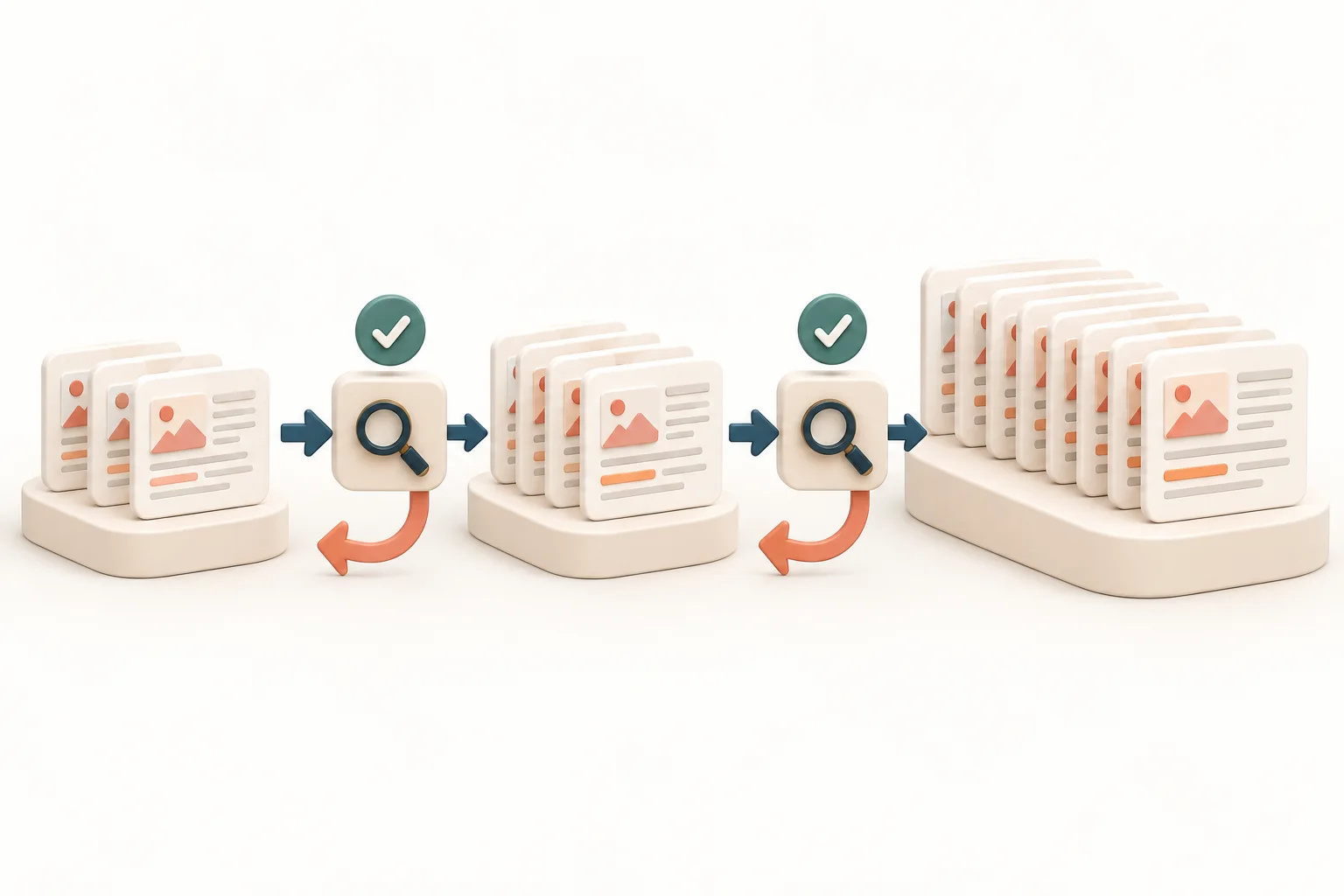
A controlled rollout might follow this sequence:
- Validate the proposed rule against a representative sample.
- Obtain the required content, SEO, technical, and business approvals.
- Publish a small initial cohort.
- Check rendering, crawling, indexation, analytics, and conversion signals.
- Correct unexpected behavior or confirm the next batch.
- Expand gradually until the defined population is complete.
- Preserve the change history for later performance analysis.
Search results may not respond immediately. Google notes that updated title-related signals can take days to weeks to be reprocessed, so rollout monitoring should separate immediate technical validation from later search-performance evaluation.
Measure Results by Page Group
Sitewide averages are rarely sufficient for SEO at scale. Growth in articles can conceal a decline in products, while a successful category update may appear insignificant when combined with thousands of unchanged URLs. Measurement should use the same page groups that guided prioritization and implementation.
Compare relevant page types across consistent reporting periods, then separate revised pages into cohorts based on what changed and when it was published. Search Console supports page filtering, regular expressions and date comparisons, making it possible to examine groups rather than relying only on domain-level totals.
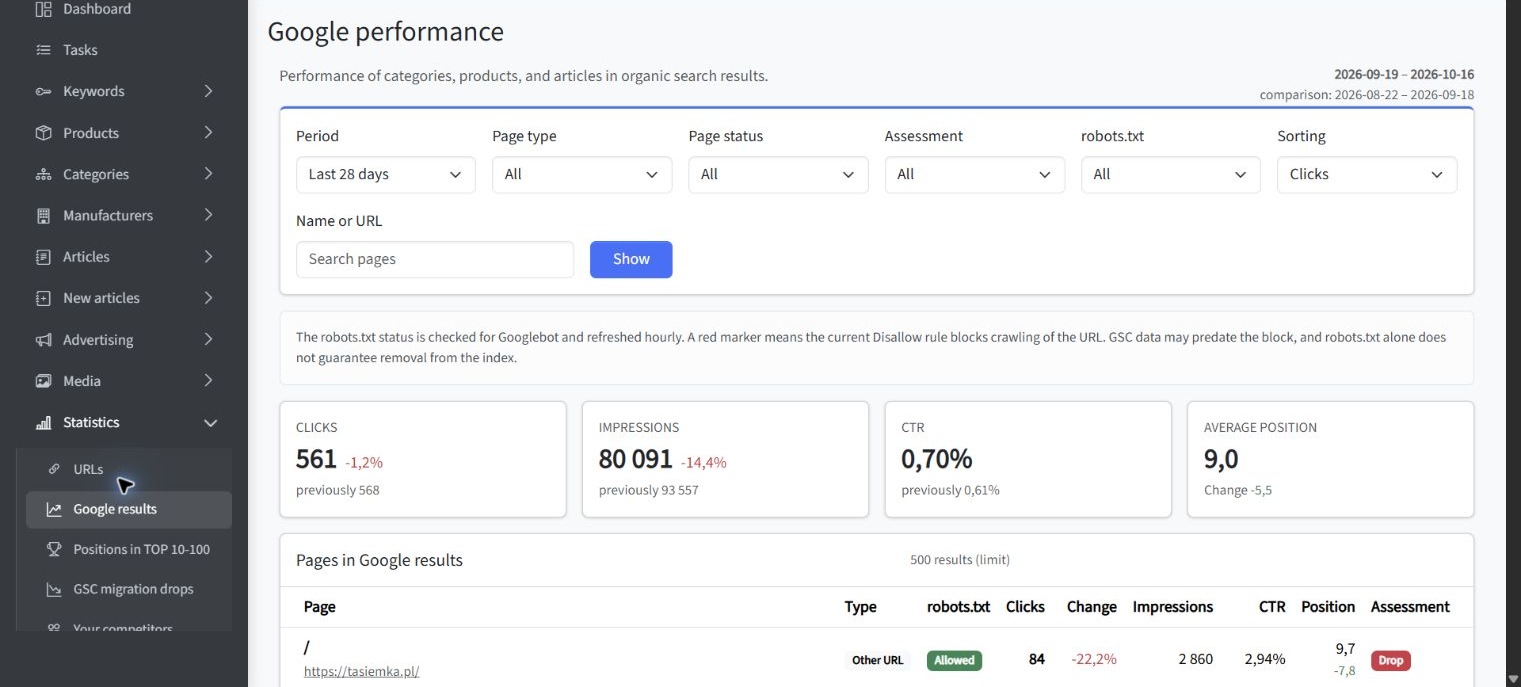
A useful reporting view may include clicks, impressions, click-through rate, average position, organic sessions, conversions, revenue, indexation status, and the number of eligible pages. The exact set depends on the role of the page type.
Interpret each metric in context:
- Impressions can indicate broader visibility, but not whether visits or commercial outcomes improved.
- Clicks show traffic from search results, but they may change because of demand, ranking, or result presentation.
- Click-through rate can help evaluate search-result performance, but query mix and position must be considered.
- Average position is an aggregate and should not be treated as a direct business outcome.
- Conversions and revenue show commercial value, but may also be affected by pricing, stock, promotions, tracking, and seasonality.
- Indexation and crawl signals help confirm technical accessibility, but indexation alone does not demonstrate useful visibility.
When comparing periods, use windows that are genuinely comparable. Account for seasonal demand, campaigns, assortment changes, migrations, promotions, algorithm updates, and other releases. Search Console’s weekly and monthly views can smooth daily fluctuations when reviewing longer-term trends.
A revision cohort creates a clearer comparison. For example, compare category pages updated in the same release with similar categories that remained unchanged. This does not establish perfect causation, but it is more informative than attributing the entire domain’s movement to one change.
For broader metric definitions and reporting choices, review how to measure SEO performance.
Build a Repeatable Optimization Cycle
SEO at scale should operate as a cycle rather than a sequence of one-off projects. Large sites continuously add products, remove inventory, update templates, publish content, create parameters, and change internal links. Every release can create new opportunities or invalidate previous assumptions.

A practical operating cycle contains eight stages:
- Collect: combine website structure, crawl data, search visibility, business performance, content status, and recent change history.
- Segment: assign URLs to page types, templates, markets, states, and relevant business roles.
- Diagnose: identify repeating problems, declining groups, growth opportunities, and individual exceptions.
- Prioritize: rank opportunities using business value, search evidence, scale, effort, risk, and confidence.
- Prepare: create the page-level revision, shared rule, technical requirement, or content brief.
- Review: verify accuracy, scope, edge cases, approvals, and rollback conditions.
- Publish: release approved changes in controlled cohorts and preserve revision records.
- Measure: compare page groups and cohorts, then feed the evidence into the next priority queue.
The value comes from connecting these stages. An audit without prioritization creates noise. Content preparation without review creates risk. Publication without revision records weakens measurement. Reporting without a path back into the work queue produces dashboards rather than decisions.
A connected SEO workflow can bring analysis, prioritization, revision preparation, review, controlled publishing, and measurement into one operating process. The platform should support accountable decisions rather than replace the people responsible for content accuracy, technical implementation, or business priorities.
The process also needs an agreed rhythm. Some teams may reassess high-value groups weekly and conduct broader reviews monthly. The appropriate frequency depends on release volume, catalogue volatility, available data, and team capacity. A smaller operation can use a two-hour weekly ecommerce SEO routine to maintain the cycle without attempting to inspect every page.
Key Conclusions for SEO at Scale
The following principles provide a practical decision framework for large websites and product catalogues:
- Manage related page groups instead of treating every URL as an independent project.
- Define the commercial or informational role of each page type before choosing metrics or recommendations.
- Prioritize business impact and actionable evidence rather than issue counts alone.
- Use template-level fixes for shared causes and page-level work where meaning, value, or intent differs.
- Define exclusions and edge cases before applying any bulk rule.
- Test representative pages and publish large changes in controlled cohorts.
- Keep human approval for decisions that affect accuracy, brand requirements, indexation, or large sections of the website.
- Measure revised groups separately from unchanged pages and sitewide averages.
- Use each measurement cycle to revise priorities rather than treating the work as complete.