
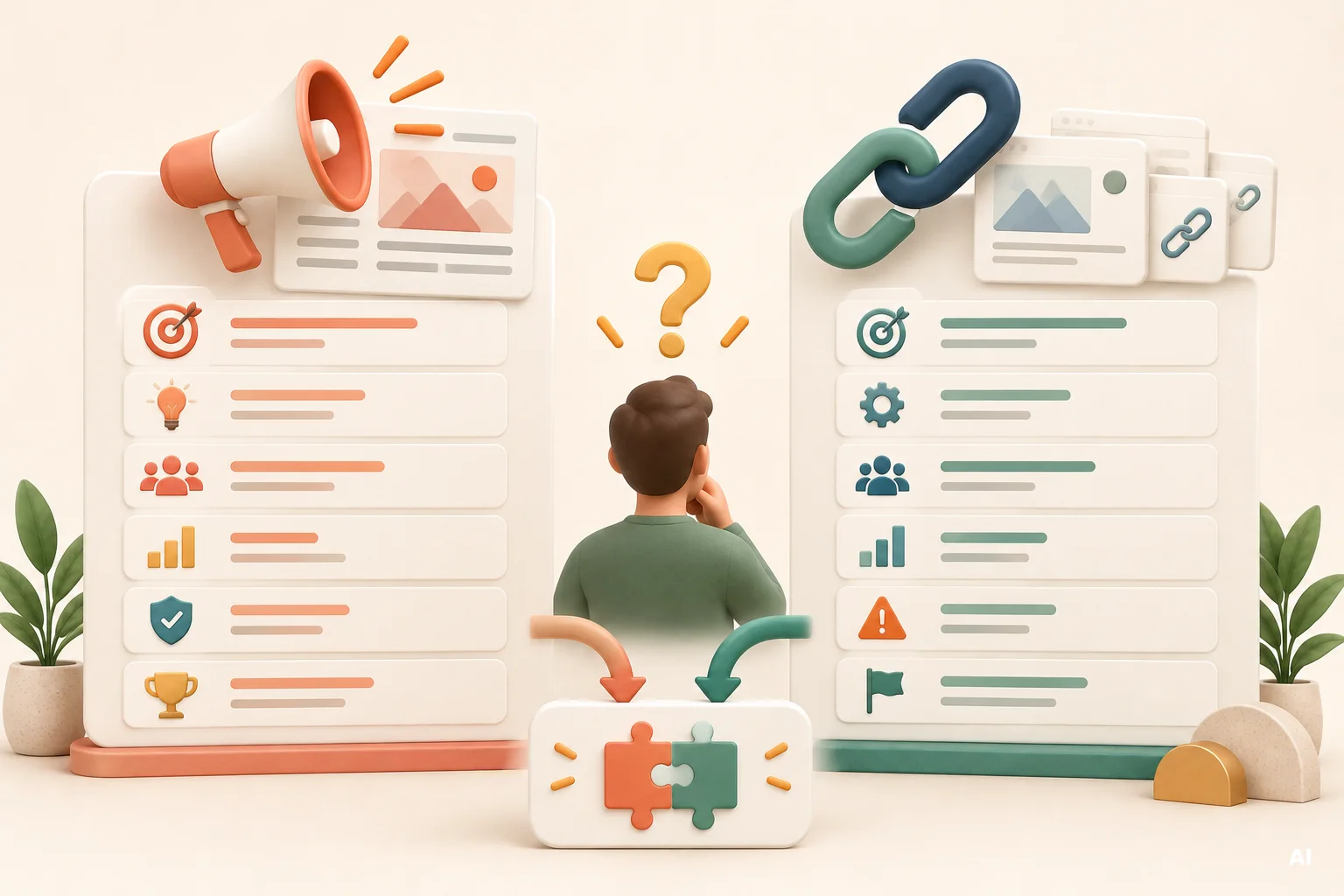
Digital PR and conventional link building can both strengthen organic visibility, but they do so through different operating models. Digital PR is typically story-led and designed to earn editorial coverage, links, mentions, referral traffic, and brand recognition from the same campaign. Traditional link building is usually more page-led, allowing teams to target specific websites and URLs through focused outreach.
The choice between digital PR vs. link building should not be based on which method can produce the highest backlink count. It should reflect your objectives, available expertise, budget, newsworthiness, risk tolerance, and the pages that need greater authority. In many cases, the strongest strategy combines both approaches.
What Is Digital PR?
Digital PR is the process of creating credible stories, evidence, expert insights, or useful resources that online publications may choose to cover. Its purpose extends beyond backlink acquisition. A successful campaign can increase brand awareness, secure media mentions, attract referral traffic, position specialists as trusted sources, and generate editorial links.
Common digital PR formats include original research, surveys, internal data analysis, industry reports, expert commentary, interactive resources, regional comparisons, and reactive responses to current developments. The campaign begins with an audience-relevant story rather than a list of websites from which the business wants links.
This distinction is important when considering how PR supports SEO. Google uses multiple ranking systems and signals, including systems that analyze how pages link to one another. However, backlinks do not guarantee rankings on their own, and their potential value depends on factors such as relevance, editorial context, the linked page, and the overall quality of the website.
What Is Link Building?
Link building is the deliberate process of identifying relevant websites and encouraging them to link to a particular page. The objective is usually more specific than in digital PR: acquire suitable backlinks for pages that need stronger authority or visibility.
A conventional link building strategy may include outreach for useful resources, replacement of relevant broken links, recovery of unlinked brand mentions, promotion of original content, partnership-based outreach, and communication with publishers that cover a particular subject.
Good link building is not synonymous with buying links or sending mass-produced emails. Google defines link spam as creating links primarily to manipulate search rankings and lists paid links that pass ranking credit, automated link creation, excessive exchanges, and low-quality directories among problematic practices.
Ethical link building therefore depends on editorial value and genuine relevance. The publisher should have a valid reason to reference the destination page, such as its original evidence, specialist explanation, practical utility, or relevance to the publisher’s audience.
Digital PR vs. Link Building: The Main Differences
Primary objective
Digital PR normally pursues several outcomes simultaneously. Backlinks may be important, but so are media coverage, brand mentions, reputation, referral traffic, expert positioning, and wider recognition.
Traditional link building usually has a narrower SEO objective. It focuses on earning relevant links to selected pages or strengthening a particular topic area within the website.
Starting point
Digital PR begins with a potential story. The team asks what journalists and their audiences would find timely, credible, surprising, useful, or significant.
Link building begins more often with a destination page, content asset, or authority gap. The team asks which websites might reasonably reference that page and what value would justify the link.
Targeting model
Digital PR frequently uses a one-to-many model. One campaign can be presented to multiple journalists, publications, creators, and industry commentators. If the story gains momentum, it may earn secondary coverage without direct outreach to every publisher.
Link building is usually more targeted at the prospect level. Each opportunity can be evaluated according to topical relevance, editorial quality, audience fit, existing content, and the suitability of the intended destination page.
Expected outputs
Digital PR can produce linked coverage, unlinked mentions, interviews, quotations, social discussion, referral visits, and increased brand searches. Not every publication that discusses the campaign will include a backlink.
Link building is assessed more directly through acquired links and their effect on the supported pages. Even so, link totals should be considered alongside relevance, placement, destination, referral traffic, and subsequent organic performance.
Predictability
Digital PR outcomes are difficult to forecast. A strong campaign can earn substantial coverage, while another campaign with comparable production quality may receive limited attention because of timing, competing news, or insufficient differentiation.
Traditional link building is generally more predictable at the activity level. Teams can estimate prospect volumes, outreach capacity, response rates, and the number of viable opportunities. However, publishers retain editorial control, so no ethical method can guarantee placements.
How the Two Approaches Earn Backlinks
Digital PR earns backlinks by giving publishers something worth citing. The link is usually part of editorial coverage rather than the sole purpose of the article. A journalist might reference a study, data set, expert explanation, tool, or report because it improves the usefulness and credibility of the story.
The usual digital PR process involves several connected stages:
- Identify a topic that is relevant to both the business and the intended media audience.
- Create an original story, credible methodology, expert contribution, or useful asset.
- Choose a suitable page on which the evidence or resource will be published.
- Build a focused list of journalists and publications that cover the subject.
- Pitch the strongest angle clearly and provide supporting materials.
- Monitor linked coverage, unlinked mentions, referral traffic, and audience response.
Traditional link building earns backlinks by matching an existing page with relevant linking opportunities. Outreach is usually based on a specific reason why the page would improve, support, update, or add evidence to content already published on another website.
A typical link building workflow includes:
- Select the page or topic that requires additional authority.
- Identify relevant publications and pages with a genuine contextual fit.
- Review each opportunity for quality, audience value, and potential risks.
- Develop a clear reason for the publisher to consider the resource.
- Send personalized outreach and manage reasonable follow-ups.
- Evaluate acquired links by relevance and placement rather than volume alone.
In both cases, the strongest results come from providing value that the publisher can assess independently. Google’s own guidance recommends creating unique, compelling content that people naturally want to reference and warns that unnatural link schemes can do more harm than good.
Comparing Cost, Speed, Control, and Scalability
Cost and resource requirements
Digital PR often requires substantial work before outreach begins. Research, data collection, methodology review, design, development, expert participation, media materials, and campaign management can all contribute to the cost. A campaign may create multiple outcomes, but those outcomes are not guaranteed.
Link building may require less investment in a single campaign concept, but it involves ongoing research, qualification, personalization, relationship management, and content support. Costs increase when prospects operate in a highly competitive or specialist market.
Speed of results
Digital PR can produce a concentrated burst of coverage when a timely story succeeds. It can also take weeks or months to prepare a defensible campaign, especially when original research or technical assets are involved.
Link building tends to produce results incrementally. Individual links may be earned relatively quickly, but building meaningful authority across an important topic normally requires consistent activity rather than a one-time outreach round.
Level of control
Neither method gives the brand complete control. Editors decide whether to publish a story, mention the company, include a link, select a destination URL, or use a particular anchor.
Traditional link building offers more control during prospecting because the team can prioritize specific pages, publishers, and subject areas. Digital PR provides less placement-level control, but one strong story can reach audiences and publications that were not part of the original media list.
Scalability
Digital PR has one-to-many potential. A single asset can generate several angles, regional versions, expert discussions, and follow-up stories. Its main constraint is the ability to produce genuinely original and credible campaigns repeatedly.
Link building can be scaled through documented research and outreach processes. However, expanding the prospect list too aggressively can reduce relevance and personalization. Greater email volume does not automatically create more high-quality links.
When Digital PR Is the Better Choice
Digital PR for backlinks is particularly useful when the business has a credible story that can interest audiences beyond its current customers. It is also suitable when SEO is only one part of a broader objective involving reputation, awareness, expert visibility, or demand generation.
Digital PR may be the better option when:
- The business has original data, specialist knowledge, or qualified experts.
- The subject has clear relevance to journalists and their audiences.
- The goal includes media coverage and brand recognition as well as links.
- The website needs stronger authority across a broad topic or category.
- A useful resource or study can act as a credible citation source.
- The team can manage media outreach and respond quickly to questions.
- The business accepts that campaign results may vary significantly.
The main digital PR benefits come from combining visibility with authority. One campaign can introduce the brand to new audiences while also earning references that support organic search. For a closer look at execution, see the guide to earning authoritative backlinks through digital PR.
When Traditional Link Building Is the Better Choice
Traditional link building can be a better fit when the SEO requirement is narrow and clearly defined. For example, a website may already have useful content but lack relevant references to a specific guide, category, research page, or specialist resource.
Link building may be preferable when:
- A clearly identified page needs additional authority.
- The niche has relevant publishers but limited mainstream news potential.
- The business needs a steady, ongoing acquisition process.
- Prospects require different value propositions or highly personalized outreach.
- The company already has link-worthy resources that have not been promoted effectively.
- Budget or production capacity does not support original research or complex campaigns.
- The SEO team needs closer control over topical targeting and destination pages.
This does not mean link building should be limited to commercial URLs. Publishers are often more willing to reference educational resources, original evidence, tools, or detailed explanations. Supporting informational assets can then connect users and search engines to relevant commercial pages through sensible internal linking.
Before allocating a significant budget to either approach, it is worth considering whether SEO is worth the investment in relation to customer demand, competition, margins, sales cycles, and the website’s ability to convert additional organic traffic.
How to Combine Digital PR and Link Building
Digital PR and link building are most effective when they operate as complementary parts of the same authority-building program. Digital PR can create awareness and attract editorial attention at scale, while targeted link building can address specific gaps that broad media campaigns do not reach.
A combined approach can follow this sequence:
- Map authority needs. Identify the topics, sections, and pages that need stronger external support.
- Create valuable destination assets. Publish research, expert resources, tools, or guides that provide a legitimate reason to link.
- Launch story-led campaigns. Use the strongest evidence or insight to attract relevant media coverage.
- Review campaign outcomes. Separate linked coverage, unlinked mentions, referral traffic, and brand exposure.
- Conduct targeted follow-up. Approach relevant publishers that would benefit from the resource but did not cover the initial campaign.
- Reclaim suitable mentions. Where a publication has mentioned the brand or research without linking, politely provide the original source page.
- Strengthen internal linking. Connect linked assets to related pages so the campaign supports the wider website structure.
- Measure page-level effects. Monitor the visibility and traffic of both the linked asset and the pages it supports.
This model also reduces dependence on a single acquisition tactic. Digital PR can expand reach, while conventional outreach maintains focus on priority topics and pages.
PR Backlinks vs. Link Building: Common Misconceptions
“Digital PR always earns high-authority links”
A strong campaign can attract respected publications, but publication-level metrics do not automatically make every link valuable. Topical relevance, editorial context, page quality, placement, link attributes, audience fit, and the destination URL should all be reviewed.
“Link building is automatically manipulative”
Link building is not inherently against search engine guidelines. The risk comes from how links are acquired. Outreach that introduces a genuinely useful resource is different from buying ranking credit, automating placements, or creating low-value content solely to manipulate search visibility.
“Media coverage always includes a backlink”
Journalists may mention a business, quote an expert, or discuss research without linking to the original source. Digital PR reporting should therefore distinguish between linked coverage and unlinked mentions rather than treating them as the same outcome.
“The campaign with the most links wins”
A large number of irrelevant or duplicated links may contribute less than a small number of contextually appropriate editorial references. Evaluation should also consider target-page performance, qualified referral traffic, brand visibility, and the publications’ relationship to the intended audience.
“A backlink campaign should guarantee ranking improvements”
Links are only part of organic search performance. Search engines use many systems and signals, while rankings can also be influenced by content relevance, competition, technical accessibility, user intent, page experience, and changes elsewhere in the search results. No responsible provider should guarantee a specific ranking solely from backlink acquisition.
“Digital PR can replace all targeted outreach”
Digital PR coverage may concentrate on the campaign asset, company homepage, or spokesperson profile rather than the pages with the greatest SEO need. Targeted link building remains useful for closing these page-level and topic-level gaps.
A Decision Checklist for Choosing the Right Method
Use the following checklist to decide whether digital PR, link building, or a combined program is most appropriate:
- Define the primary outcome. Decide whether the priority is page-level authority, broad brand visibility, media coverage, referral traffic, expert positioning, or a combination.
- Identify the pages that need support. Determine whether publishers could naturally reference those pages or whether a separate informational asset is required.
- Assess newsworthiness. Review whether the business has original data, credible expertise, a timely perspective, or a useful resource that can support a media story.
- Evaluate available skills. Digital PR requires storytelling, media awareness, campaign production, and responsive outreach. Link building requires prospect research, qualification, personalization, and persistent relationship management.
- Set a realistic budget. Include asset production, research, data review, design, outreach tools, specialist time, and performance measurement.
- Consider the desired level of predictability. Choose targeted link building for greater prospect-level focus and digital PR when wider but less predictable outcomes are acceptable.
- Review brand and compliance risks. Confirm that claims, data, methodology, and outreach practices can withstand editorial scrutiny.
- Define quality before launch. Establish what a relevant publication, useful placement, and suitable destination page look like for the business.
- Choose a blended scorecard. Measure more than total links by including relevance, coverage quality, referral traffic, supported-page visibility, mentions, and business impact.
- Plan for continuity. Authority is usually built through sustained work, so select a method that the team can execute consistently.
Key Conclusions
The most important distinctions between digital PR and link building can be summarized as follows:
- Digital PR is story-led, while traditional link building is usually page-led and prospect-led.
- Digital PR can generate coverage, links, mentions, referral traffic, and awareness from one campaign.
- Link building offers greater control over target topics, prospects, and destination pages.
- Digital PR has greater one-to-many potential but less predictable placement-level outcomes.
- Neither approach should be evaluated by backlink quantity alone.
- Editorial relevance and genuine audience value matter more than isolated authority scores.
- Manipulative paid links, automated placements, and low-quality schemes create unnecessary risk.
- A combined strategy can balance broad visibility with focused page-level authority building.
Summary
The comparison of digital PR vs. link building is not about selecting a universally superior tactic. Digital PR is often the stronger choice when a business has a compelling story and wants to build brand authority alongside backlinks. Traditional link building is more suitable when the priority is a specific page, topic, or group of carefully selected prospects.
For many businesses, the right answer is a coordinated mix. Use digital PR to create credible reasons for publications to discuss and cite the brand, then use targeted link building to promote valuable resources and address remaining authority gaps. This approach connects media visibility with measurable SEO priorities without relying on link volume as the sole definition of success.