

You run an online store. There are orders, suppliers, customer questions and problems that cannot wait. You know your product and category descriptions need work, and your blog could attract new customers. But when are you supposed to do it?
Another tool does not solve the problem if logging in gives you a task list for the next three weeks.
SEOAssistant is being built to do more of that work, not simply point it out. Our experience across the projects we work on suggests that around two hours of regular work with the app each week can be enough to steadily develop your store’s content and achieve noticeable SEO improvements.
That does not mean writing every description in two hours. It means reviewing and guiding the work the app prepares.
And it does not have to be an SEO specialist. Above all, you need someone who knows your offering and can judge whether the proposed content is factually correct.
Two hours of your time is not two hours of work on your store
Manually optimizing a single description means gathering information, researching keywords, deciding on a structure, writing the text, checking it and publishing it. Then moving on to the next product. And eventually returning to what you have already published.
With a dozen products, that is manageable. With a few thousand, you start running out of time before the work has really begun.
SEOAssistant changes that division of responsibilities. The app uses website data, your offering and analytical sources, helps establish priorities, and prepares proposed content and improvements. Changes belong to specific pages, and fields supported by the integration can be updated after approval.
You do not start with a blank document. You start with a proposal you can assess, edit and approve.
Two hours is the time you spend participating in the process. It is not a limit on the work the system can prepare during that time.
You do not need to know SEO. You need to know your products
The person using the app does not have to research every keyword or design the structure of every text independently. They should, however, be able to answer some much more practical questions:
- Does this product actually have the features described?
- Is it suitable for the suggested use?
- Does the customer receive the listed items in the package?
- Is any information that customers frequently ask for missing?
- Does the description match what we actually sell?
Suppose the app prepares a description of a kitchen tap. A team member who knows the range notices that this particular variant does not have a pull-out spout, or adds an important installation detail. That is not an edit “for the algorithm.” It is knowledge a customer needs to choose the right product.
The owner, a product manager or a customer service team member can take on this role. Often, the person answering shoppers’ questions every day knows exactly what the descriptions are missing.
Fluent writing still needs fact-checking. If a claim is uncertain, check the specification or ask someone who knows. Do not approve a sentence just because it sounds convincing.
What could a two-hour working week look like?
The schedule below is an illustrative way to organize the work, not a time measurement for every customer. You can use one block or split it into two shorter sessions each week.
| Time | Your task | Why it matters |
|---|---|---|
| 20 minutes | Review the proposed priorities against your current offering | Keep the work focused on pages that matter to the business |
| 70 minutes | Check prepared changes, correct facts and approve proposals that are ready | Get worthwhile improvements onto the website |
| 20 minutes | Add context: customer questions, product features and feedback on content | Help future proposals reflect the specifics of your store |
| 10 minutes | Check what has been published, what is waiting and whether anything needs attention | Maintain continuity and avoid overlooking problems |
Most of this time goes into decisions about prepared content, not operating the tool.
You do not have to “clear the entire queue” every time, either. It is better to review the most important proposals carefully than to approve everything just to bring the pending count down to zero. The number of descriptions you can review depends on their length, the quality of the source data and the complexity of the products.
A quick look at results does not mean judging SEO every week based on a few days of traffic. Its main purpose is to spot signals and decide what needs attention next.
A diff makes comparison faster. It does not replace judgment
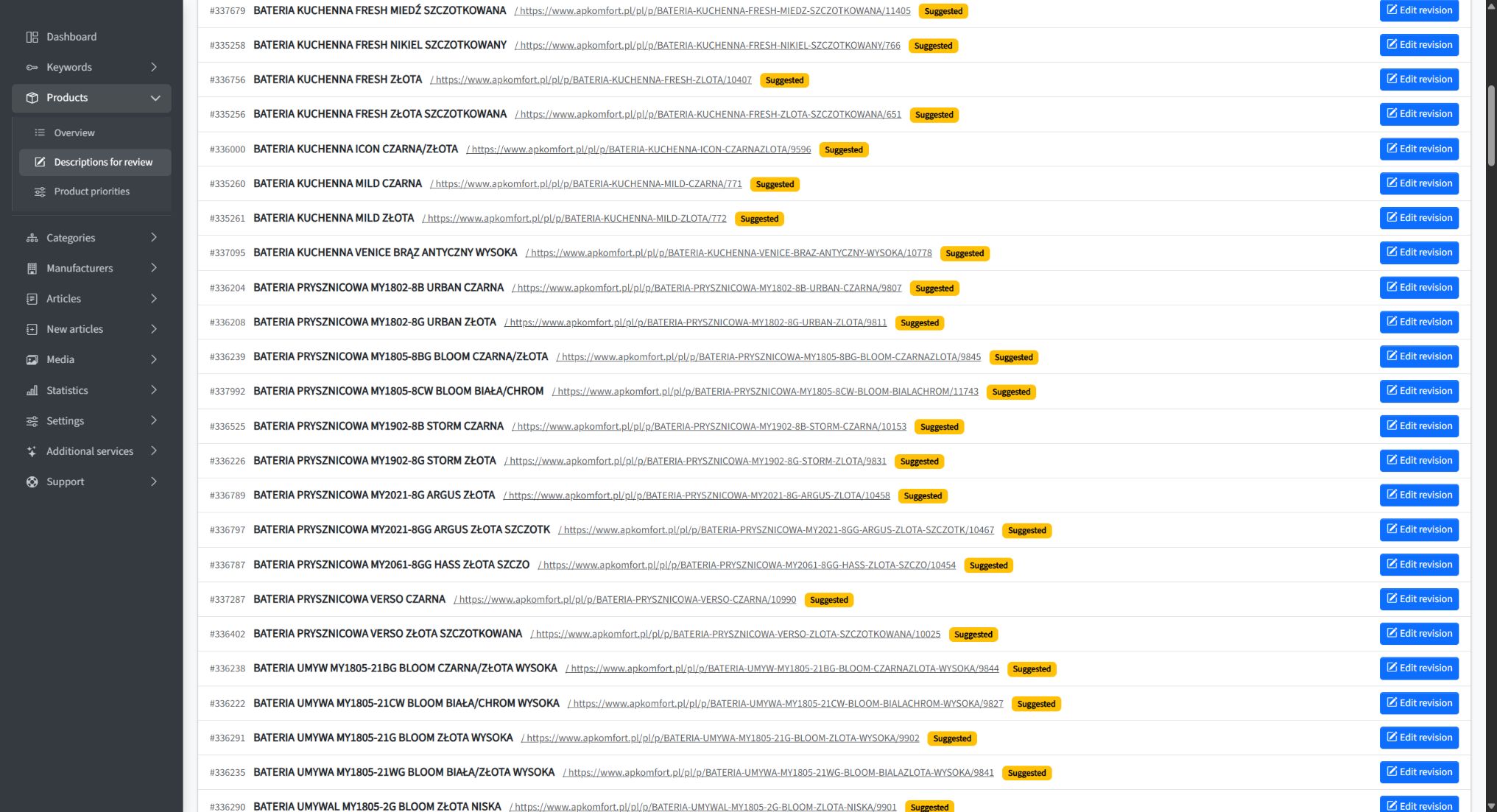
Reviewing content should not mean opening your store in one tab, a proposal in another, and looking for differences sentence by sentence.
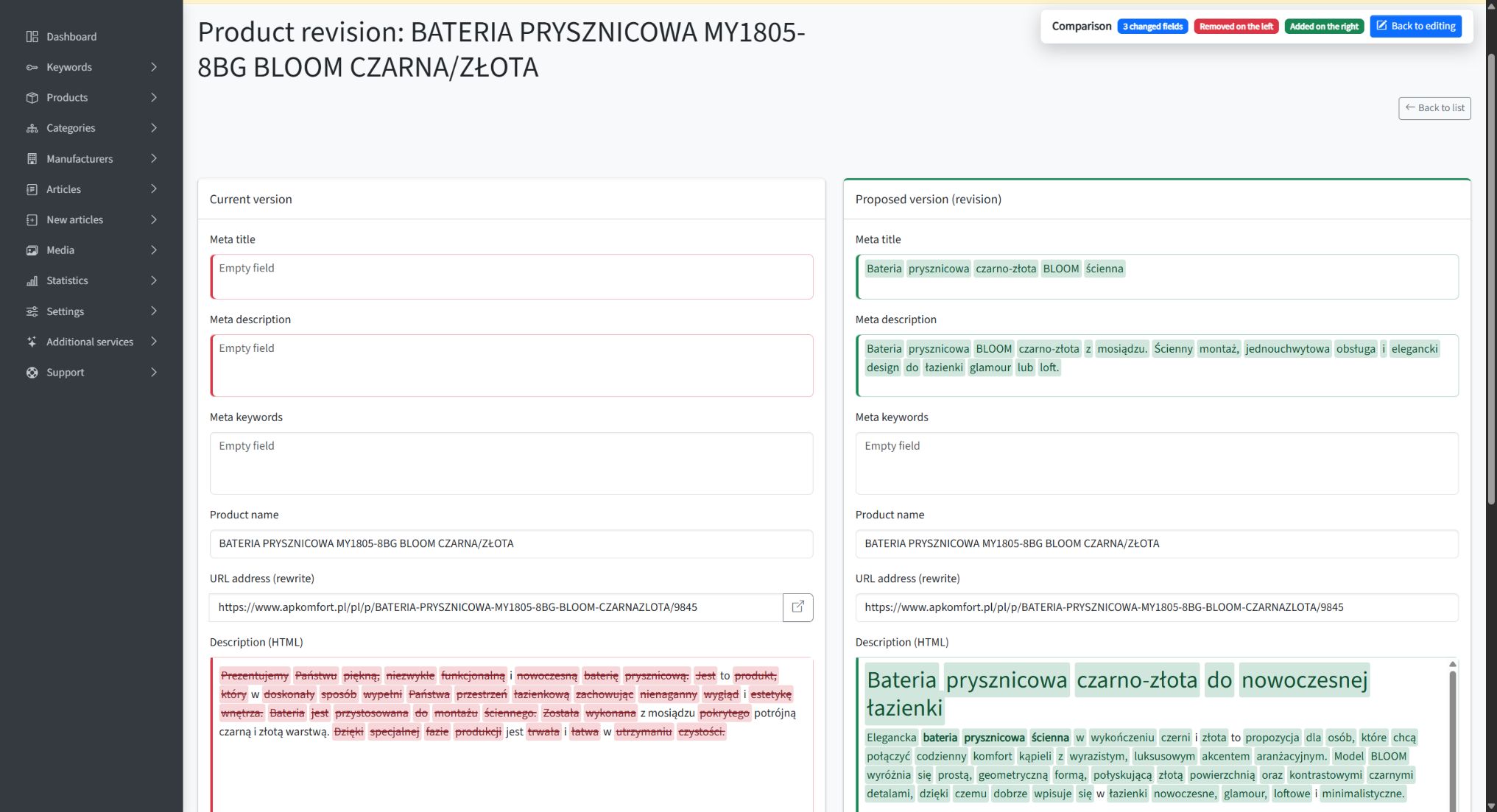
In SEOAssistant, a proposal is saved as a revision. You can compare it with the current content, and the diff highlights added and removed passages. This makes it easier to see whether a product use has been added, important information has disappeared, or the scope of the description has changed.
That is particularly useful when you return to a page that has already been improved. You do not have to work out the entire change from scratch each time.
Color alone does not confirm that a sentence is true. The diff helps you locate what needs attention; someone who knows the offering makes the decision. When a description has been substantially rewritten, it is also worth reading the finished version as a whole.
We show a practical approach in How to Review AI-Generated SEO Content Without Reading Everything Twice.
What did this look like at AP Komfort?
AP Komfort, a kitchen equipment retailer, is a useful example. The project covered a catalog of 1,858 products and 170 categories.
In the published case study, we described the client’s involvement as around one hour of approvals per week and one weekly meeting. SEOAssistant handled publication. This is not a record of exactly 120 minutes of work. It does show how a small, regular human contribution can accompany a much broader scope of activity.
The project published 211 product revisions, 83 category revisions and 20 manufacturer revisions. Comparing two equal, 41-day periods—November 21–December 31, 2025 and January 1–February 10, 2026—showed a 24.19% increase in Google impressions and a 36.73% increase in the number of pages receiving clicks. The details, data sources and scope of work are presented in the AP Komfort case study.
These results are not a promise of identical growth for another store. They demonstrate something more practical: the client did not have to personally write and publish hundreds of revisions for work on the website to move forward.
A greater volume of work than a traditional agency package
Working with a tool yourself does not have to mean a narrower scope than outsourcing SEO. With a well-prepared process, it can mean precisely the opposite.
In September 2026, public agency offers still include packages with a few texts per month and a defined scope of catalog optimization. For example, GBoost lists three pieces of content, optimization of up to 15 products and 1–2 categories per month in its Start package; larger packages increase those limits. KC Mobile lists 4–8 texts per month in its ecommerce package, plus category and product descriptions. These are examples of specific offers, not a statistical average of the entire market. GBoost’s scope, KC Mobile’s scope.
The volume of content work you can set in motion yourself with SEOAssistant can significantly exceed a traditional retainer built around a few texts and a limited number of monthly updates. At AP Komfort, we are talking about 314 published product, category and manufacturer revisions across the documented project—not 314 content ideas or drafts waiting in a folder.
Here, we are comparing the scale of catalog content work, not an agency’s entire service, which may also include technical SEO, link building and analytics. More changes make sense when they are justified, accurate and actually implemented.
For a store owner, the most important question is therefore: how much valuable work reaches my website, not how many people are involved in servicing the account?
SEO agencies need to change their operating model
Our assessment of the market in September 2026 is clear: SEO agencies need a substantial transformation to keep pace with the scale and speed of work that automation makes possible.
Replacing a copywriter with a text generator while leaving the same limited scope of work for the client is not enough. The entire process needs to change: from data analysis and prioritization, through preparing and implementing updates, to evaluating results and making further improvements to existing content.
If a store owner or employee can set work on a substantial catalog in motion with a small, regular contribution, the bar for outsourced services rises. A list of recommendations, a few new articles and a monthly report will find it increasingly difficult to justify their value.
Automation does not lower expectations of SEO. It raises expectations of how much valuable work should get done.
What needs to be in place for this model to work?
Two hours a week refers to regular work with an app that is already set up. Initially, the website needs to be connected, data and content rules configured, and the first proposals reviewed. We help with this stage—it is separate from the ongoing working routine.
The quality of the input information matters, too. If a product has a name and a one-sentence description, while important specifications exist only in a salesperson’s head, someone needs to provide them. Automation should not mean guessing product specifications.
A simple arrangement works best: one person responsible for regular review, access to reliable product information, and clear rules about what gets approved and what needs correction.
Introducing a new product line, sorting out a neglected catalog or working on more specialized content may require more involvement. Similarly, a store migration or a technical issue blocking indexing may need separate specialist work. A two-hour routine does not mean that every website problem fits into the same time allowance.
The first improvements can be noticeable after the first month
Our observations from the projects behind our case studies suggest that the first noticeable improvements can appear after just the first month of regular work. You do not have to assume from the outset that, for six months, another report will be the only visible result of the engagement.
This is an observation from projects we have worked on, not a guarantee of results in 30 days. In the AP Komfort example above, the documented increases in impressions and pages receiving clicks compare two 41-day periods.
The speed at which justified changes reach the website matters. If updates spend weeks waiting to be written, approved or pasted into the store, that time is not yet helping you assess their impact in search. Automation helps shorten the path to publication; it does not set Google’s response time.
Google explains that changes can take anything from hours to months to be reflected, and that it generally makes sense to assess their impact after a few weeks. Not every improvement produces a noticeable result. Source: Google Search Central.
The first increase is the beginning, not the end of the work. What matters is the cycle: choose justified changes, implement them, observe the results and revisit existing content. This is the process we are developing SEOAssistant around, so that further work follows your offering, customer questions and changes in search.
Your contribution is business knowledge, not a second job
The biggest change is not that a person writes faster. It is that they no longer have to carry out every stage of the work themselves.
The app prepares proposals. You or your employee check the facts, add knowledge about your offering and make decisions. That allows even a small but regular contribution to become a steady stream of improvements to your store.
You do not need more hours to write “for SEO.” You need a process that puts your product knowledge into the content without making you create everything from scratch.