
Google Ads and SEO can use the same monthly budget and produce completely different financial curves.
Paid search is usually faster. Once a campaign is active, it can start buying visits immediately. SEO normally begins slowly—especially when a website has little authority, limited content and almost no existing organic visibility.
But the difference becomes more interesting over time.
With Google Ads, the budget mainly buys access to traffic now. With SEO, the budget should improve an asset that can continue attracting traffic later: your website.
That is why the important comparison is not only what happens this month, but what happens after 12 or 24 months of consistent investment.
A simplified 24-month example
Let us give each channel the same budget: EUR 2,000 per month.
To keep the example readable, we will assume:
- the Google Ads campaign pays an average of EUR 1 per click and therefore generates 2,000 visits each month;
- both channels have the same 2% conversion rate;
- the average revenue per conversion is EUR 200;
- the advertising campaign maintains the same cost and performance;
- the SEO programme begins with almost no organic traffic and gradually improves the site.
Under these assumptions, 2,000 visits produce 40 conversions and EUR 8,000 in monthly revenue.
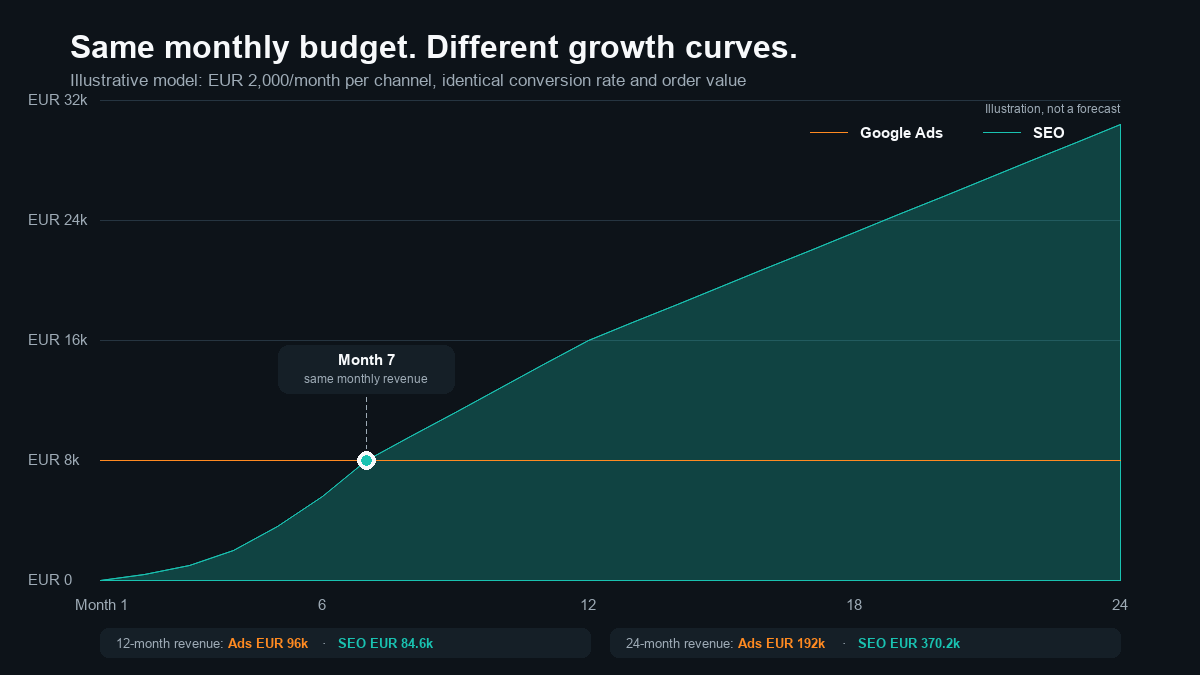
Google Ads reaches that level immediately and stays there. SEO starts close to zero, reaches the same monthly revenue around month seven, and then continues growing while the monthly budget remains unchanged.
This is an illustration, not a forecast. Real CPCs, conversion rates, order values and SEO growth curves vary enormously. The point is to show the economic mechanism.
In this example, Google Ads generates more revenue during the first year: EUR 96,000 compared with EUR 84,600 from SEO. After 24 months, however, the cumulative figures look very different: EUR 192,000 from paid search and EUR 370,200 from organic search—with the same EUR 48,000 total investment in each channel.
Why does the Google Ads line stay flat?
If CPC, conversion rate and budget remain stable, paid traffic is relatively predictable.
Spend EUR 2,000, receive approximately 2,000 clicks. Stop spending and most of that traffic stops too.
That is not a weakness. It is the reason Google Ads is so useful when a business needs speed, control or immediate demand. A campaign can target a specific product, location or offer and begin collecting data quickly.
But a fixed budget also creates a ceiling. If you want materially more clicks, you will usually need a larger budget, a lower CPC or a more efficient campaign.
Why can the SEO line keep rising?
SEO works differently because each month of useful work can strengthen what was created before.
A better category page can rank for more relevant searches. Improved product descriptions can attract additional long-tail traffic. A useful article can support commercial pages through internal links. Search Console data can reveal queries that were not visible when the page was first written.
One page begins generating information that helps improve another. More queries, pages and rankings become inputs for the next optimization cycle.
The monthly budget is no longer paying only for this month’s visits. It is also paying to expand and improve an owned source of future traffic.
The rising SEO curve is not automatic
This is the condition that matters most: SEO only becomes cheaper over time if organic traffic actually grows.
A company cannot assume that publishing a few articles every month will produce the curve shown above.
If an agency creates new texts but does not improve product pages, develop category content, revisit older articles or respond to changes in competitors and search results, growth may be slow—or stop completely.
Good SEO requires more than selecting a keyword and ordering a text. The opportunity, intent, current results, competing pages and business value all need to be analyzed properly.
What should be reviewed every month?
A compounding SEO process repeatedly examines both new and existing work:
- queries and landing pages already visible in Google Search Console;
- product and category pages with commercial potential;
- older content that is losing traffic or no longer answers the search intent well;
- pages competing with each other for the same queries;
- changes made by competitors;
- new topics and gaps in the current site structure;
- internal linking, indexation and technical obstacles;
- the relationship between organic traffic and real conversions.
The goal is not to produce the same number of texts every month. The goal is to make the website more useful, more complete and better aligned with real search demand every month.
That may mean creating something new. It may also mean rewriting a category description, expanding a product page, consolidating two weak articles or improving a page that is already close to a valuable position.
SEO or Google Ads? Often, the answer is both
Google Ads buys speed. SEO builds compounding visibility.
During the first few months, paid campaigns can generate demand and provide useful information about which offers and search terms convert. SEO can use those insights to prioritize the parts of the website worth developing.
Later, as organic traffic grows, the company becomes less dependent on buying every visit. Paid search can then focus on launches, seasonal campaigns, high-value queries or areas where organic visibility is still weak.
The better question is therefore not simply “Which channel is cheaper?” It is:
Do we need to buy traffic now, build a source of traffic for later, or do both in the right proportions?
For a broader comparison of speed, control and long-term value, read SEO vs Google Ads: Which Should You Invest In First?.
The real advantage comes from the process
SEO can become significantly more cost-effective over a one- or two-year horizon, but only when the work creates measurable growth.
That requires a continuous cycle: analyze demand, prioritize the right pages, implement improvements, measure the result and return to both new and existing content.
The chart does not promise that every website will follow the same curve. It shows what becomes possible when the SEO budget builds on previous work instead of repeatedly starting from zero.
Want to see where that process could begin on your website? Start with a free website analysis.